-
FORSIDE

- Blog
Gedser Fuglestation Blog
Her på Gedser Fuglestations blog bringes korte nyheder i dagbogsformat om hændelser på fuglestationen.
Se indlæg fra måned: jan. (2)feb. (26)mar. (31)apr. (30)maj (31)juni (20)juli (27)aug. (31)sept. (14)
Nightjar under the rain
Ringmærkningen : Det truede med regn hele morgenen lige fra nettene blev åbnet en halv time før solopgang. Jeg kunne se at det ville starte ved 7 tiden, så jeg håbede at få noget ud af de 2 timer det var muligt at ringmærke. Og jeg blev ikke skuffet. Der sad en fin Natravn(European Nightjar) i nettet denne morgen. En art jeg aldrig tidligere har haft i nettet på Gedser fuglestation eller nogen andre steder. Absolut en god start på dagen.
Selv om det blev en kort dag, nådede vi op på 18 fugle. Ganske pænt.
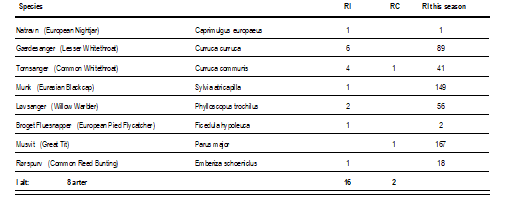
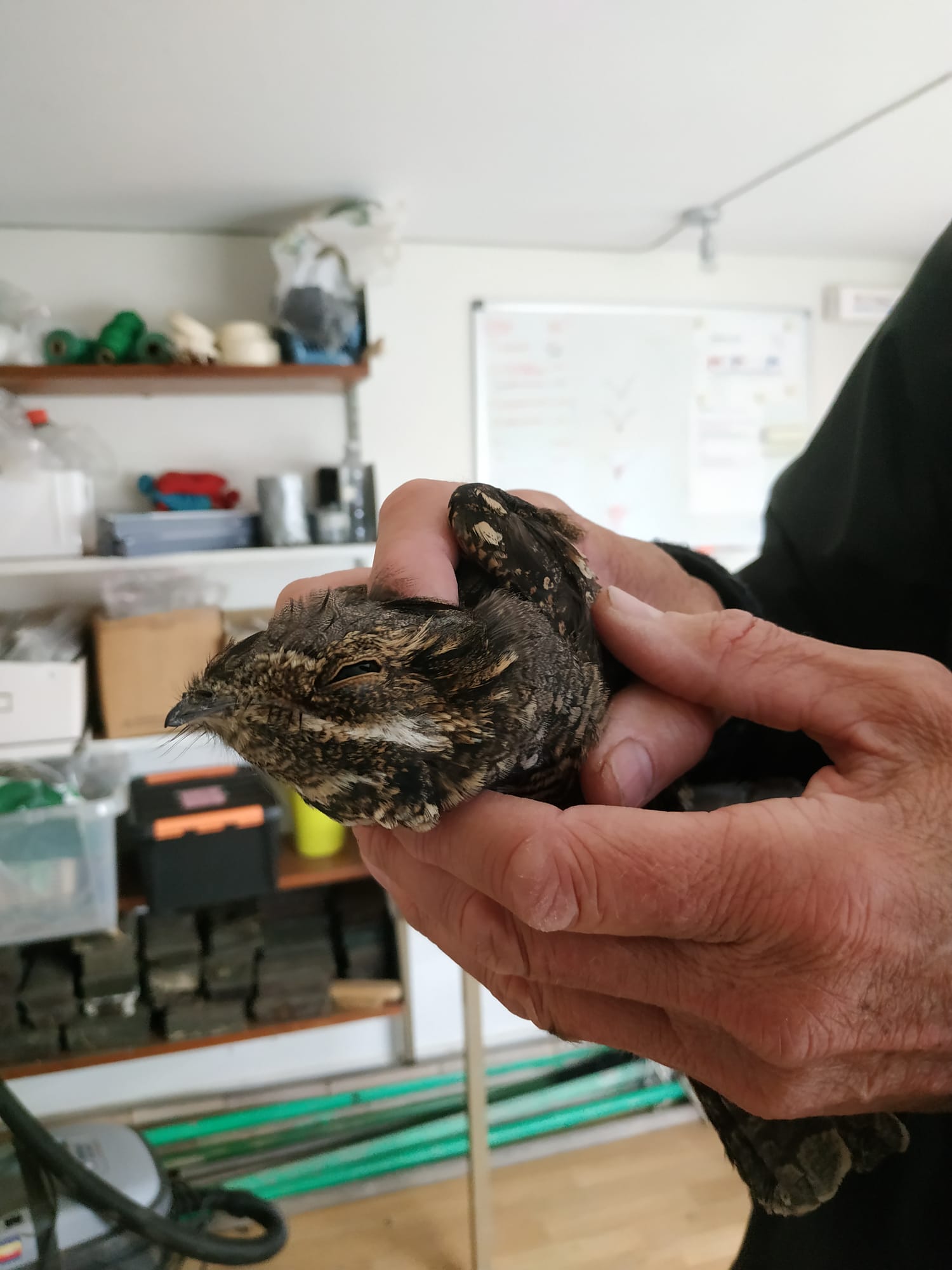 Natravn(European Nightjar)
Trækket på Odden : After two days of resting as much as I can, and therefore missing all of the great sightings of birds at the point this weekend, I woke up this morning (still tired) to a cloudy and soon rainy morning. The weather surely didn't put the birds into a migration mindset today, so it was once again a really quiet moment.
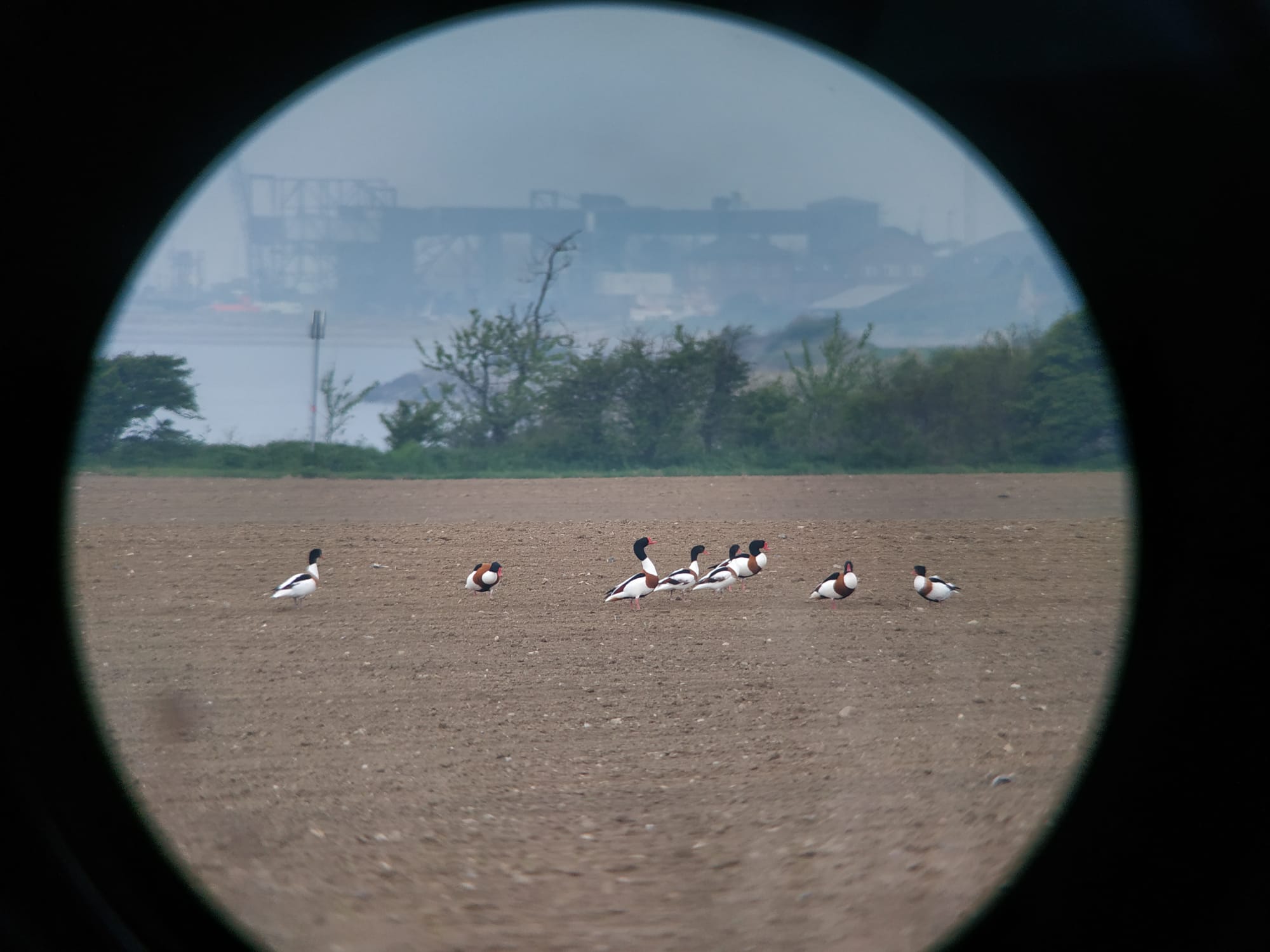 The Shelducks (Gravand) gathered on the field this morning, both males and females, spending their time chasing each others, showing off or napping under the rain. Picture by Cyann Ménard/GFU.
Luckily enough, I got at least one nice surprise : two Black-throated Divers (Sortstrubet Lom) decided to have a little stop-over near the point. I was thrilled to have the opportunity to admire their behaviour not only in flight but also on the water.
Se alle dagens observationer ved Gedser Odde i DOFbasen.
Folk på stationen: Cyann Ménard, Sjoerd van Baal, Joakim Dybbroe
Bee-eater visit
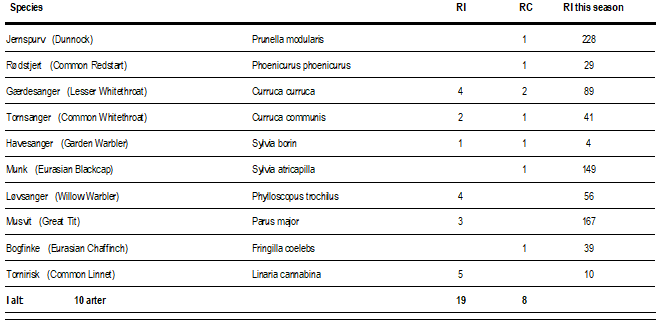
Ringmærkningen : Vi fik vejrskiftet: overskyet og teperatur hele døgnet, med ca 10 grader. Der kom lidt gang i trækket. Specielt Gærdesanager(lesser Whitetroat) og TornsangerCommen Whithetroat).
Trækket på Odden : Due to some informatical issues, we were missing some information from the tip for yesterday. Here they are :
It will probably not be a day we remember forever, but it was still good to get out after a week of work. The Common Whitethroat (Tornsanger), made famous by previous blog posts here, had a friend visiting today — and that individual carried a brand-new shiny leg ring. Another visitor at the tip today was also ringed, although this was a rather old — or perhaps just dirty — ring. The bird carrying it was a male Yellow Wagtail (Gul vipstjert) of the subspecies flava. We only managed to read part of the ring number: ...84... Tomorrow will be better in every way.
And now, about today :
Another very quiet day at the tip. A day we had anticipated to be a more enjoyable in terms of numbers. But a single bird at 05:36AM lifted the spirit for the rest of the count – a European Bee-eater (Biæder) decided that its visit in Denmark was over and headed southwards.
The Common Whitethroat (Tornsanger) kept the observer at his toes the rest of the days with incorporating the call from the Bee-eater thought out the count period. Never a dull day at the tip.
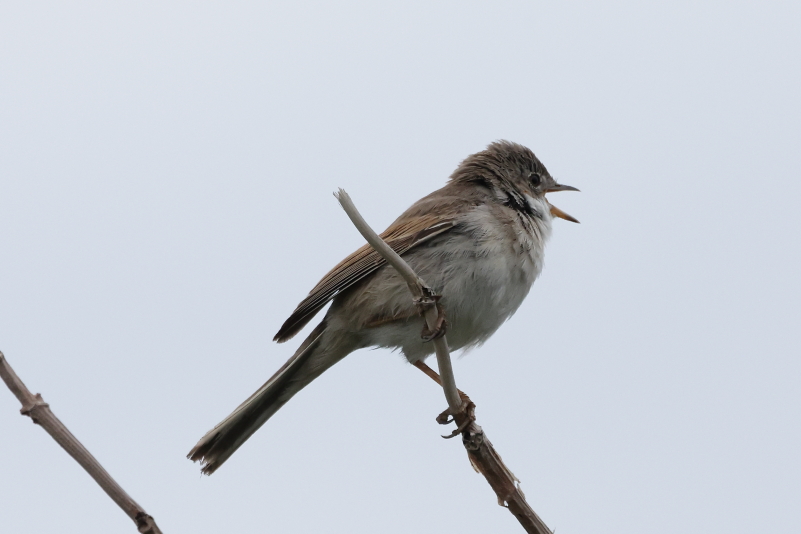 The Common Whitethroat caught red-handed imitating the Bee-eater. Picture by Louis A. Hansen.
Se alle dagens observationer ved Gedser Odde i DOFbasen.
Folk på stationen: Cyann Ménard, Sjoerd van Baal, Joakim Dybbroe, Louis A Hansen
First sighting of Black terns !
Ringmærkningen : Dagens ringmærkning kan bedst beskrives som meget beskeden. Tallene og arterne ligner gårsdagens og der er ikke meget bevægelse i krattet....... Vi venter stadig på at der sker noget.
Trækket på Odden : As I got more and more tired lately, Louis kindly offered to take over the count once again this weekend (and I am really grateful for that). To the question "Was it quiet or super quiet today?" he answered without a doubt "Super quiet". You can see that by looking at today's number, which are only slightly higher than the past few days. But despite today's migration's slow rythm, I can't help but notice that it is also the first record of Black Terns (Sortterne) for this year ! As usual, as some friends of mine like to say "When there isn't much to see, there's always something to look at!". Am I excited because I've never seen this species yet? Maybe. Or maybe it just my optimism trying its best to keep this slow period as interesting as possible, who knows...
Se alle dagens observationer ved Gedser Odde i DOFbasen.
Folk på stationen: Cyann Ménard, Sjoerd van Baal, Joakim Dybbroe, Louis A. Hansen
Vi venter på de sene trækkere
Ringmærkningen : Vi havde en klar morgen og formiddag med skyfri himmel og næsten ingen vind. Men desværre ikke mange fugle. Vi har brug for et vejr skifte for at få gang i det sidste småfugletræk. Så kun 14 fugle mærket og aflæst denne morgen, denne morgen.
Trækket på Odden : The migration past Gedser Odde was roughly the same today as yesterday, with around 300 birds, and surprisingly a third of it was Eiders (Ederfugl) ! I am now surprised whenever I see a group of Eiders as they become quite rare. Mathilde went to join the migration count one last time before leaving, but we ended up spending more time admiring the local female kestrel (Tårnfalk) and two Roe deers (Rådyr) than seeing migrating birds.
Se alle dagens observationer ved Gedser Odde i DOFbasen.
Folk på stationen: Cyann Ménard, Mathilde Sif Eiby, Sjoerd van Baal, Joakim Dybbroe
More people coming and going than birds
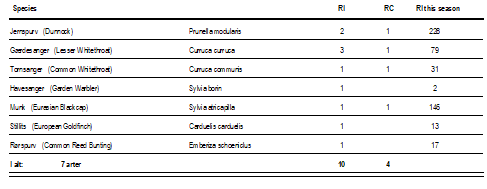
Ringmærkningen: Another beautiful sky this morning, just with a less beautiful number of birds. However I started the ringing with a nice Song Thrush (Sangdrossel), and ended it with a very shiny Starling (Stær) - our first male Starling of the season, with a blue bill base instead of pink! I forgot to take a picture, but here's one of a lovely male Blackcap (Munk) from today:
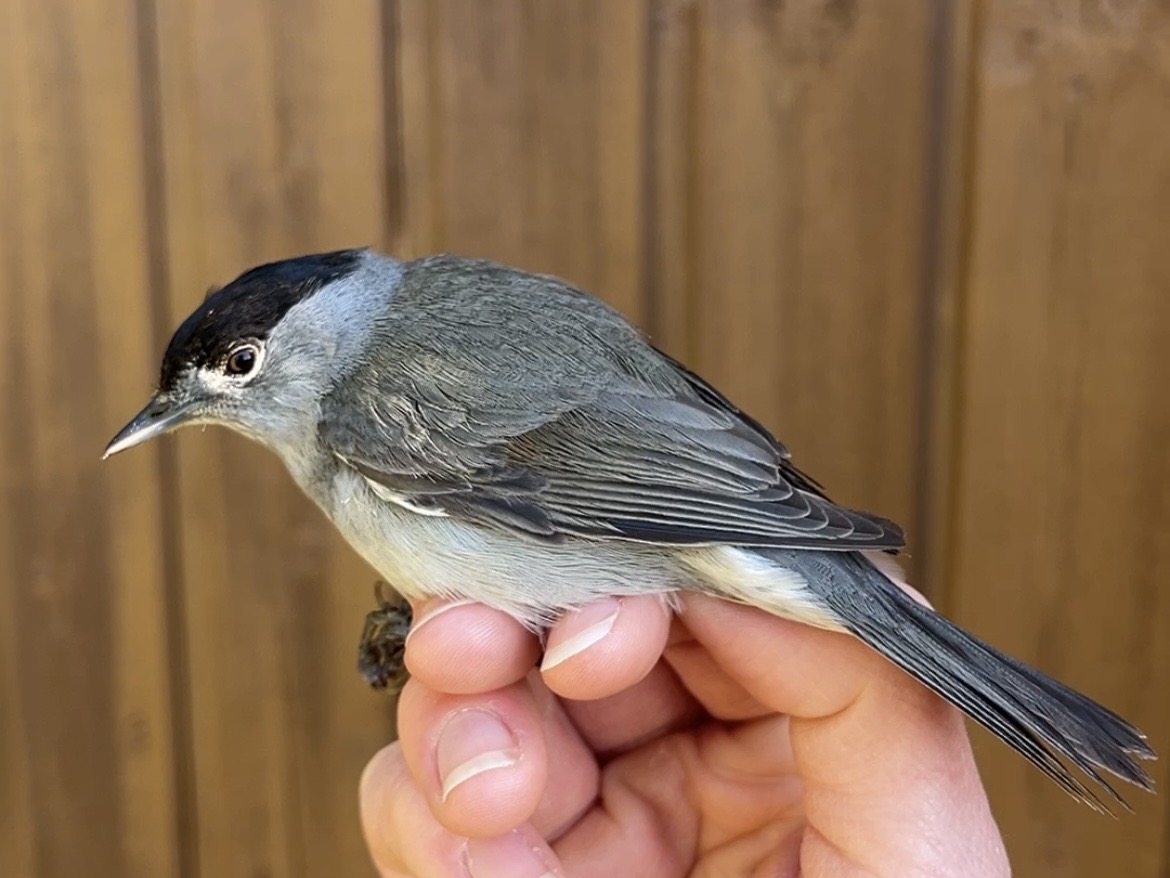 In spring, all the male Blackcaps have a black cap, and the females reddish-brown. Picture by Mathilde Sif Eiby / GFU
Today's numbers:
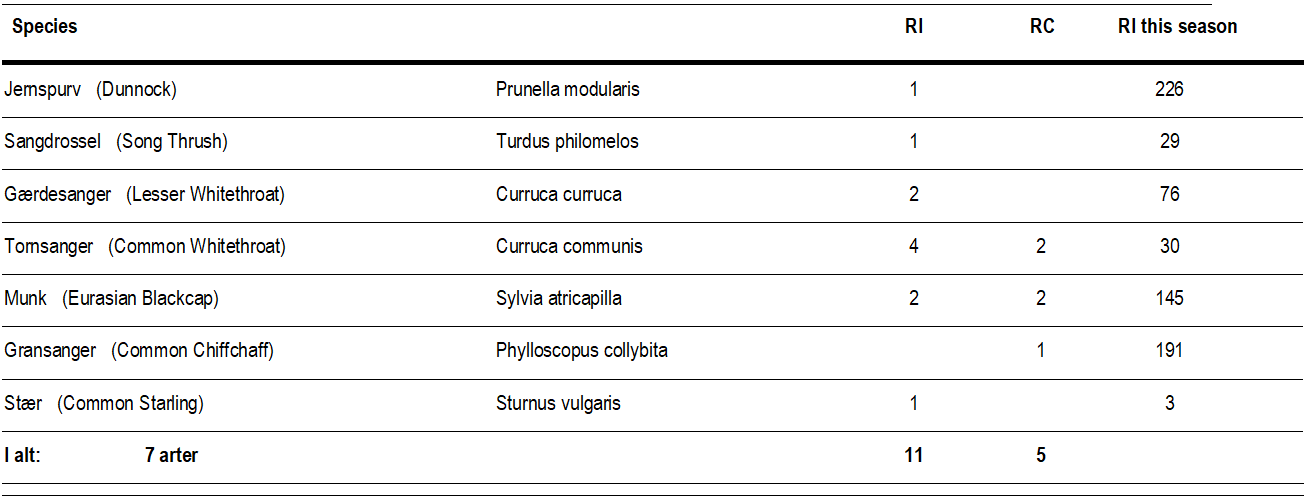
Trækket på Odden : Same amount of birds as yesterday (so really quiet), but with more sunshine and some nice company !
Se alle dagens observationer ved Gedser Odde i DOFbasen.
Other stuff and appreciation: Bo came by today for his last human vs AI sound detection of the spring, Mads is still working hard, testing out where the new lawnmower will go, aaaand where it will get stuck, while Sjoerd is stumbling upon Grey Seals (Gråsæler) on the beach.
Also a lot of people are coming and going these days. Sjoerd came back Tuesday, Vagn left yesterday, Joachim arrived yesterday, Olga left today, Hans also had his last day for now today, and I (Mathilde) am leaving tomorrow - so this is sadly my last blog :(
I've learned so much in my almost two months here, and I'll definitely be back. I've had the chance to learn from 6 very different head-ringers, and ring with other awesome trainees too. I even got a week at migration-counting, that offered me a different and super useful perspective, and I thouroughly enjoyed (or maybe it was the company)! So a huge thank you to all the people I've met here, and hope to see you again somewhere - even just on a blog :)
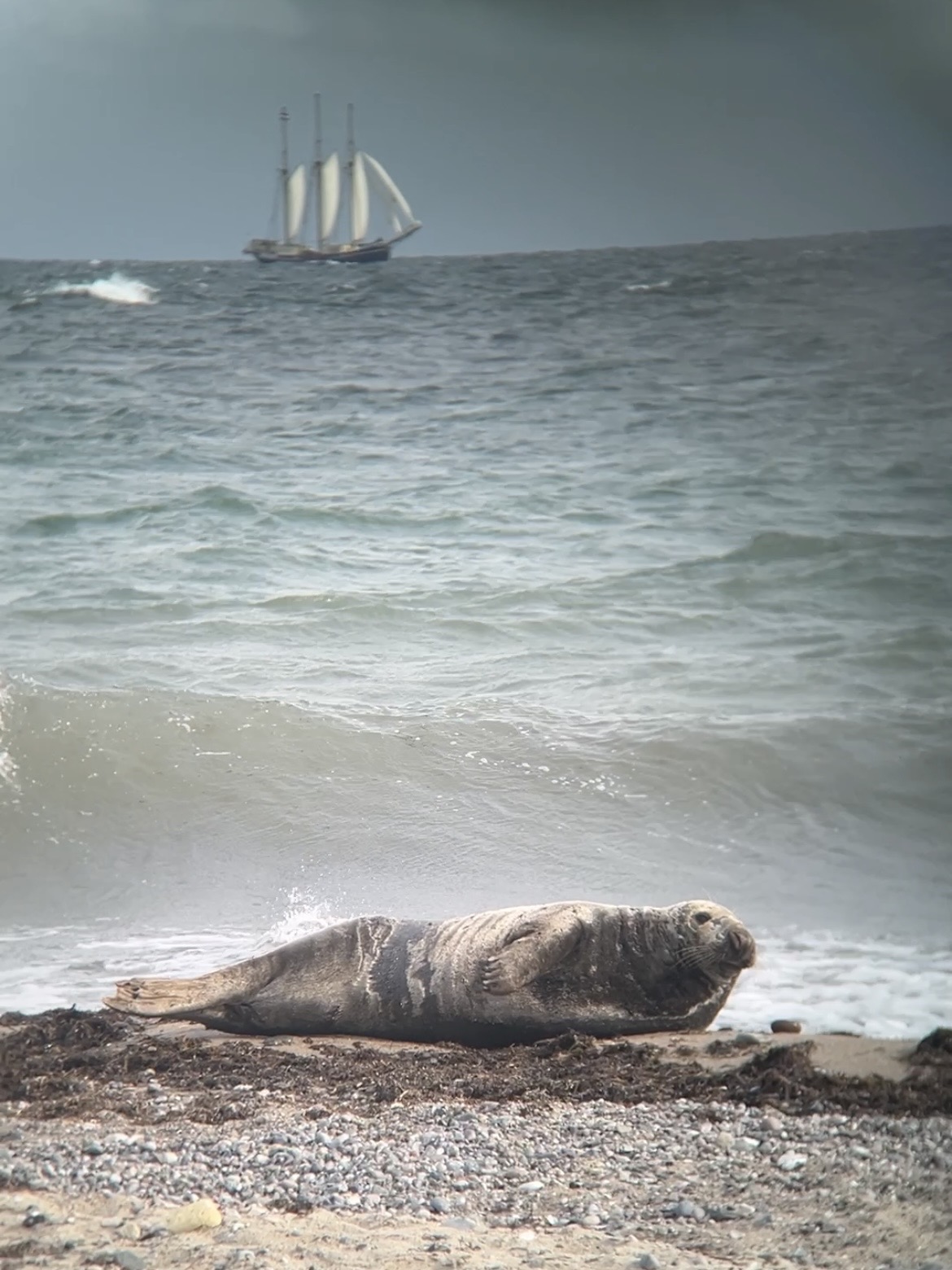 Grey Seal and Dutch ship. Picture by Mathilde Sif Eiby / GFU
Folk på stationen: Cyann Ménard, Mathilde Sif Eiby, Sjoerd van Baal, Olga Fernandez Enriquez, Hans Lind, Joachim Dybbroe. Praktikanten Agnes, Mads Elley, Bo Kayser
Garden Warbler and garden rules
Ringmærkningen: Even though the sunrise was beautiful this morning, it didn't bring us a lot of activity in the garden, so there was time for coffee, storytelling, and datacheck.
With only one bird for most rounds, we weren't expecting much, but at 9 o'clock, I (Mathilde) suddenly saw a new bird in the net, pretty dull in color. My first thought was Garden Warbler (Havesanger), which we've been waiting for, but I waited to examine it further, before I met up with Vagn and Olga in the lab.
True enough - first Garden Warbler of the season! Clear with the grey collar and the rest of it shades of pale brown. Kind of funny that we still get new species with so few birds.
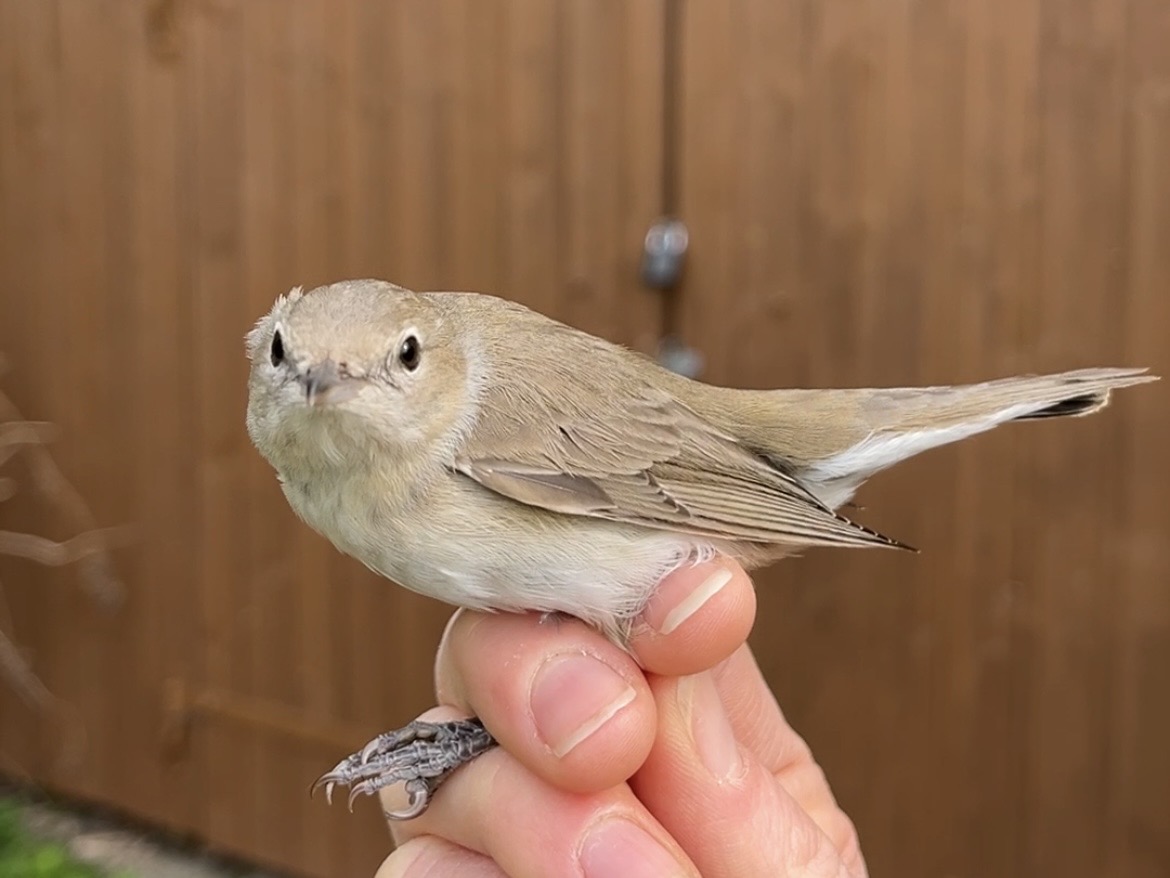 Our first Garden Warbler (Havesanger) this season! Picture by Mathilde Sif Eiby / GFU
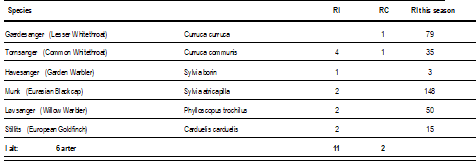
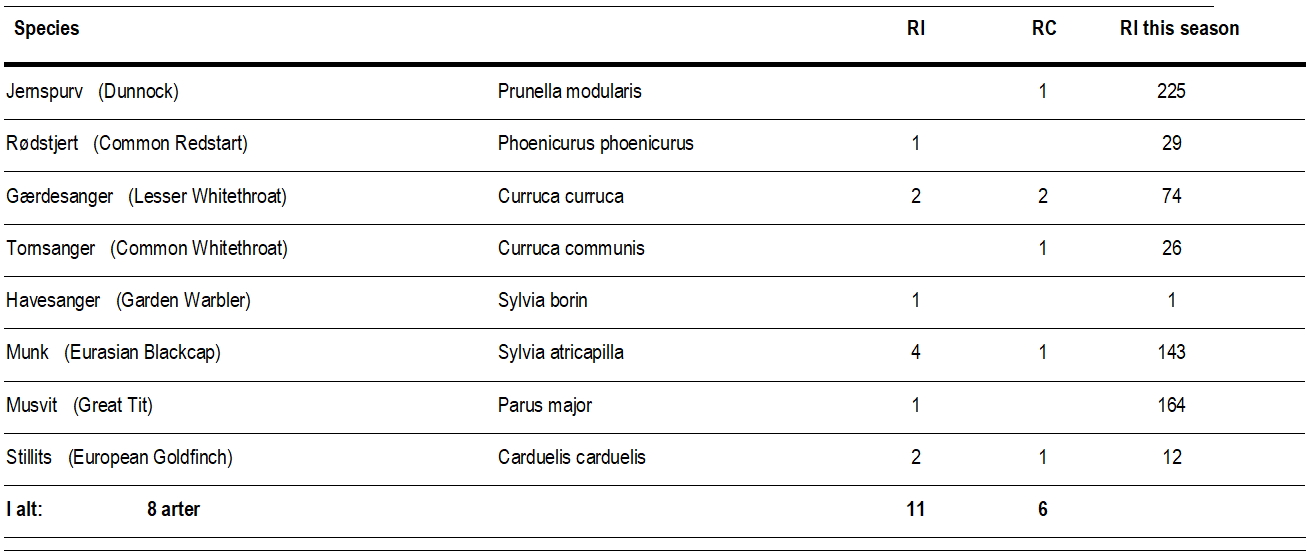
The round after we then suddenly caught three Goldfinches (Stillits), and a Great Tit (Musvit) as well, which got us up to a total of 11 new and 6 recaptures - including everyone's favourite old Dunnock (Jernspurv), clearly spending the season here, its sixth year in a row, with its first recapture of this year exactly two months ago.
On another note please remember if you come by, that the gravel road, terrace/benches and field is public, but the garden is reserved for ringing. If you're interested in ringing, you can send us an email, or take your chances in the morning and wait at the terrace, until the ringers come by, and they'll let you know if they have time to talk or even show parts of the ringing. Please don't enter the garden or go near any open nets on your own, despite your former experience with birds.
Today's numbers:
Trækket på Odden : With only 332 birds of 29 species today, I realize that each passing day gives me around a hundred bird less than the previous one. Let’s hope this trend won’t last too long…
As usual, a slow day doesn’t mean there is nothing to see : I am still enjoying the Swallows’ (Svale) ballet, the presence of the Common Whitethroat (Tornsanger) who has started building its nest, the sudden appearance of magnificent Red Kites (Rød Glente) over my head, the beautiful flights of local and migrating terns (Terne), or the nice surprise of Little Gulls (Dværgmåge) hiding among the Black-Headed ones (Hættemåge). Enjoying the little things really helps staying focus !
Se alle dagens observationer ved Gedser Odde i DOFbasen.
Folk på stationen: Cyann Ménard, Mathilde Sif Eiby, Sjoerd van Baal, Olga Fernandez Enriquez, Hans Lind, Vagn Lind
Exciting new species !
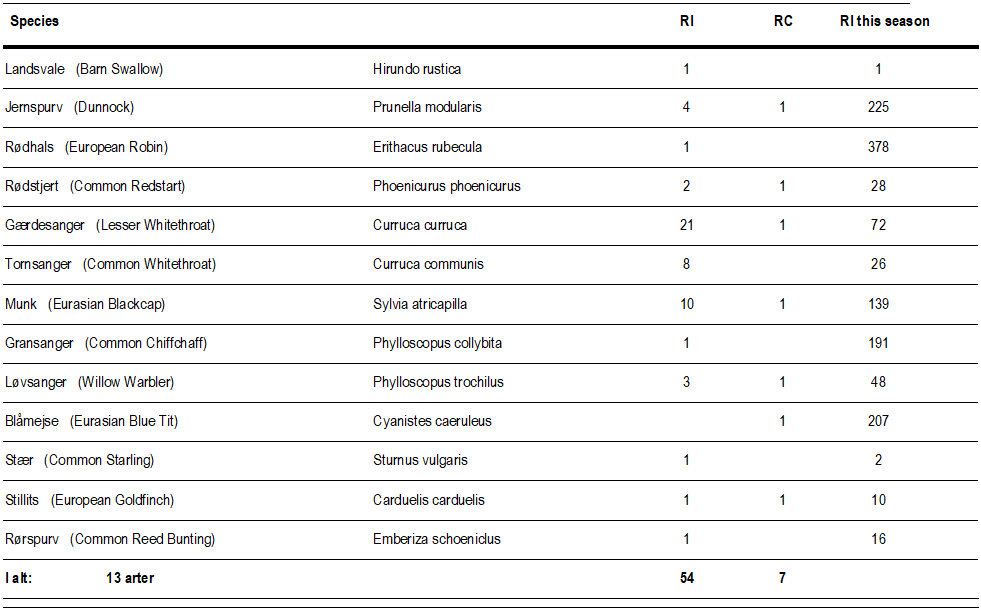
Ringmærkningen : The weather has improved from yesterday to today and we have noticed that in the nets. 54 new ringed birds, mainly lesser whitethroats (gærdesanger) and black caps (munk). One of the lesser whitethroats was very special since it looked different from its conspecifics, it showed a yellowish pattern on the chest, as you can see on the picture.
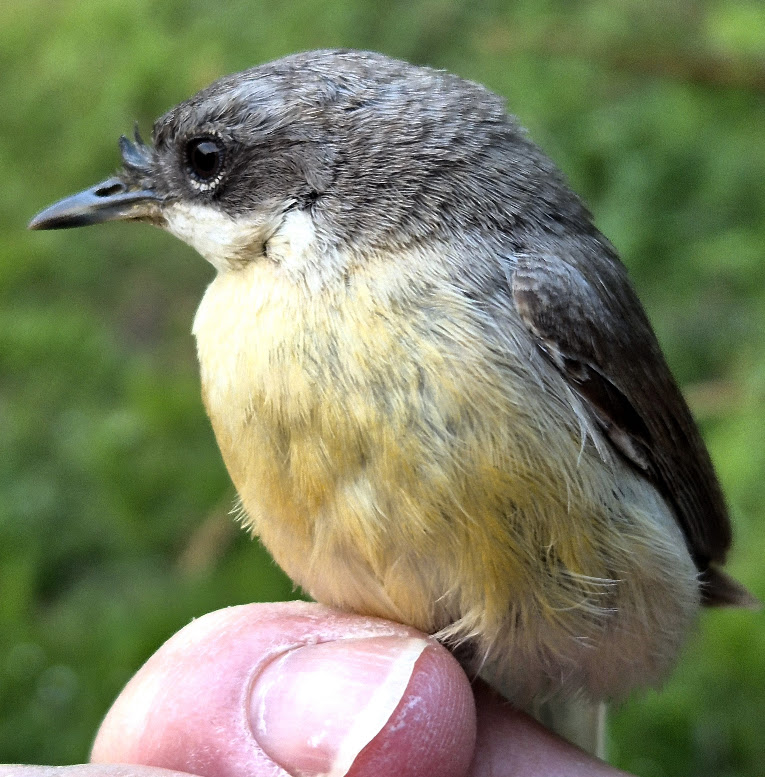 Hvordan denne Gærdesanger er lykkedes med at få den gule farve på brystet er os en gåde. Det så ikke ud til at være noget der kunne smitte af, men tanken om en spændende ny art for landet skød vi nu hurtigt til hjørne. Det VAR en Curruca curruca, men med en fejl i printerpatronens farver. Foto: Vagn Lind / GFU
Other colorful birds we had today was a recaptured blue tit (blåmejse) - it had been a while since I (Olga) last saw one in the nets, I almost forget how much they like to bite your fingers, when you work with them. Also two goldfinches (stillits), a reed bunting (rørspurv), three common redstarts (rødstjert) and one robin (rødhals).
In one of the first rounds, I was checking the nets, and I saw a dark bird trapped in one of them. I instantly thought it was a blackbird, but when I came closer, I realized that I was wrong, it was a starling (stær)! It is the second one we ring this season, and it is again a female, as the one we caught some days ago.
When we finished with the standard protocol and closed the nets, we decided to open the pond nets, hoping to find something interesting. On the first rounds, the nets were empty and no birds could be seen around. It did not look like a nice day for those nets. Sometimes even when we don´t catch anything on them, we can see birds flying around the pond, mainly wagtails and swallows flying up and down the nets without getting caught, or sitting on the poles, as if they are laughing at us.
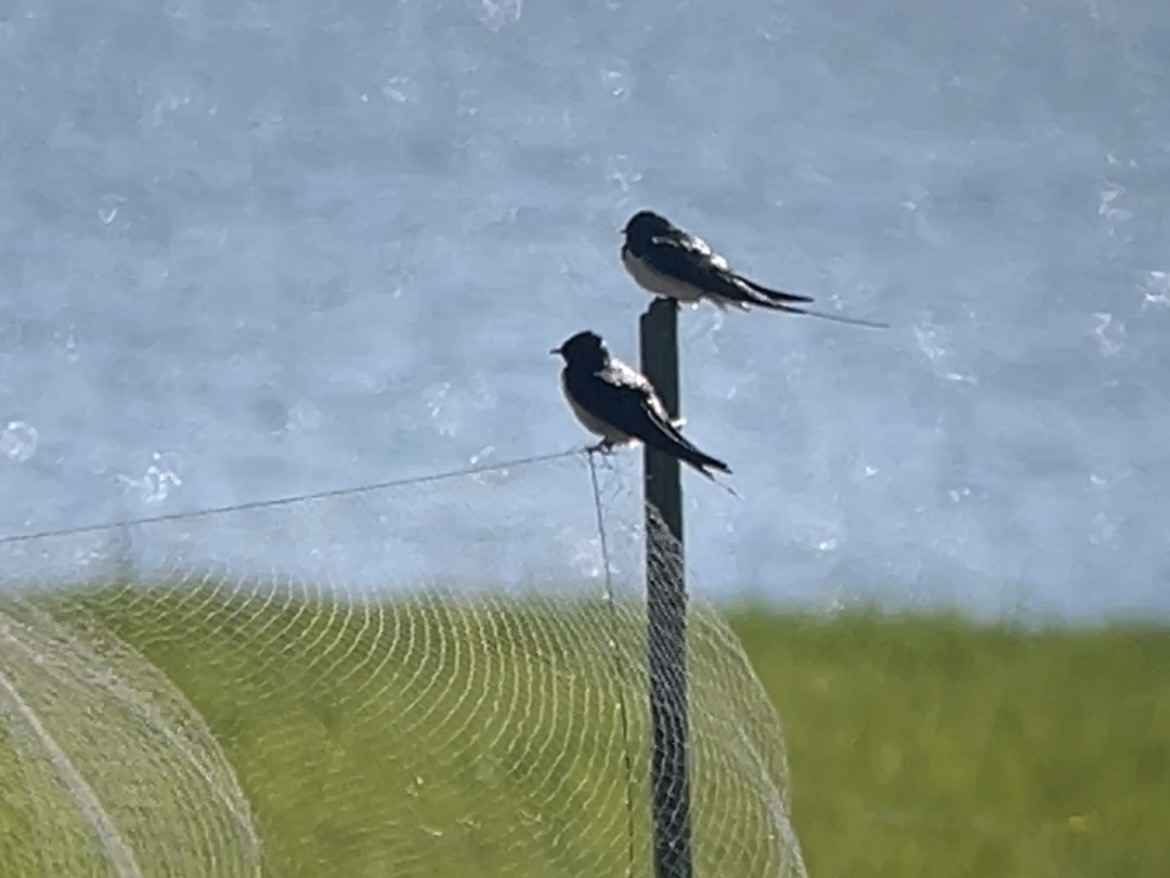 Barn Swallows (Landsvaler) laughing at us from on top of the nets instead of in them. Picture by Mathilde Sif Eiby / GFU
However today the place was too calm, so I wasn´t expecting to find anything when I went to check them at 12:30, but there was a beautiful surprise waiting for me in one of the lower pockets of one of the nets. A barn swallow (landsvale) was laying there, waiting to be released. We couldn´t help but smile - our perseverance had a prize.
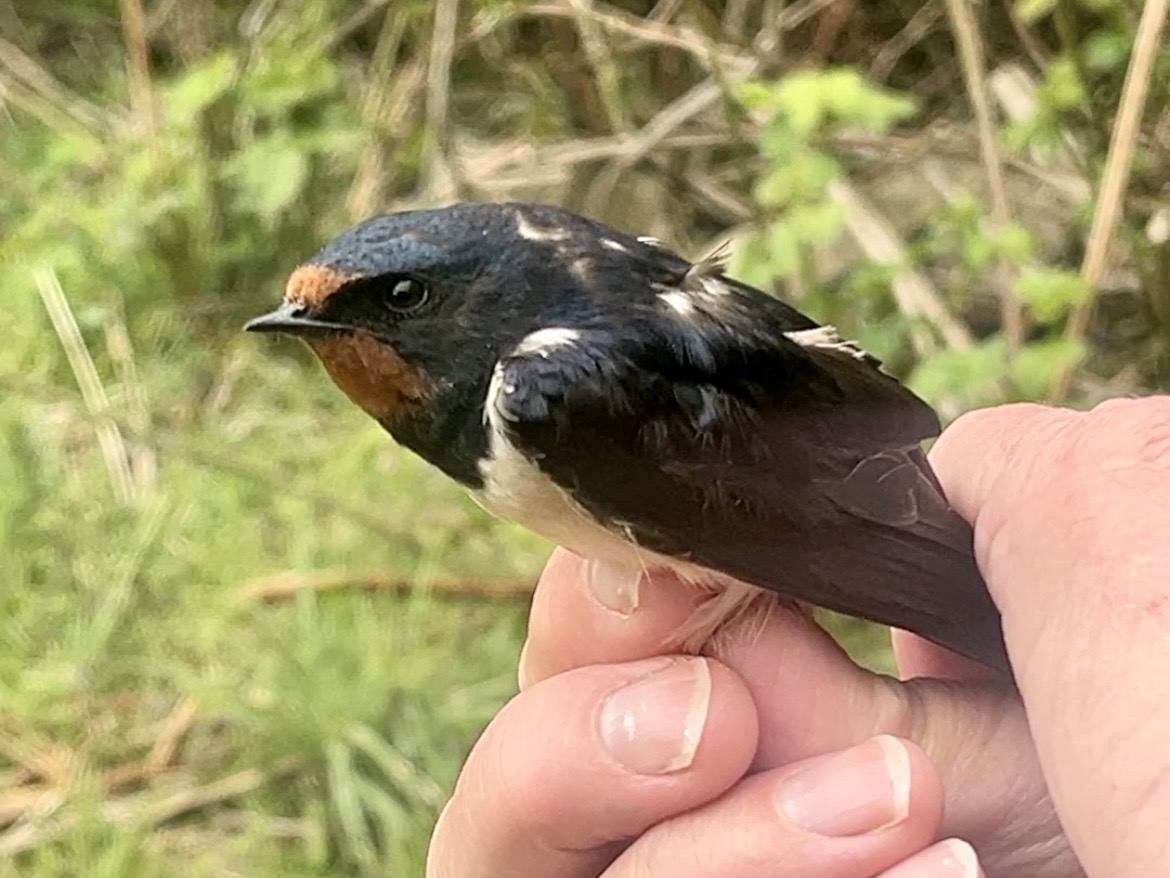 Olga's Barn Swallow (Landsvale) from today - first of the season! Picture by Mathilde Sif Eiby / GFU
In the afternoon Hans brought us with him for something special. We drove to a very nice house in Lolland with a nest box high on one wall - used by Tawny Owls (Natugler)! Together we managed to put up (and later down) a tall ladder without harming any windows, before Hans, with great courage, climbed up and brought down two young owls!
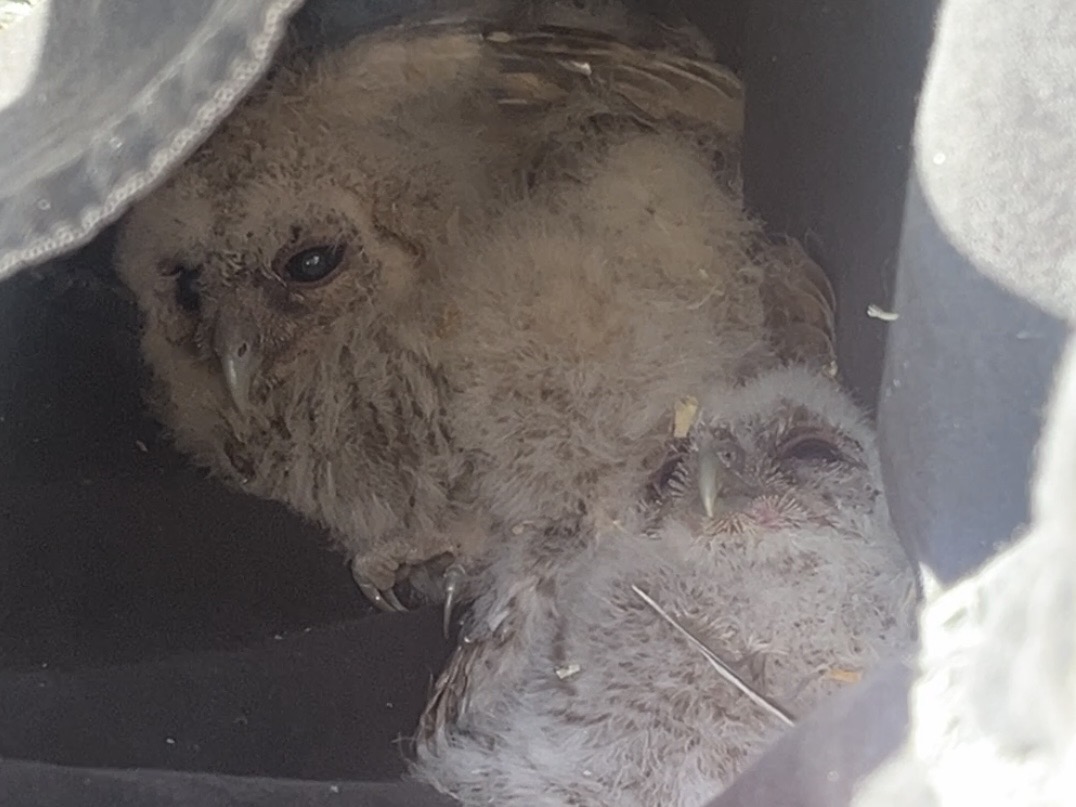 Two half-asleep juvenile Tawny Owls - one for Olga and one for me! Picture by Mathilde Sif Eiby / GFU
They had just woken up, and were very sleepy for the most part, but started softly clicking their beaks, before we put them back in their nest box. They looked so adorable, it was very special to hold them with your own hands.
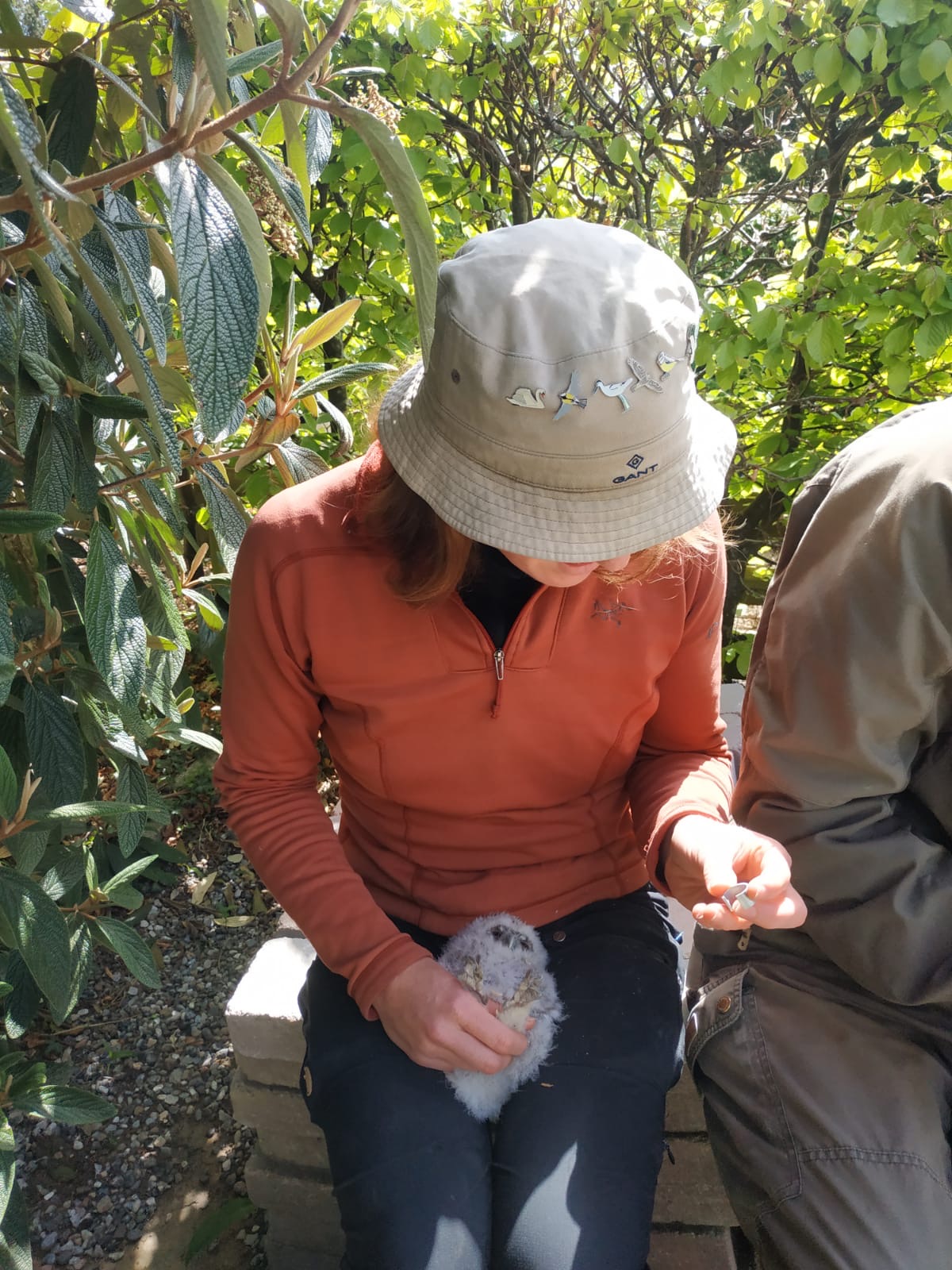 This is the biggest ring I (Mathilde) have put yet, because of those cute chubby owl legs. Picture by Cyann Ménard / GFU
Today has ended up being a very special day of ringing - full of surprises!
Today's number:
Trækket på Odden : For those who love to see many many birds, today was definitely not the day to come at the point. I genuinely couldn’t help but laugh out loud when I saw that the total number of birds I recorded after the two first hours was still under a hundred. Good thing I was once again by myself then ! Not completely alone, as I am still in good company with the Common Whitethroats (Tornsanger) singing in the bushes; and the Swallows (Svale) having fun over the building. I kept an eye on them all morning, and I am really happy I did as one bird among them suddenly caught my eyes : my first Common Swift (Mursejler) of the season !
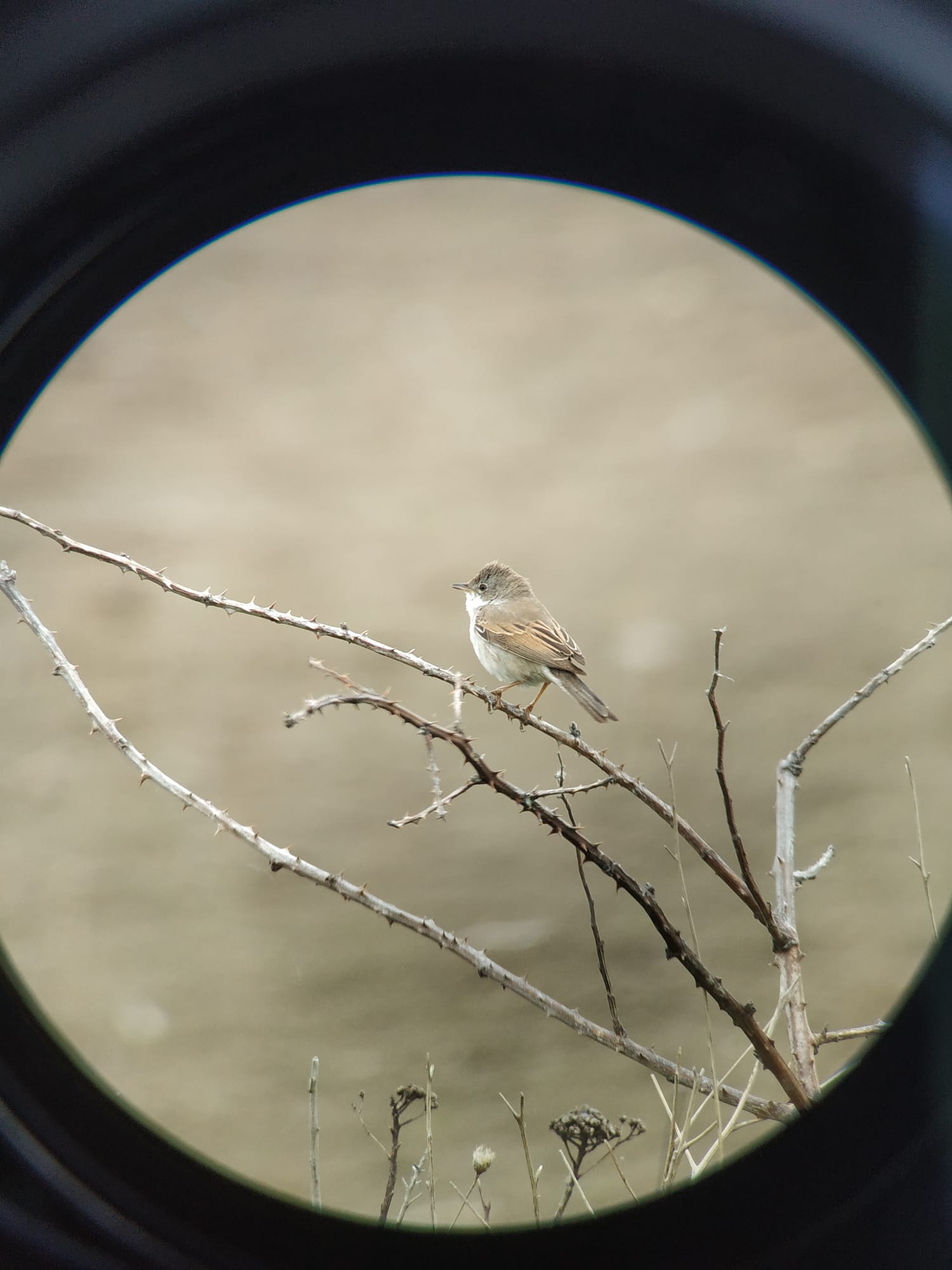 My best friend at the point for the past few days, the Common Whitethroat ! I can't have enough of them, and you can't deny they are really good models. Picture by Cyann Ménard/GFU.
In addition to these beautiful birds, I got really puzzled early in the morning by a big bird flying far over the sea. Because I wasn’t really able to evaluate the distance, I first thought it could be a Gannet (Sule). However, as soon as I got it through my scope, I had to admit that it definitely looked more like "the biggest tern I had ever seen" than anything else. After collecting all the clues I needed, and texting a few people to make sure I wouldn’t go in a unlikely direction, I was absolutely sure that this was my very first sighting of a Caspian Tern (Rovterne) ! The bird actually came back closer a few hours later, which definitively dispelled my last doubts (if I had any left).
Se alle dagens observationer ved Gedser Odde i DOFbasen.
Folk på stationen: Cyann Ménard, Mathilde Sif Eiby, Olga Fernandez Enriquez, Hans Lind, Vagn Lind. Desuden Mads og Tina Elley med gæster fra København samt besøg af Agnes.
Swallows party !
Ringmærkningen: Til morgen valgte vi at sætte alle nettene op som sædvanlig, men vi var godt klar over, at vi måske kom til at lukke enkelte net senere, da vinden var sprunget om i VSV og der var lidt vel rigeligt af den. Kl. 7 sløjfede vi så 5 af nettene, men det ændrede nu ikke meget på dagens fangst-tal. Vi oplevede én af de dage vi med et godmodigt blink i øjet kalder "Blåvands-tal", nemlig når det kniber med at nå op på hele 2 cifre.
Der skete bare ingenting i stationshaven, så vi skiftedes til at tage runderne og da Hans og jeg havde lavet al data-tjek i går, blev det mest til kaffedrikning og røverhistorier om ringmærkningen i "gamle dage", samt lidt reklame for Ringmærkerforeningen, som vi mener alle danske ringmærkere bør være medlem af.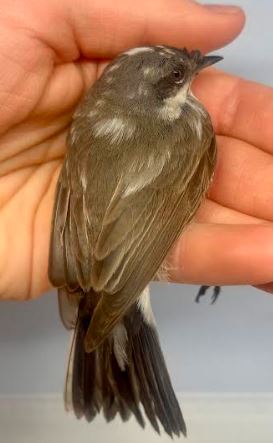
En Gærdesanger (Lesser whitethroat) faldt lidt ud over det sædvanlige ved at være partielt leucistisk (med spredte hvide fjer rundt om i fjerdragten)
Dagens fangst-tal: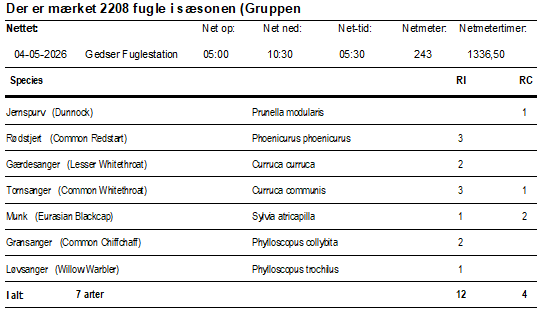
Trækket på Odden : After some discussion with me, myself and I, I decided to set today’s observation post close to the bushes despite the strong west-coming wind, as I wanted to be sure to be able to see any raptors coming from inland. Protected by the bushes and accompanied by the Common Whitethroat (Tornsanger), I was ready for any birds the wind would send my way. The birds in question were mostly Barn Swallows (Landsvale), House Martins (Bysvale) and Sand Martins (Digesvale) today. They seemed to enjoy the wind a lot, flying over the waves or close to the cliffs. I was sure that one would bump into me eventually, and one actually nearly flew into my scope ! It made me really happy to see them everywhere, and their acrobatic flight kept me busy when no other birds were to be seen.
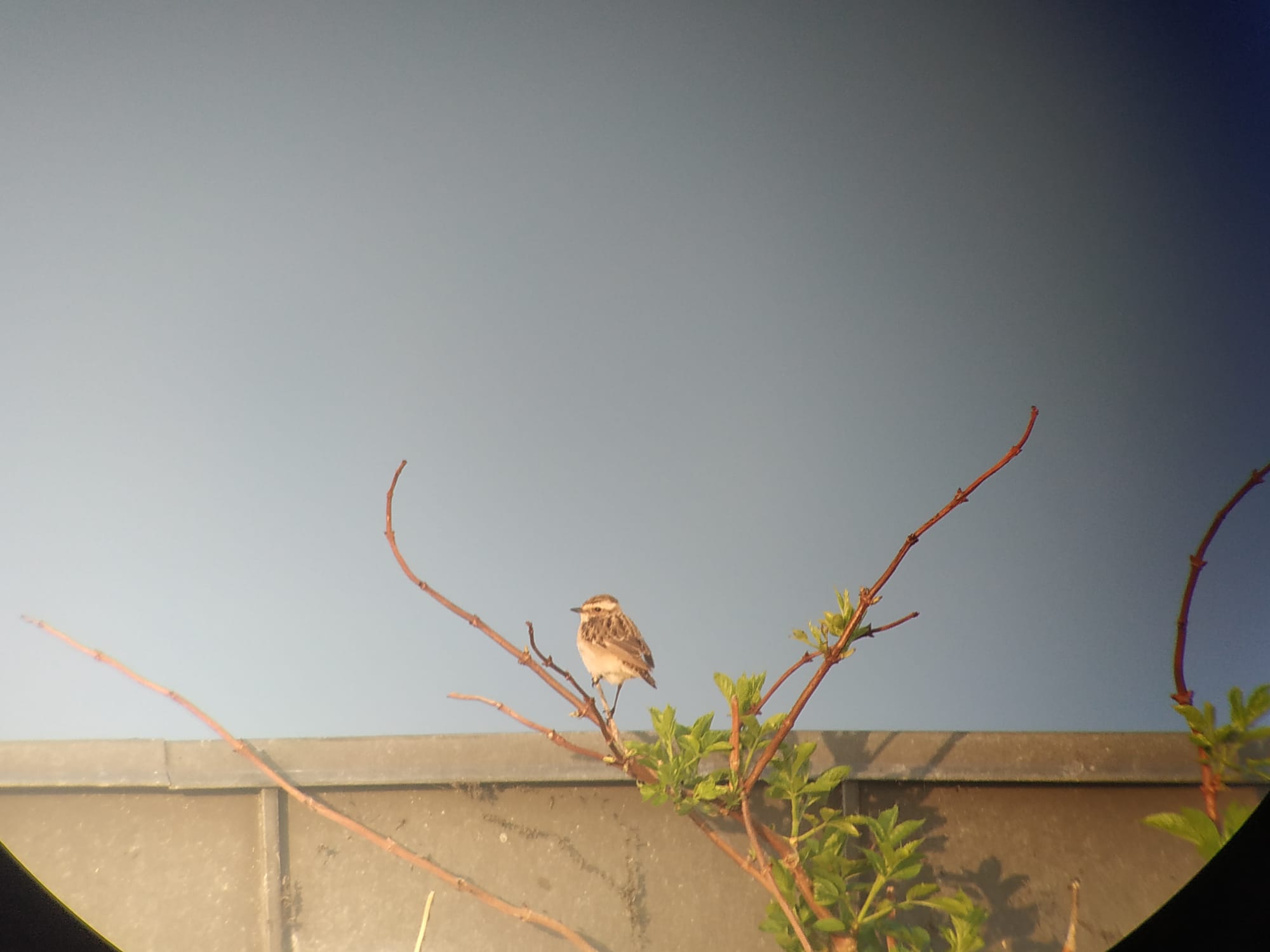 As I saw two birds landing on the branches next to the building, I first thought of two linnets (as they usually behave like that). One of them turned out to be the Common Whitethroat (Gærdesanger), acting like it owns the place (as usual), while the other was a species I haven't seen this year yet : a Whinchat (Bynkefugl) ! Picture by Cyann Ménard/GFU.
With such few birds, I took the time to enjoy the nice sightings of the morning. Alongside with the Common Whitethroat, I had a glimpse of my first Whinchat (Bynkefugl) this year, which only lingered long enough for a photo. After one last long and quiet hour, I had the surprise to see a Black Kite (Sort Glente) flying south, just in front of a female-type Marsh Harrier (Rørhøg). As they were flying almost together, it was the perfect occasion to look precisely at the details and all of their differences, so I will be able to explain it perfectly to the next person who wants to learn more about raptors !
Se alle dagens observationer ved Gedser Odde i DOFbasen.
Folk på stationen: Cyann Ménard, Mathilde Sif Eiby, Olga Fernandez Enriquez, Louis A Hansen, Mads Elley, Hans Lind, Vagn Lind
Wagtails for everyone
Ringmærkningen: We had become used to the sunny and bright weather, but a sky covered by clouds received us, when we woke up this morning. We put up the nets, unsure if we could keep them open the whole morning, as it was likely to rain, but in the end it was not necessary. Despite the change of weather, the temperatures were still quite warm, and the numbers of birds in the nets was as usual. We also opened the sparrowhawk nets and the pond nets to have more chances of catching interesting species. And thanks to this, Mathilde and I were lucky. Yesterday we were saying that we would like to see more wagtails, and then today we caught not one, but three yellow wagtails (gul vipstjert)!
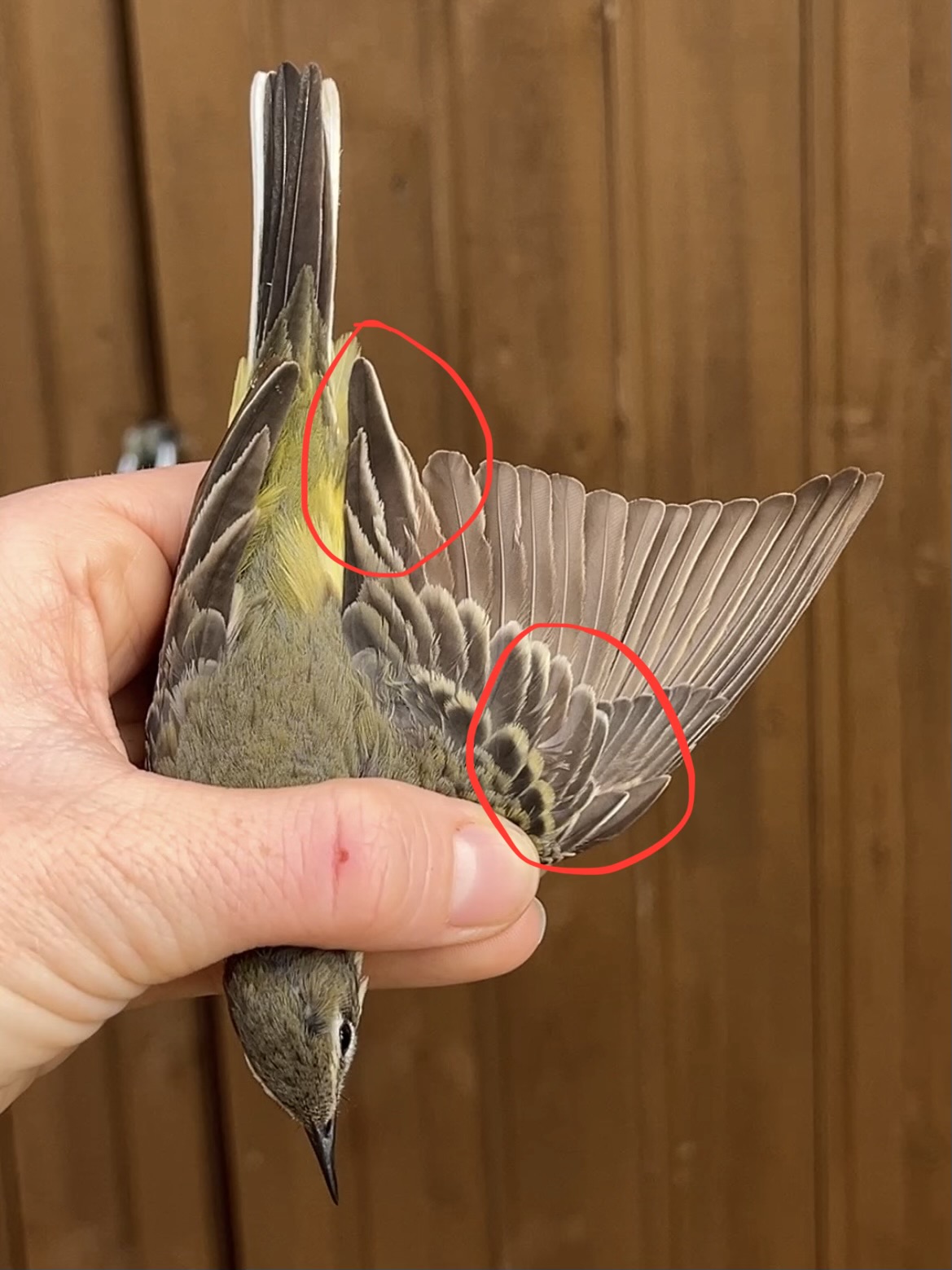 Yellow wagtail (gul vipstjert). You can see the moult limit on the greater coverts, as the outer ones are more brownish, and their fringe is more white and less wide than the inner greater coverts, that are darker, shinier and with yellowish and broad fringes. A moult limit can also be found between the tertials and the secondaries. Picture by Mathilde Sif Eiby / GFU
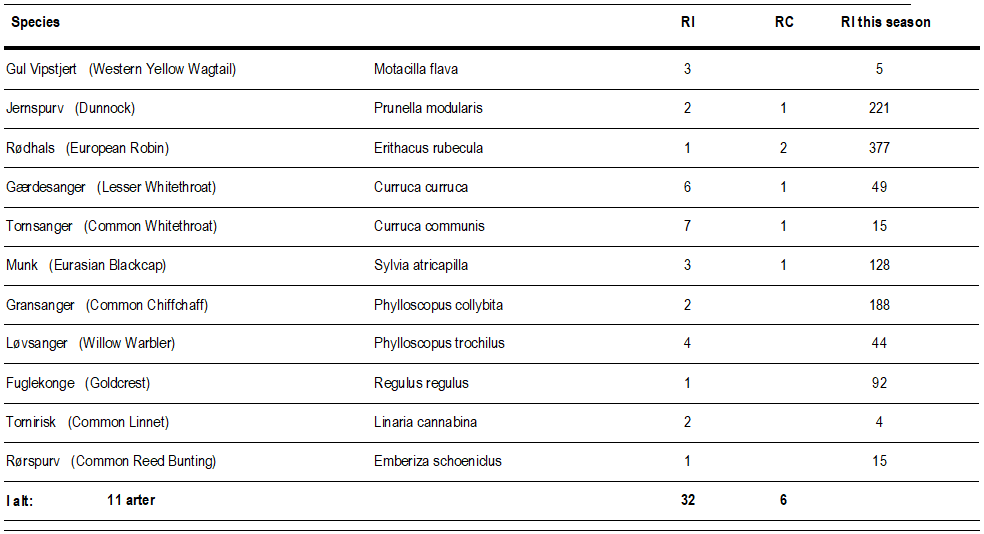
We also caught a couple of linnets (tornirisk) and a reed bunting (rørspurv). The most common species for the day are again the lesser whitethroat (gærdesanger), the common whitethroat (tornsanger), the willow warbler (løvsanger) and the black cap (munk). And we had the visit again of an old dunnock (jernspurv) that has been recaptured more than 70 times over the past 5 years!
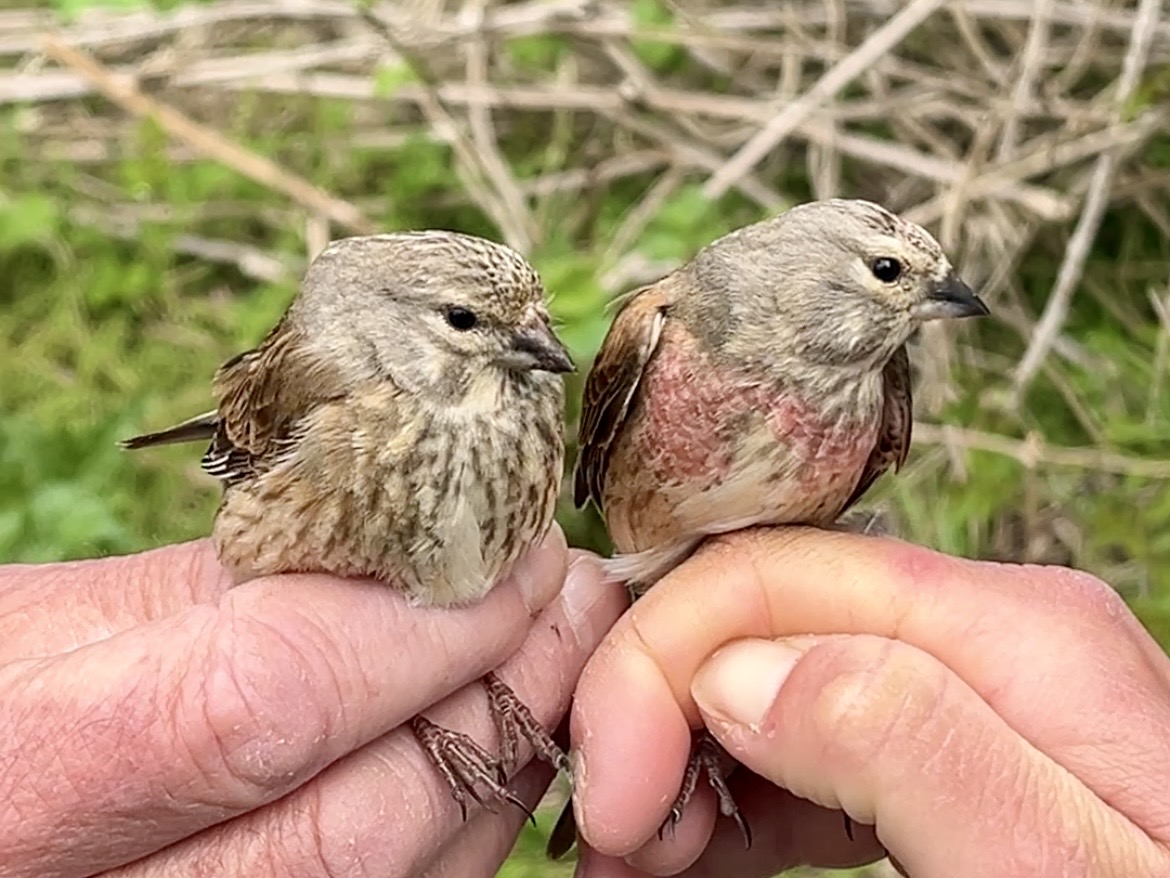 Couple of linnets that were caught together in the net, and flew together after they were released. The male is the one on the right, showing its reddish plumage on its chest, while the female (on the left) lacks this pattern. Picture by Mathilde Sif Eiby / GFU
Today's numbers:
Trækket på Odden : After so many sunny days and clear skies, I went to the point this morning under a really moody one. The colours of the sunrise on the clouds were absolutely stunning. The frogs of our little pond definitely loved this weather, and were choiring all morning long. Unfortunately, this change in the weather didn’t bring any new birds, and today’s migration was as steady as the sea on a non-windy day (just like today).
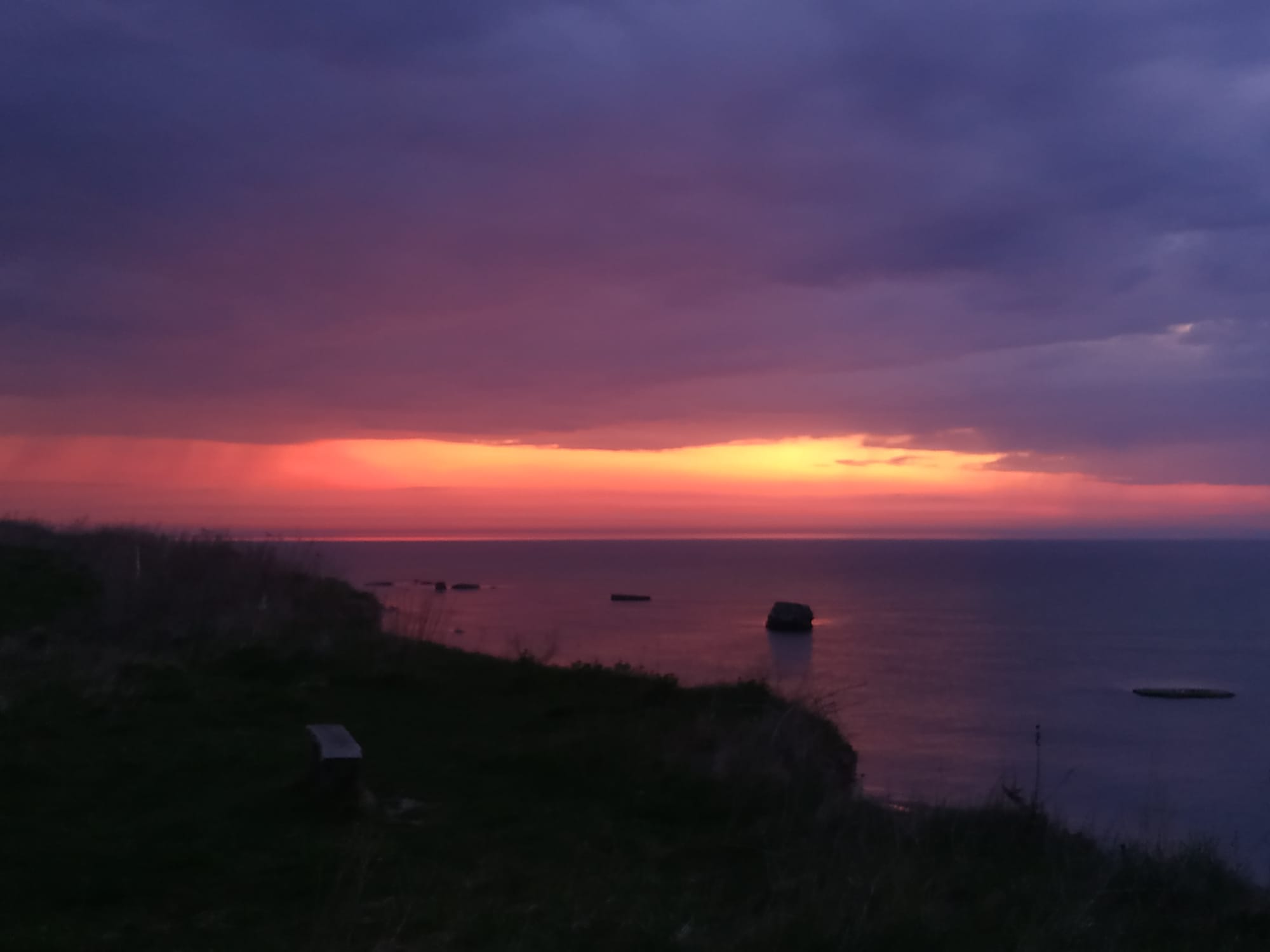 The stunning colours of today's moody sunrise. Picture by Cyann Ménard / GFU
In addition to the frogs’ calls, our day (or at least mine!) was enlightened by the really close presence of the Common Whitethroat (Tornsanger) singing in the surrounding bushes. It was mimicking a lot of different birds, so we kept on hoping for some Bee-eaters (Biæder), or maybe a small Quail (Vagtel) somewhere in the field, both ending up being the Common Whitethroat pranking us… Early in the morning, we also had an unexpected sighting of a little bat – likely a Common Pipistrellus (Pipistrelflagermus) – hunting over the sea before heading to the building for a well-deserved day of sleep.
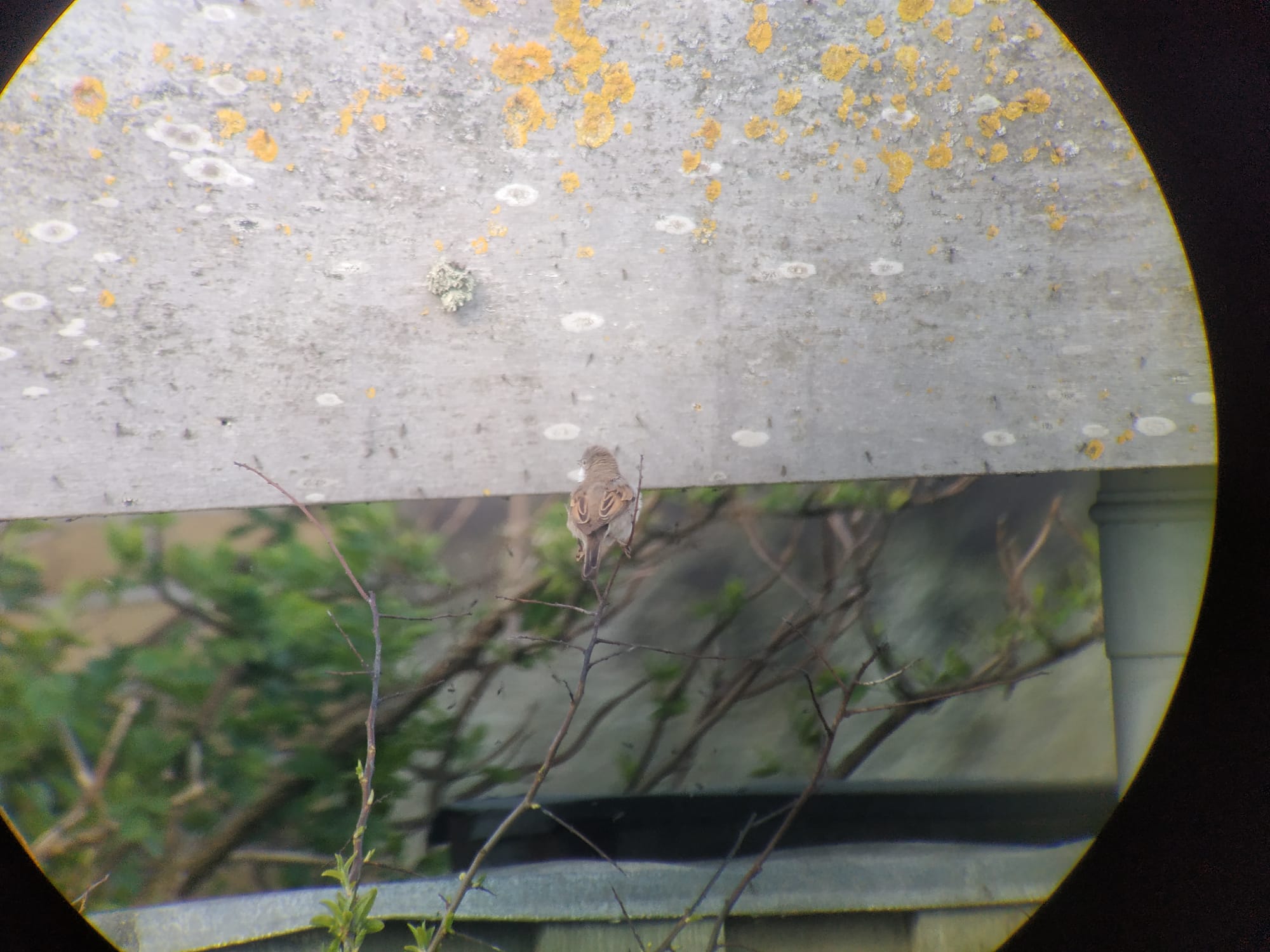 The Common Whitethroat was really uncooperative, and refused to show me its face, but at least we can have a glimpse of its beautiful back feathers ! Picture by Cyann Ménard / GFU
Se alle dagens observationer ved Gedser Odde i DOFbasen.
Other news: In the afternoon, Mads and Tina + family came by to set up the new lawnmower, and program the intricate path it has to take through the garden - so hopefully less manual mowing in the future!
Folk på stationen: Cyann Ménard, Mathilde Sif Eiby, Olga Fernandez Enriquez, Mads Elley, Tina Elley, Hans Lind, Vagn Lind
First Nightingale in 5 years and other new species!
Ringmærkningen: First round today already seemed very calm, but with an amazing surprise in the last net for me! A Nightingale (Sydlig Nattergal), that I’ve never even seen before, so I had to tell the others: “I have a new species, slightly bigger than a Robin, completely reddish-brown back and pale front”, and they said: “Sounds like a Nightingale!”, which I agreed was definitely possible! Even though it didn’t look like a Thrush Nightingale (Nattergal), we examined the differences in the lab to make sure it couldn’t be confused, and I aged it to be an adult by the appearance and quality of the whole moult. It’s only the 10th ringed by the station, and the first one since 2021! Also happens to be my 200th species ever seen in Denmark!
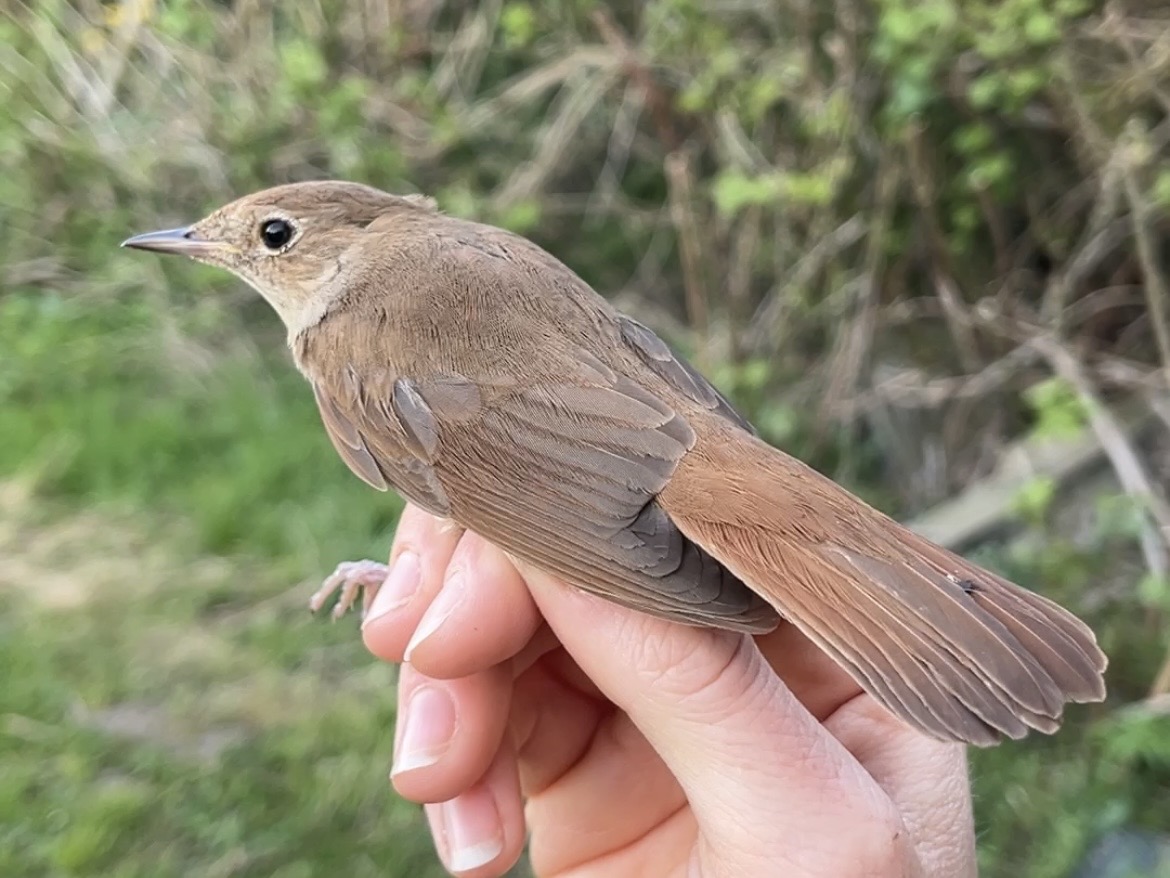
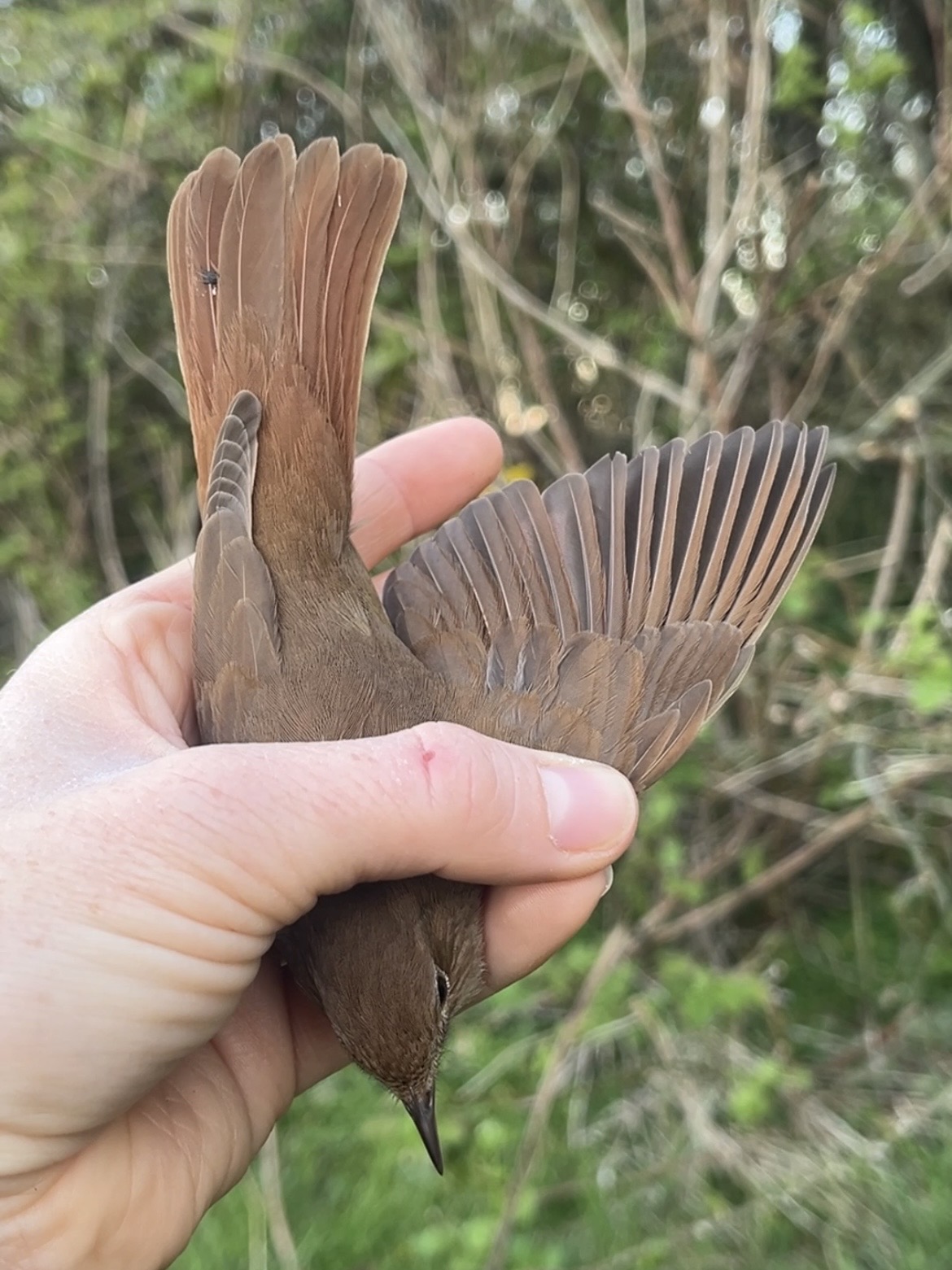 The Nightingale, with the uniform reddish-brown feathers on the back, and the pale front, with no spots on the chest (not visible here). An adult due to the broad, rounded and uniform feathers on both the wing and the tail. Pictures by Mathilde Sif Eiby / GFU.
Just a few rounds later, another surprise was bestowed upon me! The first Pied Flycatcher (Broget Fluesnapper) of the year, that I quickly recognized, and had to take a deep breath before extracting from the net – two new species that early got my heart pounding! This one we had to ensure wasn’t confused with the Collared Flycatcher (Hvidhalset Fluesnapper), and I ended up aging it as a young male.
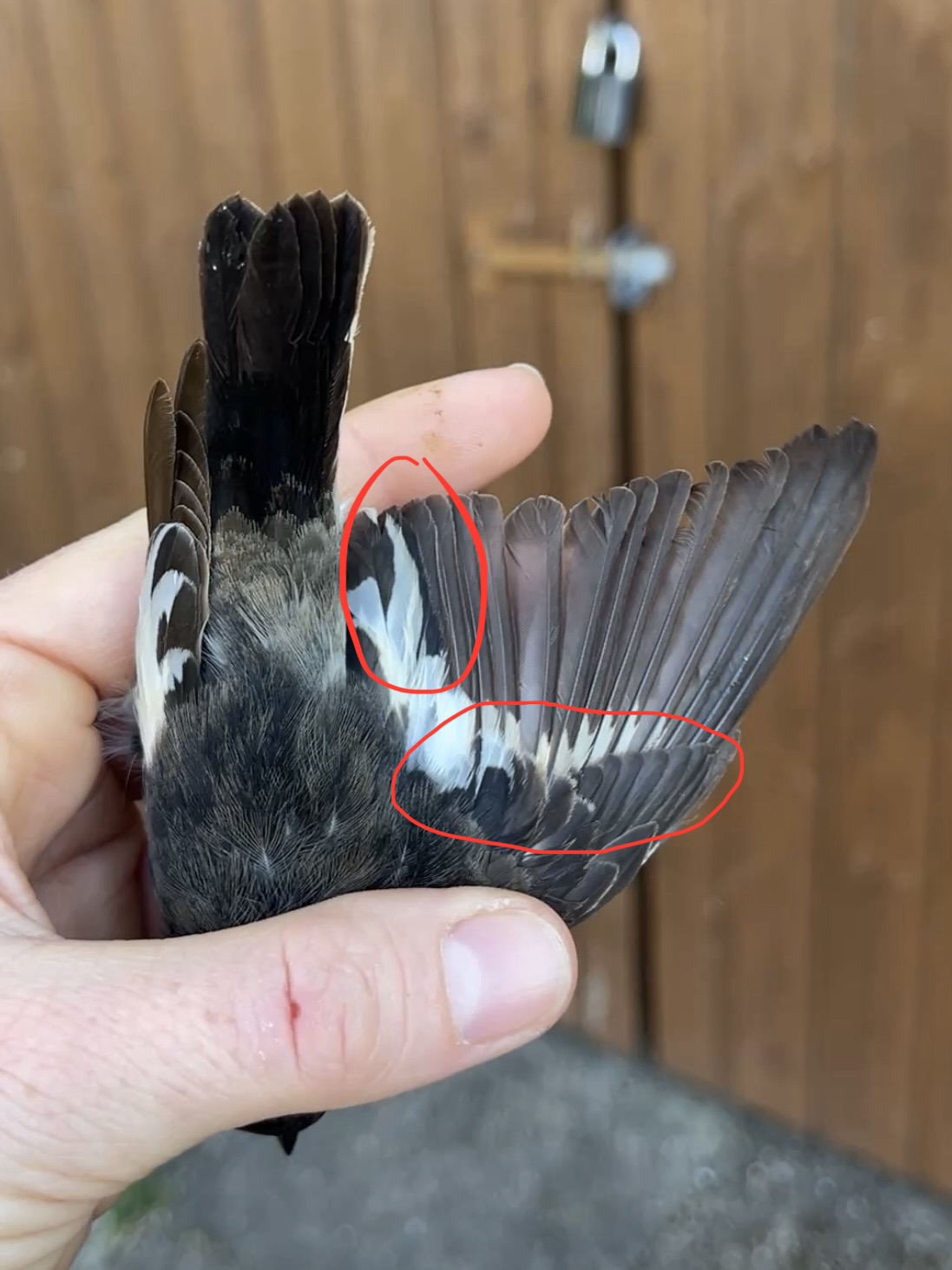 These ones can be more tricky with both young and adult moulting, but the combination of all the signs still led me to a young male.
After closing down the standard, we kept the pond open for a bit longer, since there was a rather high activity of Linnets (Tornirisk) and Barn Swallows (Landsvaler) - and there was also word of a Hoopoe (Hærfugl) on the loose! It wasn’t until the closing round though, that Vagn and Hans caught yet another Yellow Wagtail (Gul Vipstjert) – we still need one for both Olga and me though!
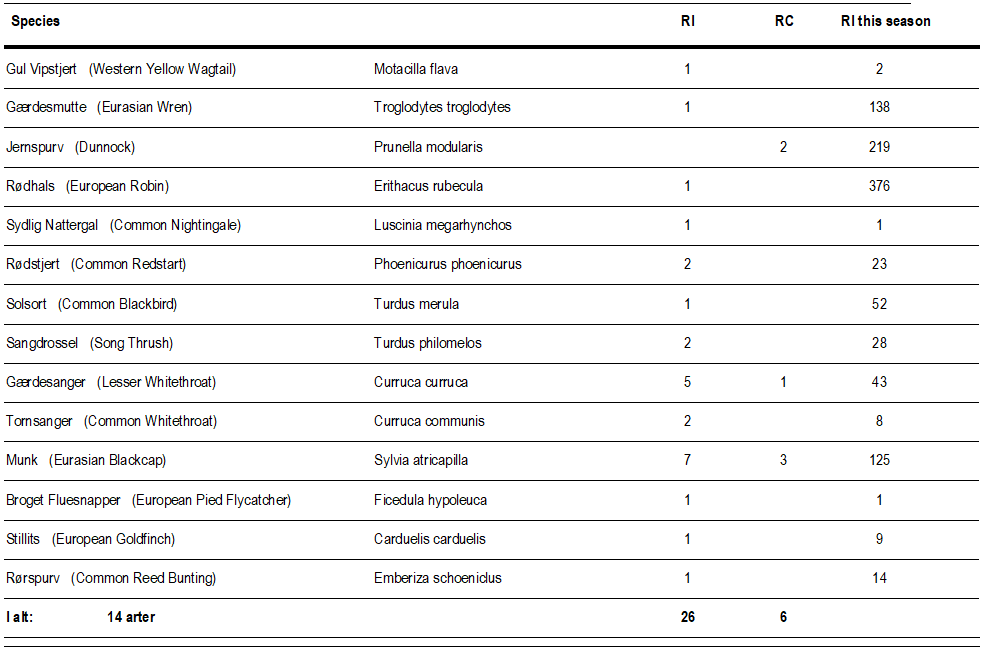
Today's numbers:
Trækket på Odden : For the second day in the row, the full moon was absolutely stunning when I walked out to the tip this morning. There was much more wind than the previous days, and it seemed that the birds were here for it. We counted 1283 individuals of 33 species, half of it being Black-headed Gulls (Hættemåge). We once again had several different gulls species, with mixed flock containing both black-headed and Common Culls (Stormmåge); a few flocks of Little Gulls (Dværgmåge), and on my behalf I was really happy to see my firsts Lesser Black-backed Gulls (Sildemåge) of the year, even though I know some have already been seen here at Gedser Odde.
The local birds were also a real treat today. Two avocets (Klyde) flew just above the tip, flashy black and white spots in the blue sky, taking a similar path than a Little Tern (Dværgterne) who came quite close over our heads. The only raptor of the day , a male Marh Harrier (Rørhøg), wasn’t migrating, but he was able to show off his beautiful plumage in the sunlight. But none of them could outcompete the unexpected sighting of the Hoopoe (Hærfugl), which sent Danish birders into raptures. They were running everywhere (I swear), taking a thousand pictures (at least), as they should ! Because it is indeed a wonderful bird, and quite a rare observation to make at the tip.
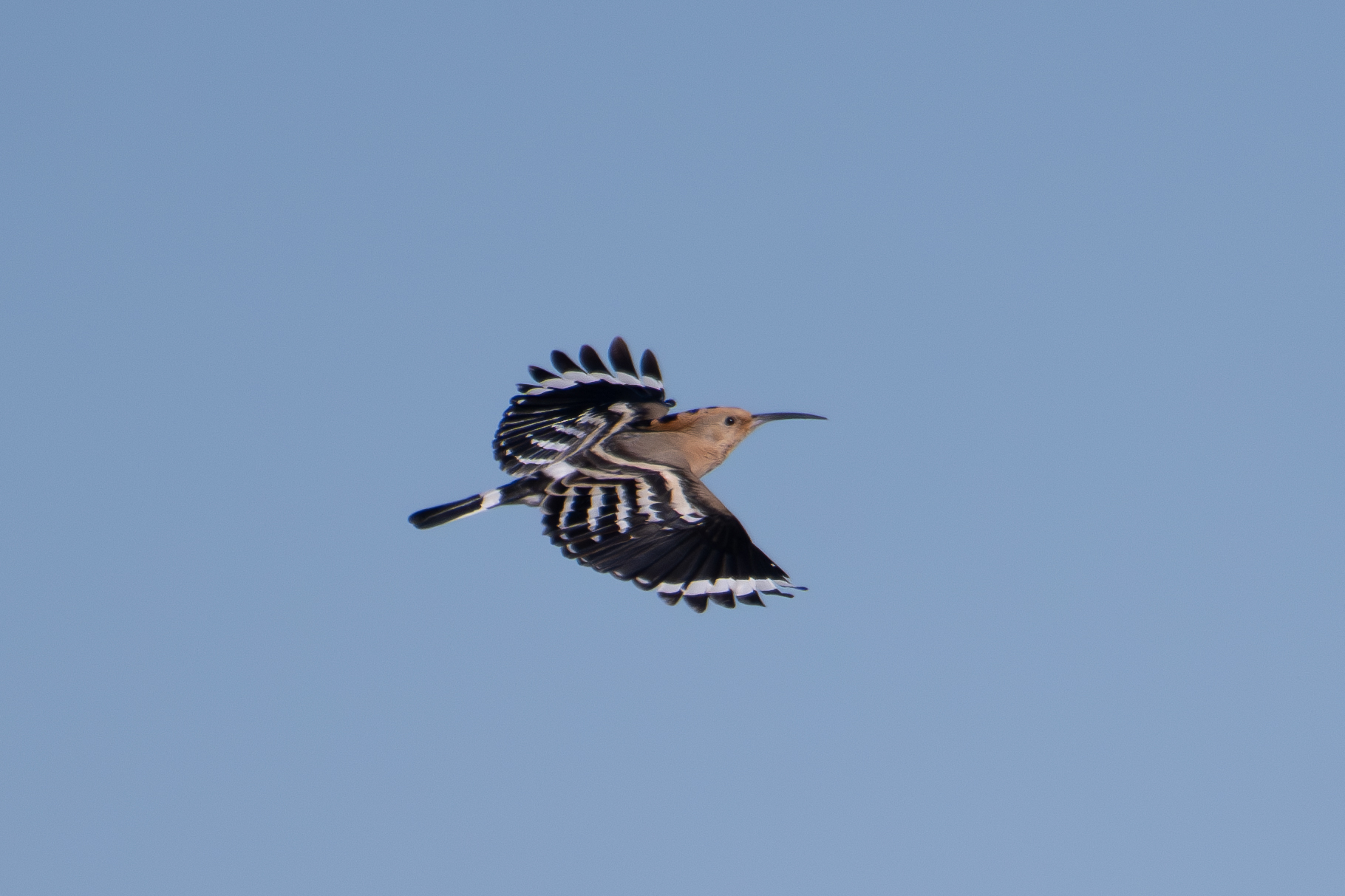 A lovely surprise today at the tip ! Picture by Morten Lisse.
Se alle dagens observationer ved Gedser Odde i DOFbasen.
The rest of the day: In this weather we had to go to the beach. There we were puzzled by a mysterious ocean bloop sound (thing sp.), I (Mathilde) stepped on a flatfish, we inspected jellyfish, and lastly we heard the first Cuckoo (Gøg) of the year while swimming! Back home Vagn had prepared build-a-pizza for dinner - what a day!
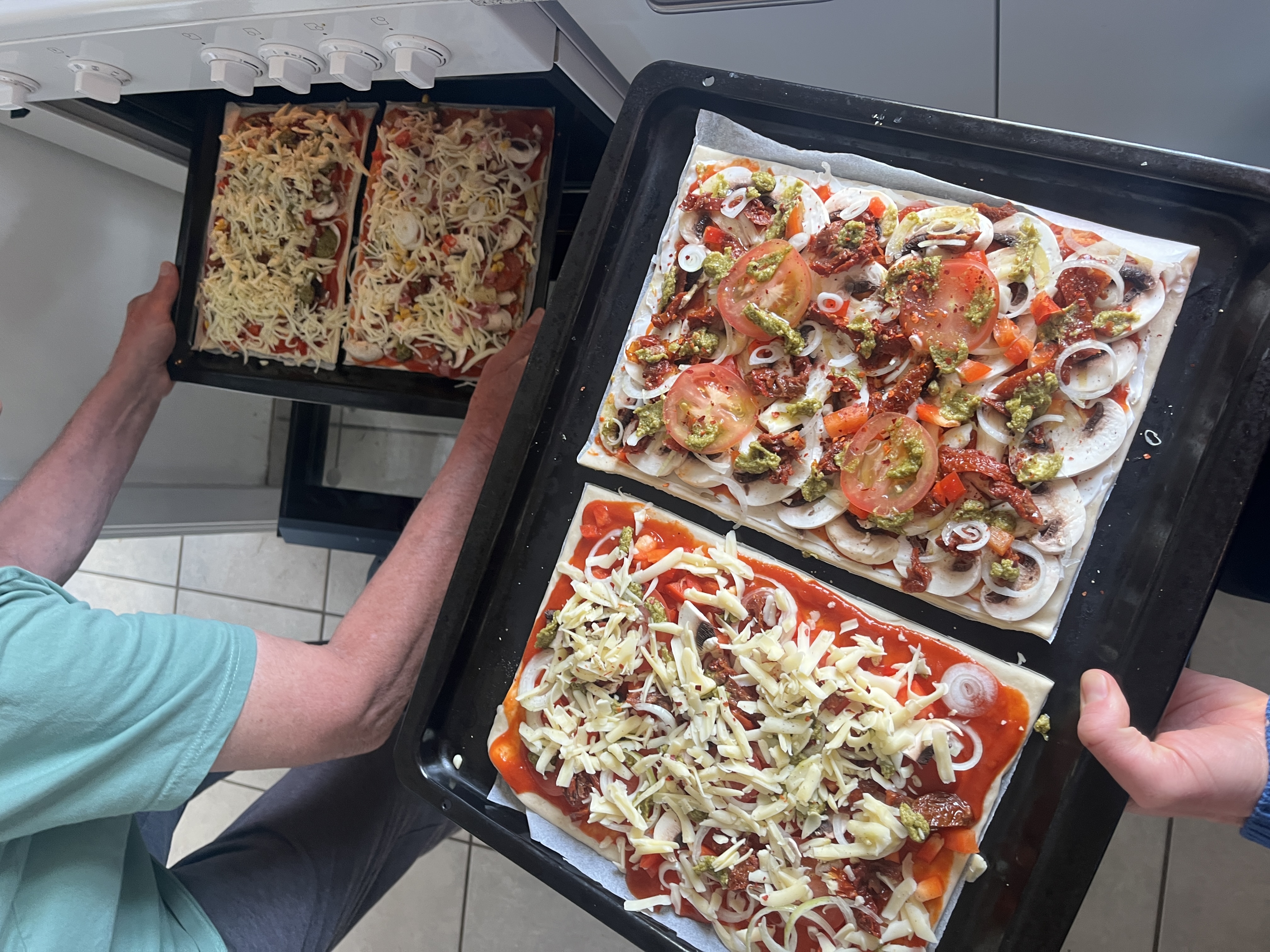 PIZZA! Picture by Mathilde Sif Eiby / GFU
Folk på stationen: Cyann Ménard, Mathilde Sif Eiby, Olga Fernandez Enriquez, Louis A Hansen, Mads Elley, Hans Lind, Vagn Lind