-
FORSIDE

- Blog
Gedser Fuglestation Blog
Her på Gedser Fuglestations blog bringes korte nyheder i dagbogsformat om hændelser på fuglestationen.
Wry bird
After quite a good day yesterday, today went very well again. We had a good number of birds on most net checks, it was never too busy but also not too slow, and Mathilde’s family, who were visiting, got to see many different birds of different species – most of all whitethroats of different species, to be honest.
It is really amazing that there are still unringed whitethroats in the garden, but there are and we ringed 18 of them again today – all of them juveniles. I guess this means either that the whitethroats in the garden are having a very good breeding success this year, having a successful second brood – or it is young birds that are moving around a bigger area before beginning migration. In any case, none of them had particularly much fat on them so they are not in a hurry to leave the mainland any time soon.
Quite different the single marsh warbler (kærsanger) we caught: it had a lot of fat and is clearly on its way south – hopefully crossing the ocean tonight, before the strong winds come with rain tomorrow.
Next to all the whitethroats, we also caught and ringed some new icterine warblers (gulbug) again. Two of them had clearly only just left the nest – the wings were barely long enough for the birds to fly at all. Apparently their first trip away from home has taken them right into our net. Must also have been a second brood here, which is good, because with the entertaining song they have, there can never be too many icterine warblers!
Towards the end of out standard ringing time, and when our visitors had already left to pack their things, we had to call them back to the lab for a rather special guest: a wryneck (vendhals) flew into our nets. The wryneck is the only long-distance migrant species of woodpecker in Europe and winters in Africa south of the Sahara. The one we caught also already had a lot of fat, so might join the marsh warbler on its way south tonight – they winter in more or less the same region, so maybe they can be travel buddies for a while…
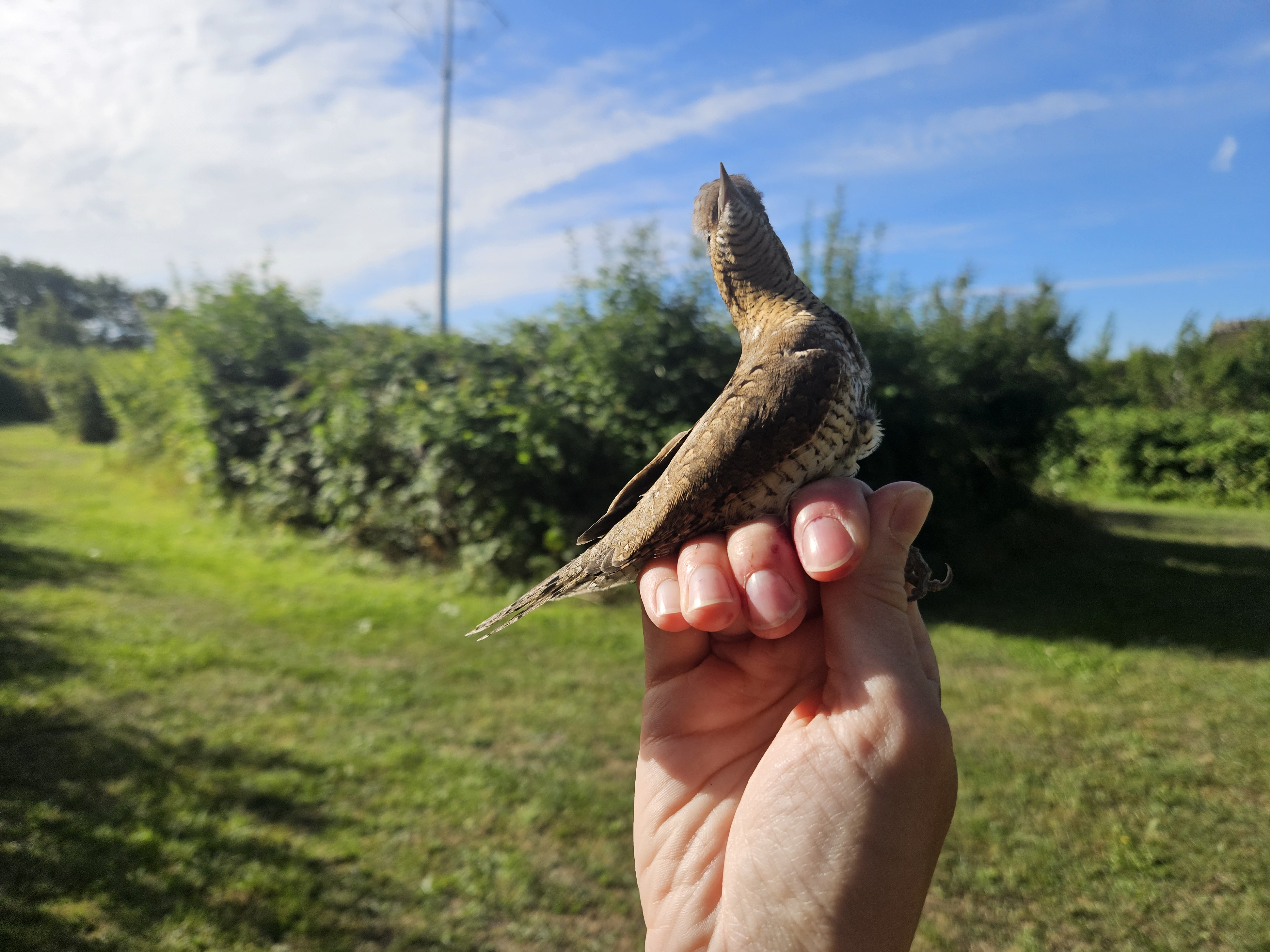
When attacked, the wryneck moves its head in a snake-like way to scare off the attacker – doesn’t fool an ornithologist, but with its perfect camouflage it might fool other people…
In the afternoon, we again opened the swallow nets down by the pond and again the swallows seemed to think that we only put them up so they can sit on them. Many of the actually learned the trick of sitting on some of the middle net lines without getting caught – a few juveniles tried but failed, so we caught a total of 5 swallows again – including a house martin this time.
Dagens fangst
Net op: 05:00, Net ned: 10:00, Netmeter: 278
Rødstjert / Common redstart / Phoenicurus phoenicurus: 2
Kærsanger / Marsh Warbler / Acrocephalus palustris: 1
Gulbug / Icterine Warbler / Hippolais icterina: 5 (2)
Gærdesanger / Lesser Whitethroat / Curruca curruca: 12 (3)
Tornsanger / Common Whitethroat / Curruca communis: 6 (5)
Havesanger / Garden Warbler / Sylvia borin: 2 (1)
Munk / Eurasian Blackcap / Sylvia atricapilla 3
Gransanger / Chiffchaff / Phylloscopus collybita 1
Løvsanger / Willow Warbler / Phylloscopus trochilus 4
Nattergal / Thrush Nightingale/ Luscinia luscinia: 2
Træløber / Eurasian treecreeper/ Certhia familiaris: 1
Vendhals / Wryneck / Jynx torquilla: 1
Non-standard (16:00-18:30):
Digesvale / Sand martin / Riparia riparia: 3
Landsvale/ Barn swallow / Hirundo rustica: 1
Bysvale / House martin / Delichon urbicum: 1
I alt: 45 mærkninger, 11 genfangster, 56 fugle, 15 arter
På stationen: Storm Hauris Borum, Mathilde Lundt Larsen, Cyann Ménard, Martina Hillbrand, Lise Mastrup