-
FORSIDE

- Blog
Gedser Fuglestation Blog
Her på Gedser Fuglestations blog bringes korte nyheder i dagbogsformat om hændelser på fuglestationen.
The raptors are rising! (in the thermals)
Ringmærkning: xxxxx
Trækket på Odden: It is very interesting to see how different days at the migration count can be. After yesterday’s cold and wet weather, we had a lot of sunshine but still chilling wind today. Also the birds were very different. As usual, we focused on the seabirds, however, there was almost nothing to focus upon. A few Sandwich Terns (Thalasseus sandwichensis) migrated by and we had a grand total of 16 ducks for the whole of the count. Still, three Arctic Skuas (Stercorarius parasiticus) made a quick stop on their way south to congratulate me on my birthday (probably rather to harass some terns…). They were the first special guests, but certainly not the last. After looking at an almost empty Baltic Sea for the first hour, we turned by 180° for the rest of the count and focused our attention on the skies. In the warming air, an amazing migration of raptors was picking up. The first sign of that came in the form of two Sparrowhawks (Accipiter nisus), still in the dark. They were followed by 127 more Sparrowhawks alone – and these birds were not the only raptor species on the move today. There also were European Honey-Buzzards (Pernis apivorus), 76 in total. Most of them migrated alone, though some decided to get some company and created a group of 27!
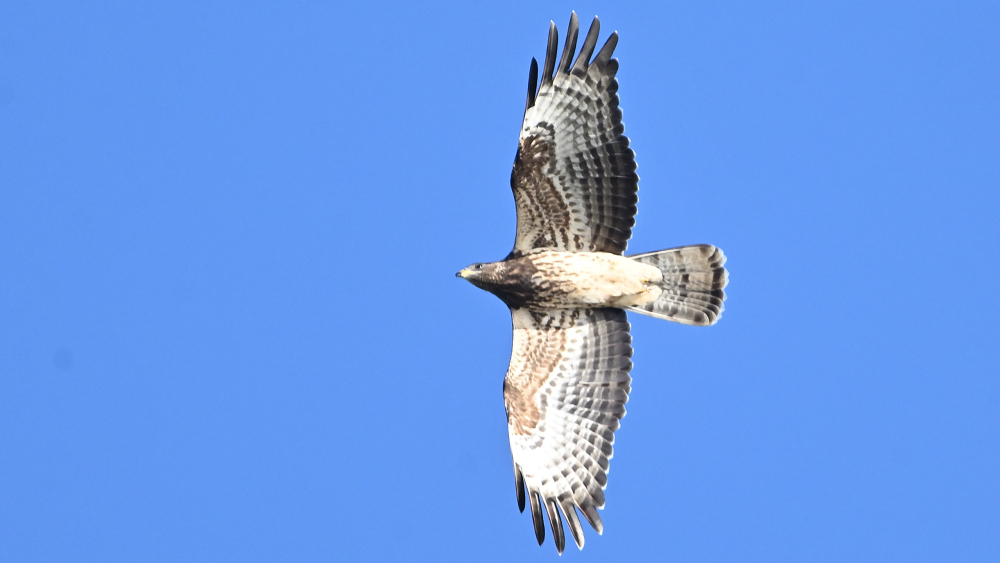
European Honey-Buzzard. If the birds show themselves nicely, we can age and even sex the Honey-Buzzards based on several criteria. This one is a juvenile identified by the dark eye (adults have yellow eyes) and the black beak.
The raptor party was joined by a few Common Buzzards (Buteo buteo), some Eurasian Kestrels (Falco tinnunculus) and several Eurasian Marsh-Harriers (Circus aeruginosus). Apart from the Marsh-Harriers, these birds are not really known for being migratory. They just move around to where they can find enough food. The Marsh-Harriers though winter in central Africa. The raptor-bird-day-party didn’t really start though, until the big bullies arrived: Three White-tailed Eagles (Haliaetus albicilla) made an impressive appearance. Only one of them was brave enough to attempt the crossing to Germany, the other two decided to stay in Denmark for a bit. However, the real special guest joined the party quite early, hid for most of the time and made a quick appearance again towards the end of the count. Escorted by two crows and with its typical swaying flight style, a Short-eared Owl (Asio flammeus) suddenly appeared it made a few rounds over the field, before disappearing as quickly as it came. The deep gaze of its bright yellow eyes stayad with us for a long time after the owl itself had already left.
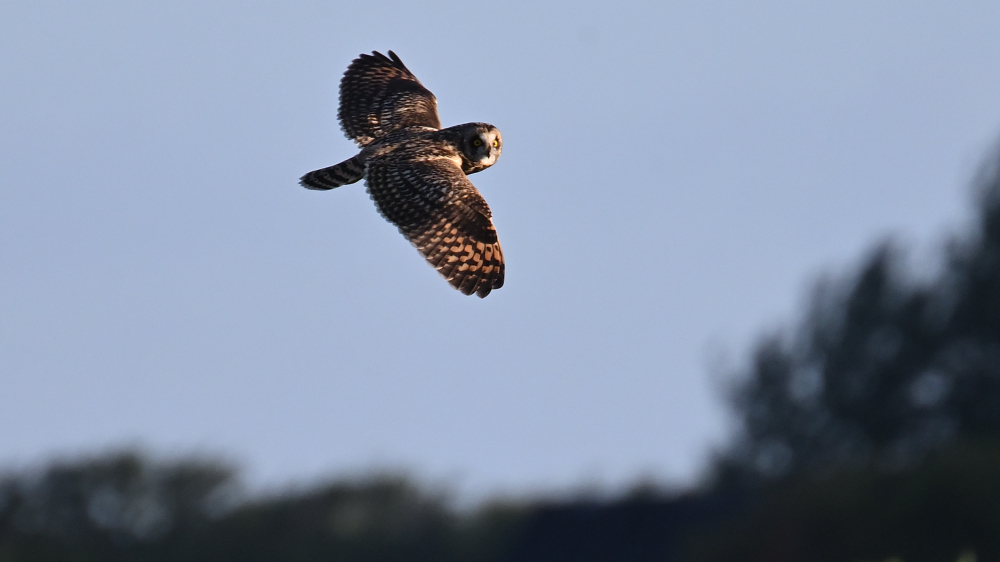
Short-eared Owl (Asio flammeus). In owls, an interesting correlation between the eye colour and the time of activity can be observed. As a rule of thumb, the eye colour is the same as the colour of the sky when the owl is most active. Different from most owls, Short-eared owls can often be seen during the day hunting over meadows, fields and marshy areas.
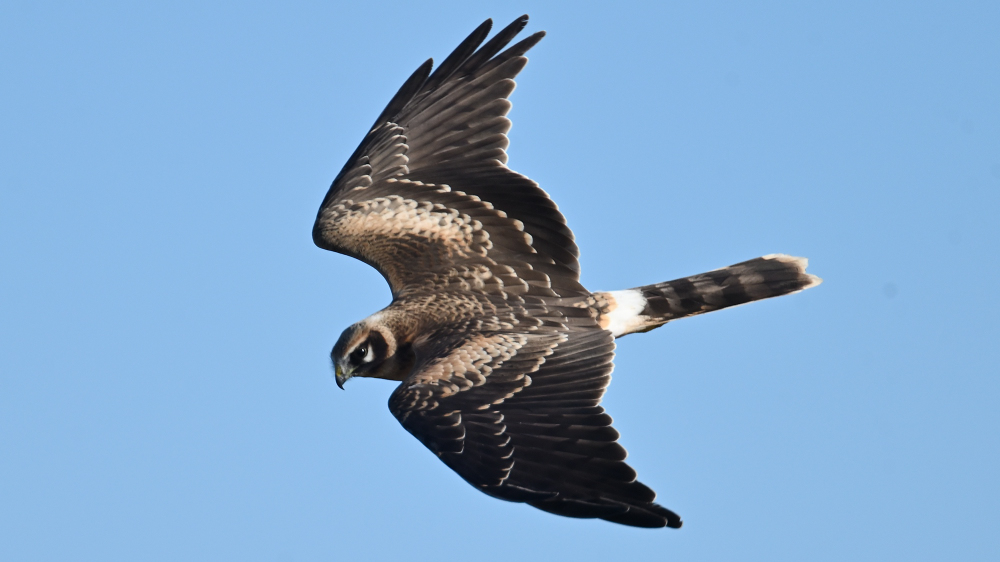
As promised, we had a real party today. Logically, seven species are not yet enough, so more came to greet us. A Red Kite (Milvus milvus) was showing off itself, however everyone only had eyes for its cousin, the Black Kite (Milvus migrans). It is likely that the individual we saw yesterday mustered finally enough courage to cross the scary blue. It was joined by another Black Kite later that tried to be brave but returned quickly. But the real star (arguably even better than the owl) came just calmly soaring over the grass, when it discovered us observers speechless a few metres in front of it. It then made a quick turn, so we could all see the reddish underside, the four-fingered hand, the light necklace and even the colour of its eyes! Have you figured out who made this spectacular show? Of course, it was a Pallid Harrier (Circus macrourus), giving some of the best views anyone has ever had on this species. Just to make sure everyone got their perfect pictures, views and incredible lifer experiences (me!), it circled over our heads several times before heading out over the sea. These birds have become more common over the last few years, probably at least partially due to climate change. Still they are an amazing species, especially at this range!
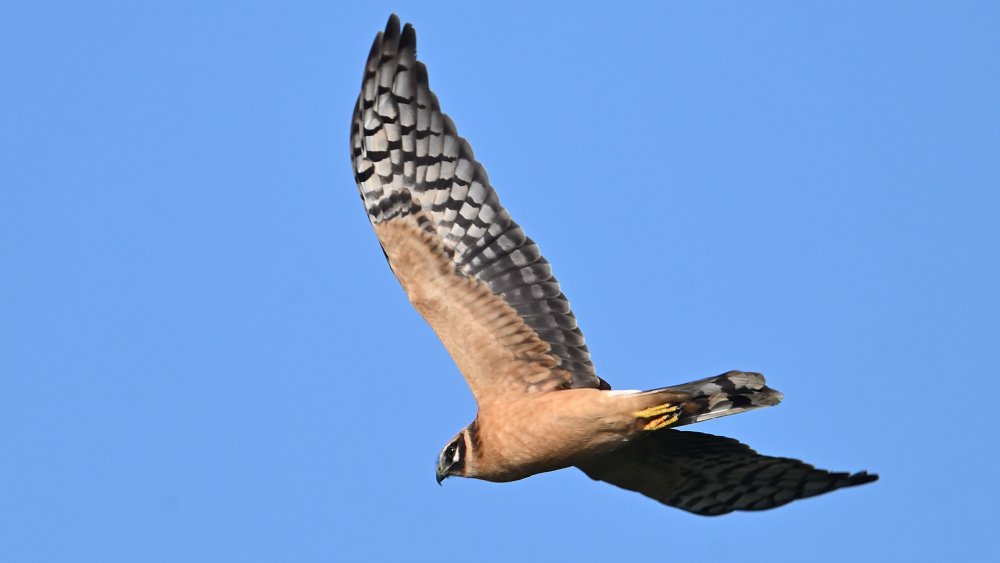
Pallid Harrier (Circus macrourus). As in all the other Harriers, young Pallid Harriers look nothing alike the adults. They are more colourful and grow their patterns only with age. The pale eye also tells us that this is a young female.
In the afternoon, Tina came by with some delicious cake and we celebrated my birthday and the amazing observations a little. Thank you to everyone for all your congratulations, best wishes, songs and presents. It was an amazing birthday and I am so grateful for being able to celebrate it here, surrounded by all the great other ringers, observators and, most importantly, friends!
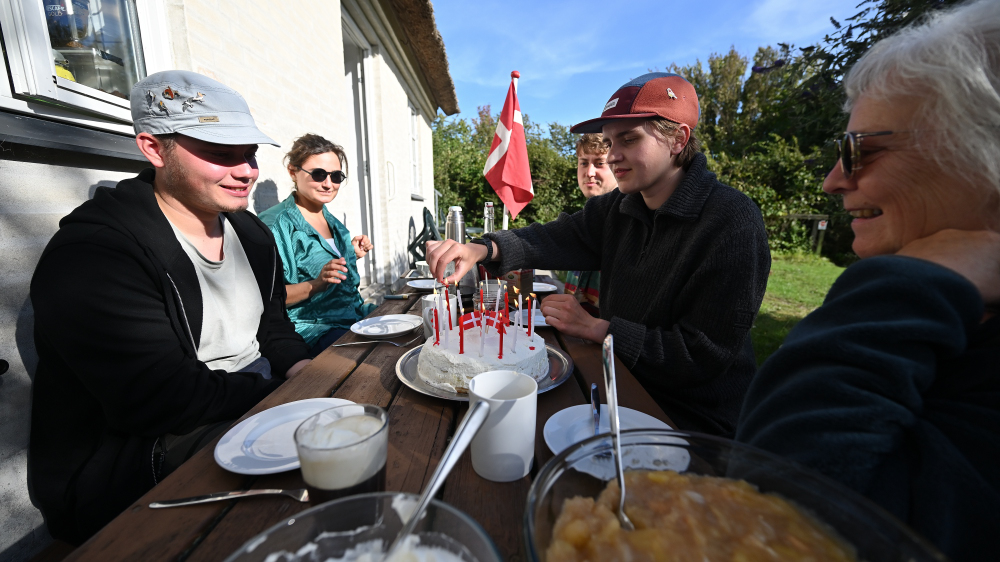
The Danish birthday cake
Fugle registreret i standardtiden: 1584. Arter: 37. Tællingen startet 06:04, sluttet klokken 11:04.
Se alle dagens observationer på Gedser Odde i DOFbasen.
På stationen: Hannah Schmidt, Storm Hauris Borum, Frederikke Dufke, Lua Koplin, Tina Elley, Ole Friis Larsen, Marek Ebert