-
FORSIDE

- Blog
Gedser Fuglestation Blog
Her på Gedser Fuglestations blog bringes korte nyheder i dagbogsformat om hændelser på fuglestationen.
A (potentially) trist day
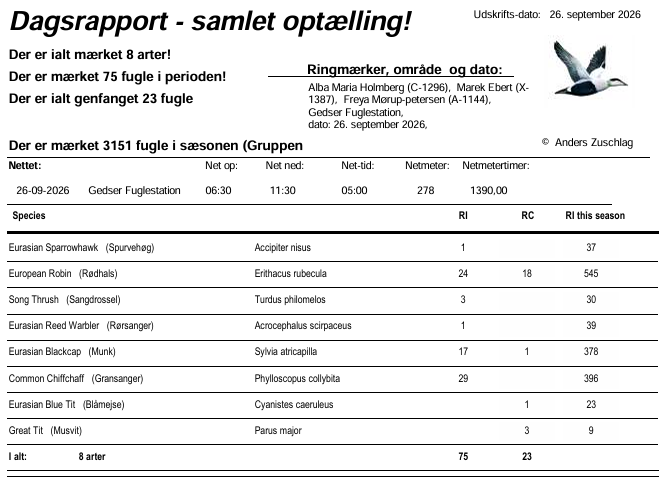
Ringmærkning: After having spent a few weeks out at the tip for migration count, I was excited for finally another day of ringing. We also were joined by Freya who will be here for the next weeks. Looking forward to some nice ringing! We had some ligth wind, otherwise the conditions were pretty good though. But that doesn't mean nice weather: the sky was totally grey, it did not seem to get really light and it generally was gloomy. In Germany, we call this weather "trist", especially in autumn (and I think, you can do the same in Danish). The birds didnt seem to mind that and kept migrating in goos numbers over our heads. In the garden itself, not a lot was happening but we could see some movement of tits, finches and leaf-warblers.
In total, we got almost a hundred birds, though it felt way less than that. As in the last days, the numbers were dominated by European Robins (Erithacus rubecula, "Small red robin") and Common Chiffchaffs (Phylloscopus collybita, "Money-changing leaf-searcher") and one of the most interesting birds today actually was a Chiffchaff. When I took it out of the bag, I immediately noticed that it felt a bit off: it was not as green and yellow as the other Chiffchaffs and just gave a different vibe. After closer inspection and comparison, we concluded that it probably was part of the tristis subspecies, the Siberian Chiffchaff. But we can't say for certain, except if we took genetic samples. Apparently, the bird enjoyed his treatment, because we caught it again a few rounds later.
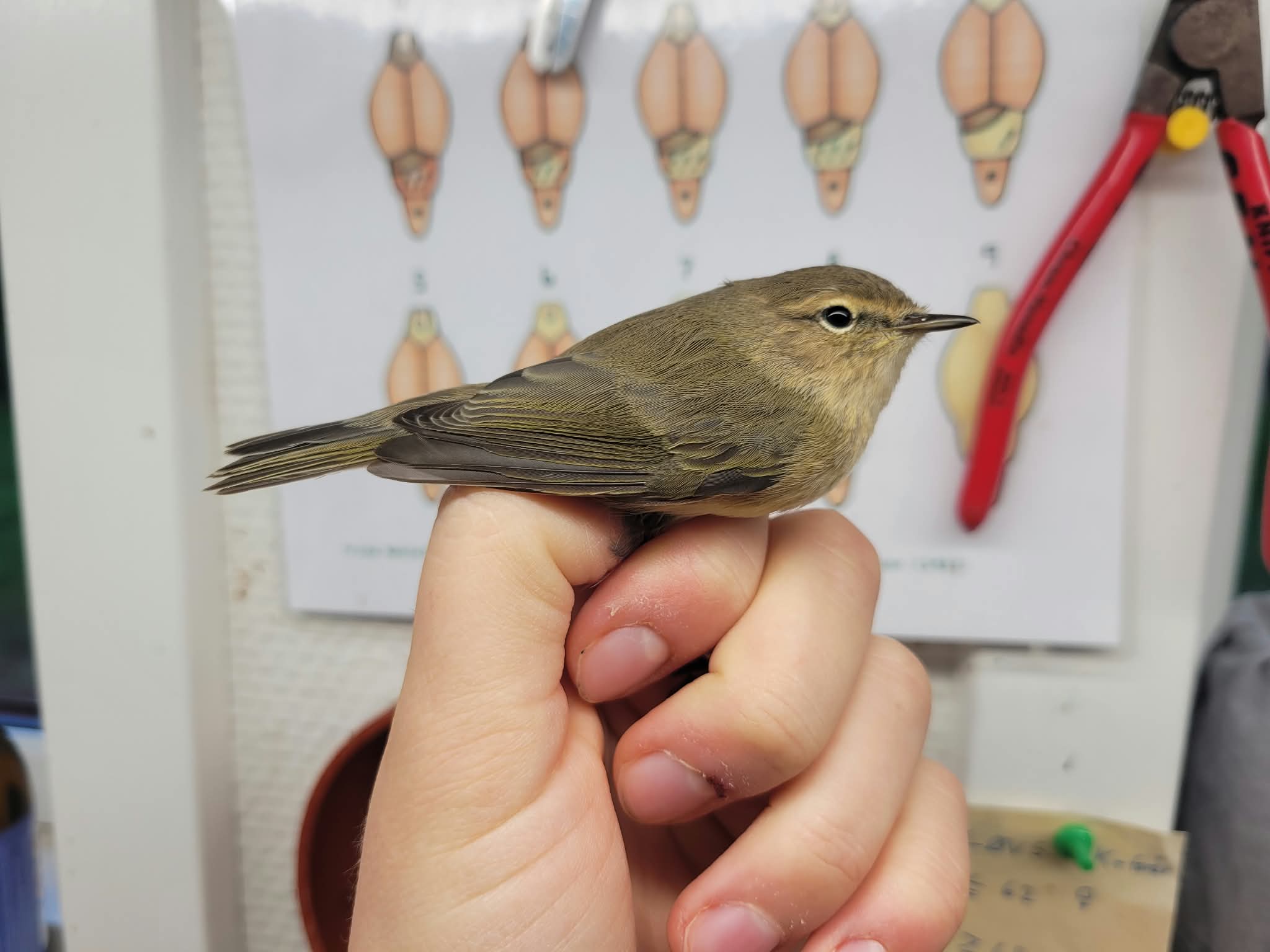
tristis-looking Chiffchaff. The Common Chiffchaff has a very big range and so naturally, quite distict supspecies have evolved. Until a few years ago, there were even more, e.g. the Iberian Chiffchaff (Phylloscopus ibericus, "Iberian Leaf-searcher") or the Mountain Chiffchaff (Phylloscopus sindianus, "Indian Leaf-searcher"). It is very possible, that this subspecies may also soon be considered a seperate species.
In comparison to the Common Chiffchaff (subsp. collybita), the tristis birds are overall more grayish-brown and less green. They also have a buff brown supercilium (the "eyebrow") instead of a bright yellow one. Also, their vocalisations differ slightly. When we released this bird, we did not hear the typical tristis call, which makes everything even more confusing.
Left: Common, Right: possible Siberian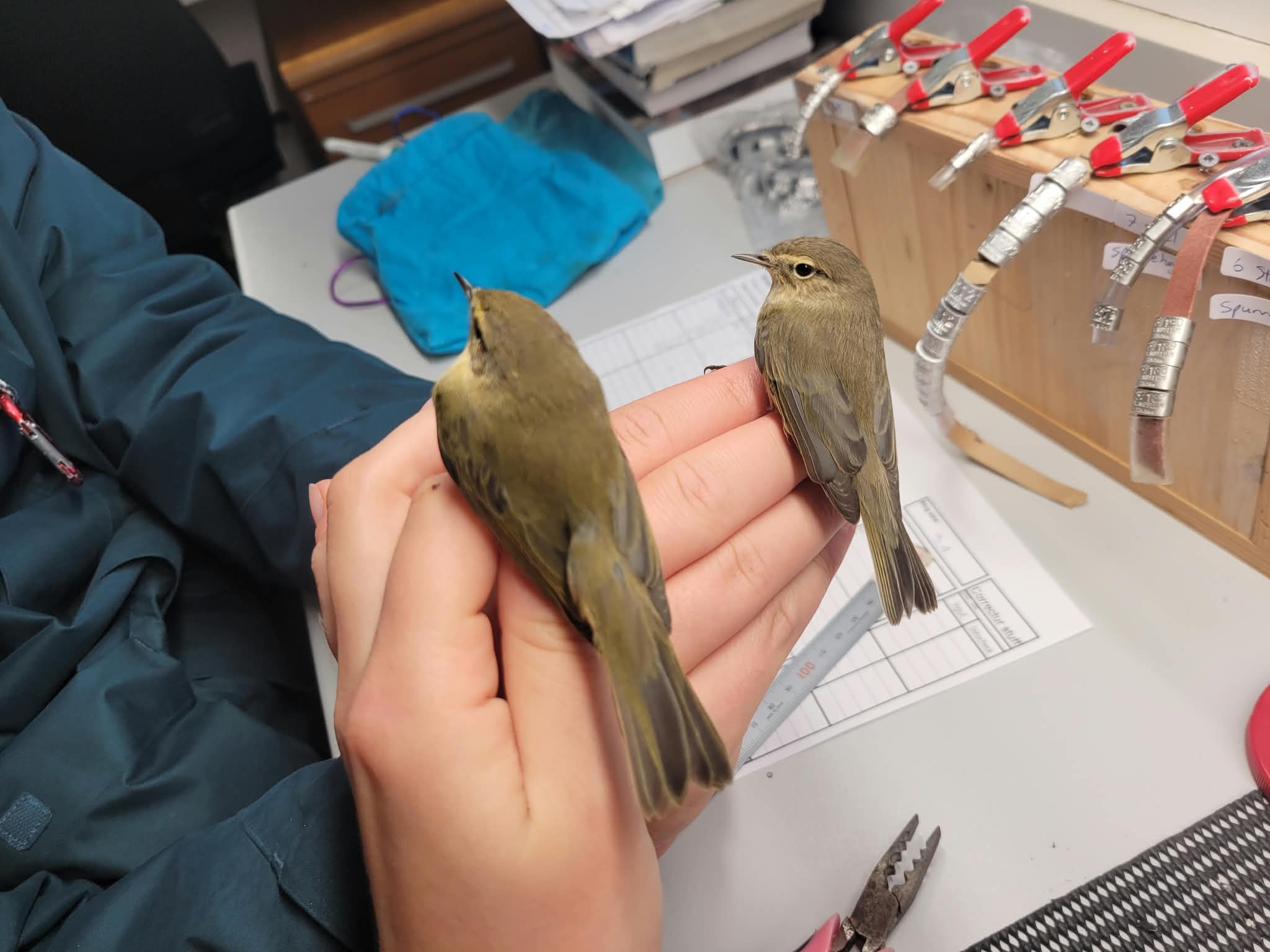
Other than that, we also caught a Common Reed-Warbler (Acrocephalus scirpaceus, "Bulrush high-head"), likely the last one of its species this year. Reed-Warblers winter in sub-saharan Africa, so it still has quite some distance to cover. In the last round, we had a species that is always a nice addition to every day: a Eurasian Sparrowhawk (Accipiter nisus, "down-swooping hawk").
Now we have opened the "snipe nets" down by the pond in hopes for Meadow Pipits (Anthus pratensis, "small grassland bird from the meadow"). We'll keep you updated in case we get something special!
Update (18:52): We actually were really succesful and got a total of four Pipits! So one for each.
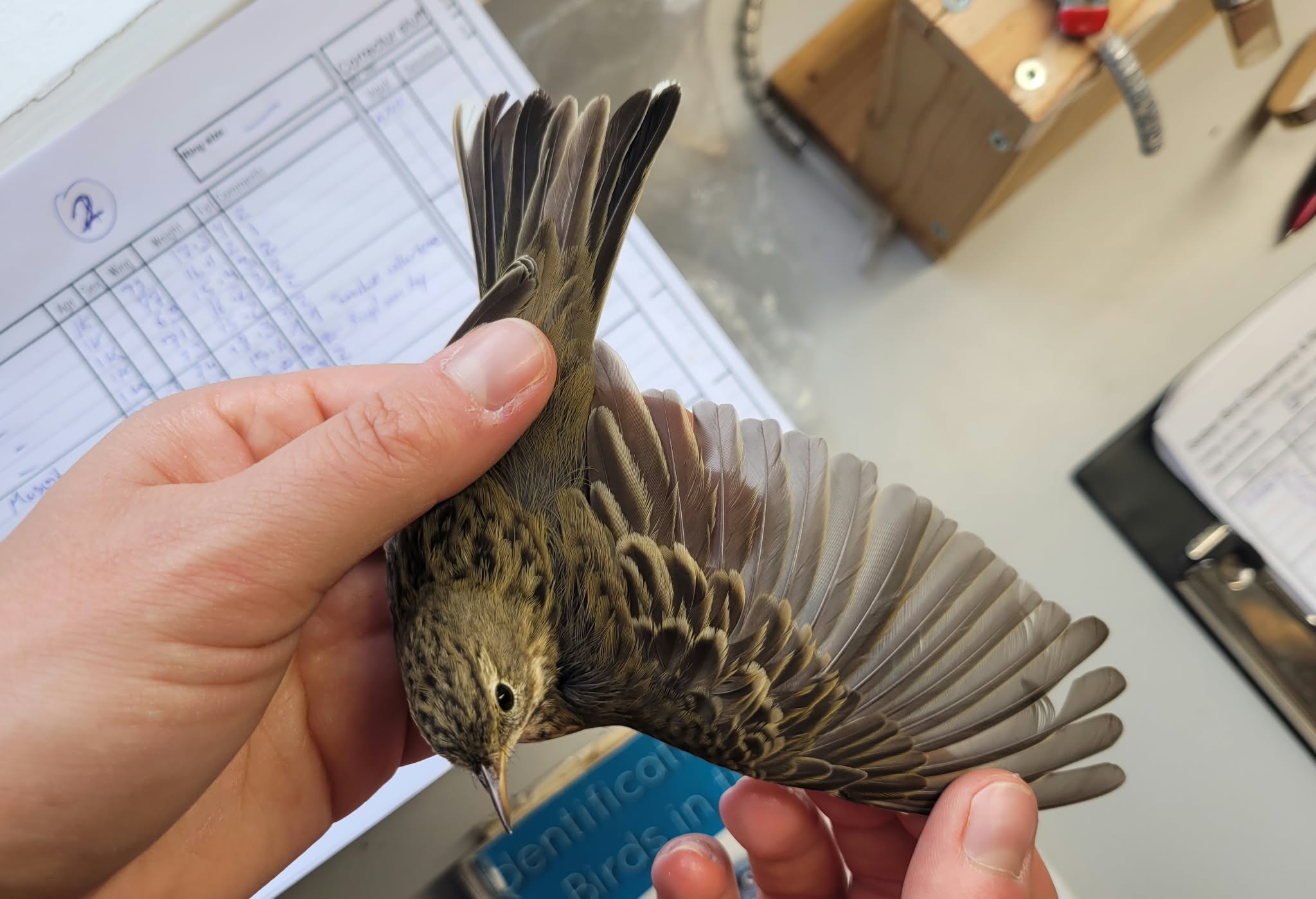
One of this afternoon's Meadow Pipits. I wasn't sure, how they compare to Tree Pipits (Anthus trivialis, "normal grassland bird"), but they feel very different. And of course you got these enormous hind claws!
Trækket på Odden: Weather-wise, the day greeted us with clouds, sunshine, a bit of rain, some haze over the ocean – in other words it was all over the place. Bird-wise, not so much was out of the ordinary. The majority of individuals were of course our beloved Common eiders (Somateria mollissima), with which we were busy as soon as the counts started. After two hours of counting over 2,000 individuals, the eider migration slowed down somewhat. Still, we reached over 3,000 individuals by the end of the day.
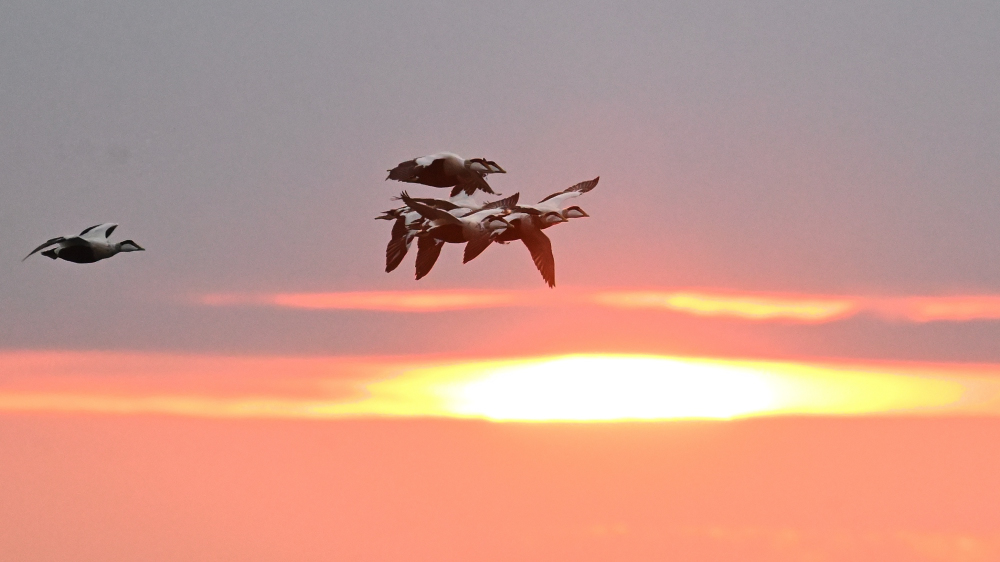 One of the first Common eider (Somateria mollissima) flocks of this morning soaring past a beautiful sunrise.
I’m enjoying seeing more species that I recognize from Svalbard. Today, the eiders were joined by Barnacle Geese (Branta leucopsis), Red-throated divers (Gavia stellata), and of course more dark-bellied Brent geese (Branta bernicla) and Dunlins (Calidris alpina). Otherwise, skies were filled with more Eurasian wigeons (Anas penelope), Common scoters (Melanitta nigra) and some Northern pintails (Anas acuta). A Northern gannet (Morus bassanus) made a surprise appearance. It was brown overall, allowing us to conclude that it was a juvenile individual. After flying around with other gull species, it continued its migration south-west.
Among the raptures, there was little movement over land. Whilst 14 Eurasian sparrowhawks (Accipiter nisus) managed to migrate, a single Pallid harrier (Circus macrourus) stayed and circled over the nearby field. The adult female captured the attention of several local birders – including ours!
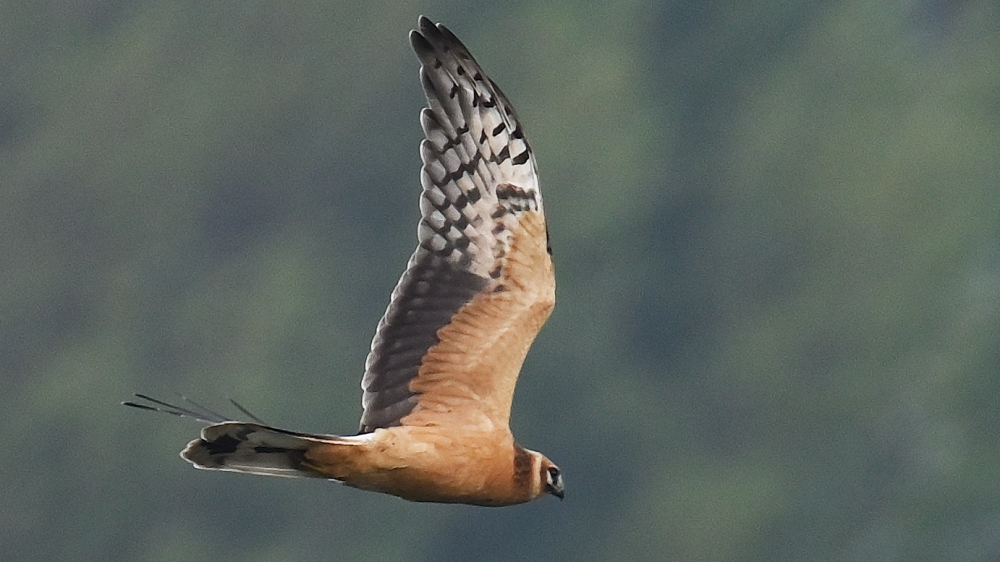 A juvenile female Pallid harrier (Circus macrourus) circling above a nearby field.
With Marek back on ringing duties, a usual friend of the Gedser Bird Observatory, Louis A. Hansen, was luckily back in time to assist us with the counting of passerines. Lots of Swallows (Hirundo rustica), Eurasian siskins (Carduelis spinus), Common linnets (Linaria cannabina) and Eurasian chaffinches (Fringilla coelebs) were out and about today.
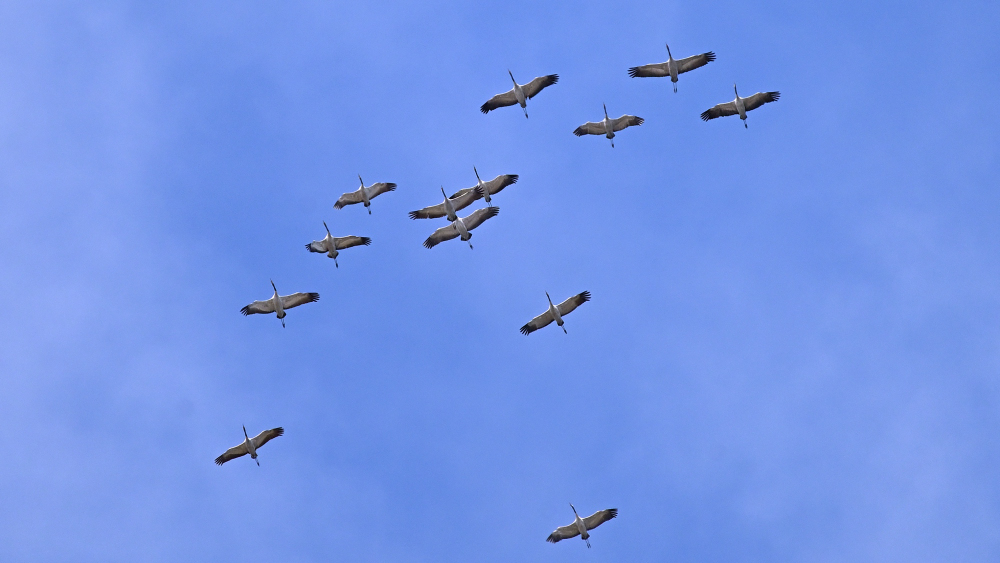 In the afternoon af group of Cranes (Grus grus) circled high over the bird observatory.
Fugle registreret i standardtiden: 6.048. Arter: 44. Tællingen startet 06:34, sluttet klokken 11:34.
Se alle dagens observationer på Gedser Odde i DOFbasen - af Dansk Ornitologisk Forening.

Husk, at fuglestationen har åbent hus næste lørdag, og kom gerne. Vi deltager i EuroBirdWatch 26 ved at vise ringmærkning inde ved fuglestationen og træk ude på Odden fra klokken 9 til 12. Parker på p-pladsen ved Odden og gå over engen til fuglestationen eller følg vejen ud til den gamle marinestation. Vi byder også på kaffe, saft og kage. Her er et link til omtalen på vores hjemmeside: https://www.dof.dk/oplev-fuglene/ture-og-aktiviter?event_id=6541
På stationen: Hannah Schmidt, Alba M. Holmberg, Frederikke Dufke, Ole Friis Larsen, Marek Ebert, Freya Mørup-petersen, Vibeke Holst Jensen