-
FORSIDE

- Blog
Gedser Fuglestation Blog
Her på Gedser Fuglestations blog bringes korte nyheder i dagbogsformat om hændelser på fuglestationen.
The sun after the rain
Ringmærkningen: Yesterday evening we were really excited what this morning would bring. A drastic change in wind direction usually brings new birds (wait a bit...) and it looked like the rain would end just before standard time, inhibiting nocturnal migration. Well, it didn't. The whole morning, rain came pouring down, so no standard ringing was possible. Instead, we enjoyed a relaxing time which we defintitely deserve from time to time. Relatively quickly though, we were eager to do some ringing and got annoyed at the rain. So as soon as it stopped around 12, we immediately set out to open some nets. It was really nice outside, the sun was shining and the sky was completely blue, a stark contrast to only a few minutes prior.
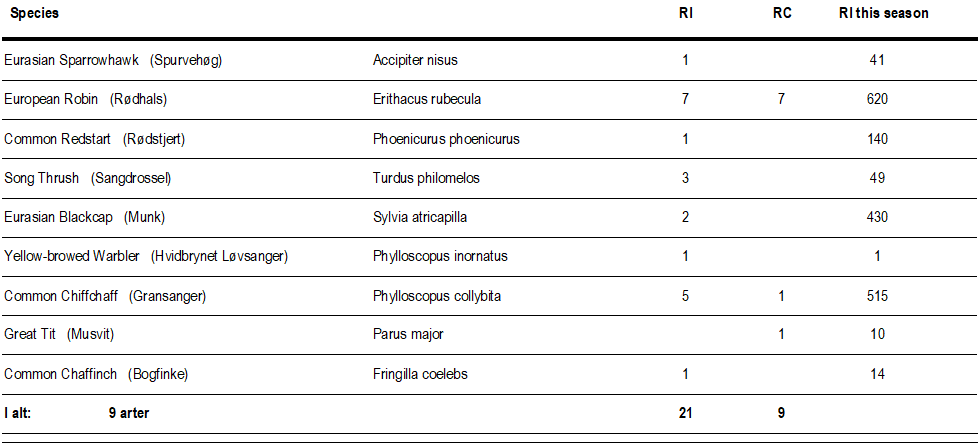
Oh, and as soon as we stepped out of the door, excited screaming started and everyone ran outside. A Yellow-browed Warbler (Phylloscopus inornatus, "plain leaf-searcher") was calling clearly and very near to the house! For many non-bird-people, our excitement is probably hard to understand, a very drab small bird makes a sound and we can't even see it. But in these circles, the Yellow-browed Warbler has an almost mystical status. It is one of the more common eastern rarities with several each year observed in Western Europe. Still, it comes from Siberia and normally would winter in South-East Asia. Also, it belongs to a group of usually very plain birds and is one of the most colorful of those. Naturally, we were even more eager to put up some nets now. But sadly, we did not - wait. As I was about to write these lines, I was rudely interrupted by excited calling, that they did indeed get the Yellow-browed Warbler!!!
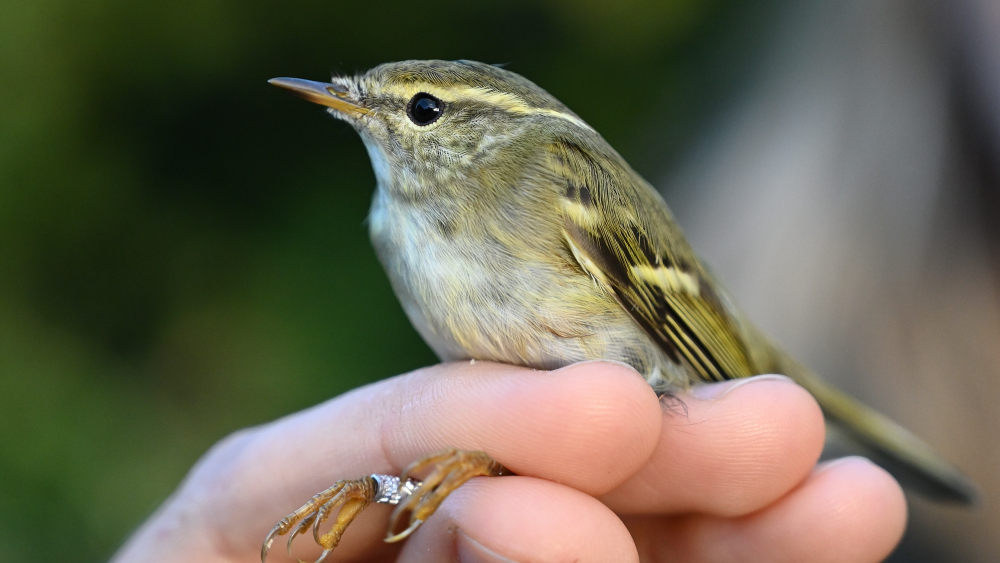
The Yellow-browed Warbler is observed in Gedser only every couple of years and caught even rarer. So we were incredibly lucky to be at the right time at the right place.
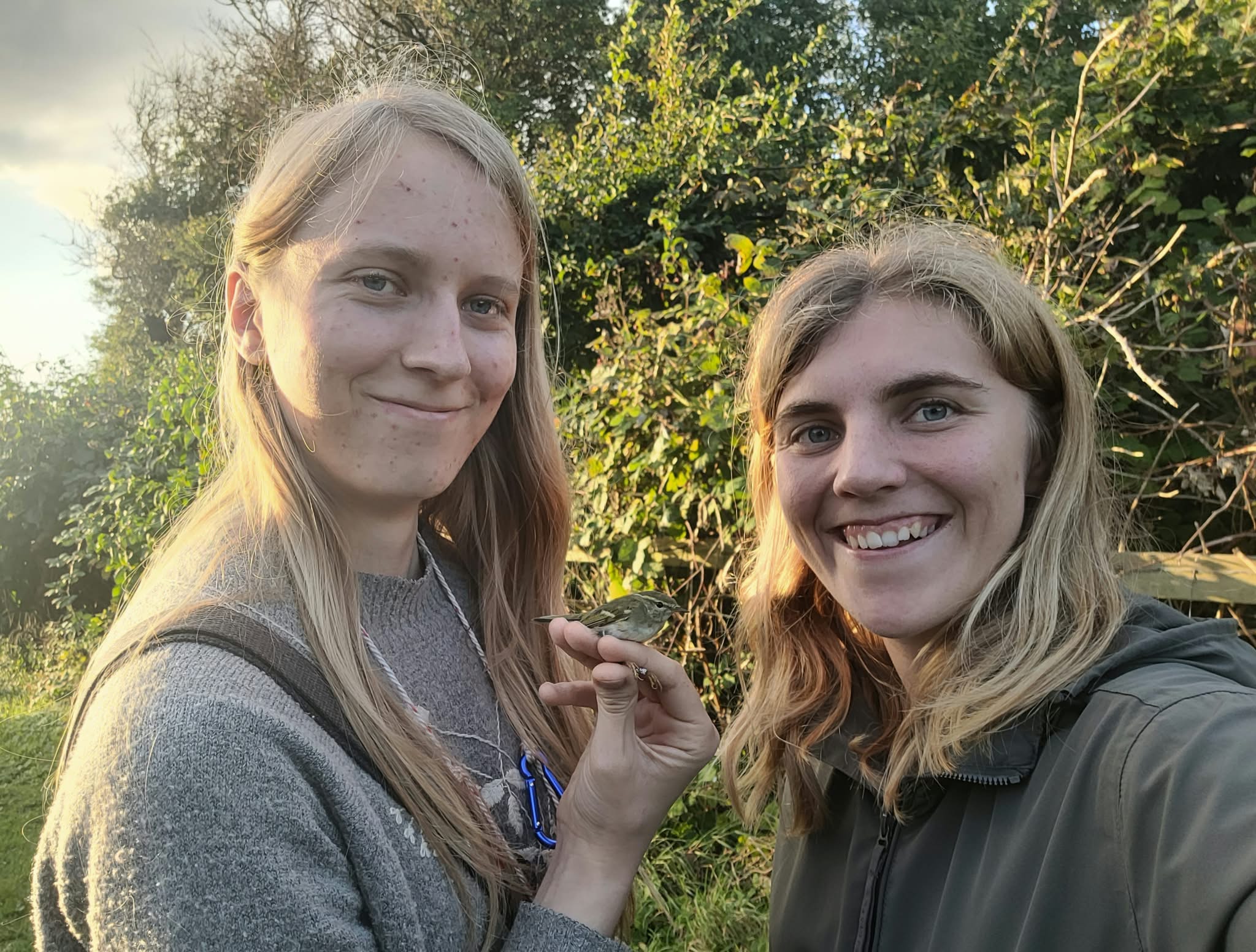
Two unbelievably happy finders
We still are all so hyped rigth now. That bird was a lifer for Hannah, Alba and me and a first in hand for both Freya and Alba. I was already settling with the thought of having heard it which would have been enough for me. So I still can't believe that we actually caught it. Apparently, there is an invasion of Yellow-browed Warblers in Finland right now, so we are hoping for more of these spectacular birds to come our way.
Other than that, I was preparing for showcasing the other birds that we caught today, some of them really nice in their own right. So I feel a bit sad now for not giving them the space they deserve. In the nets, we found a surprisingly good number of birds, given the time of day and the weather conditions. There were multiple Song Thrushes (Turdus philomelos, "song-loving thrush"), our usual mix of European Robins (Erithacus rubecula, "little red robin") and Common Chiffchaffs (Phylloscopus collybita, "money-changing leaf searcher") and a very nice female Common Chaffinch (Fringilla coelebs, "unmarried finch"). Hannah got to ring this bird which she really enjoyed.
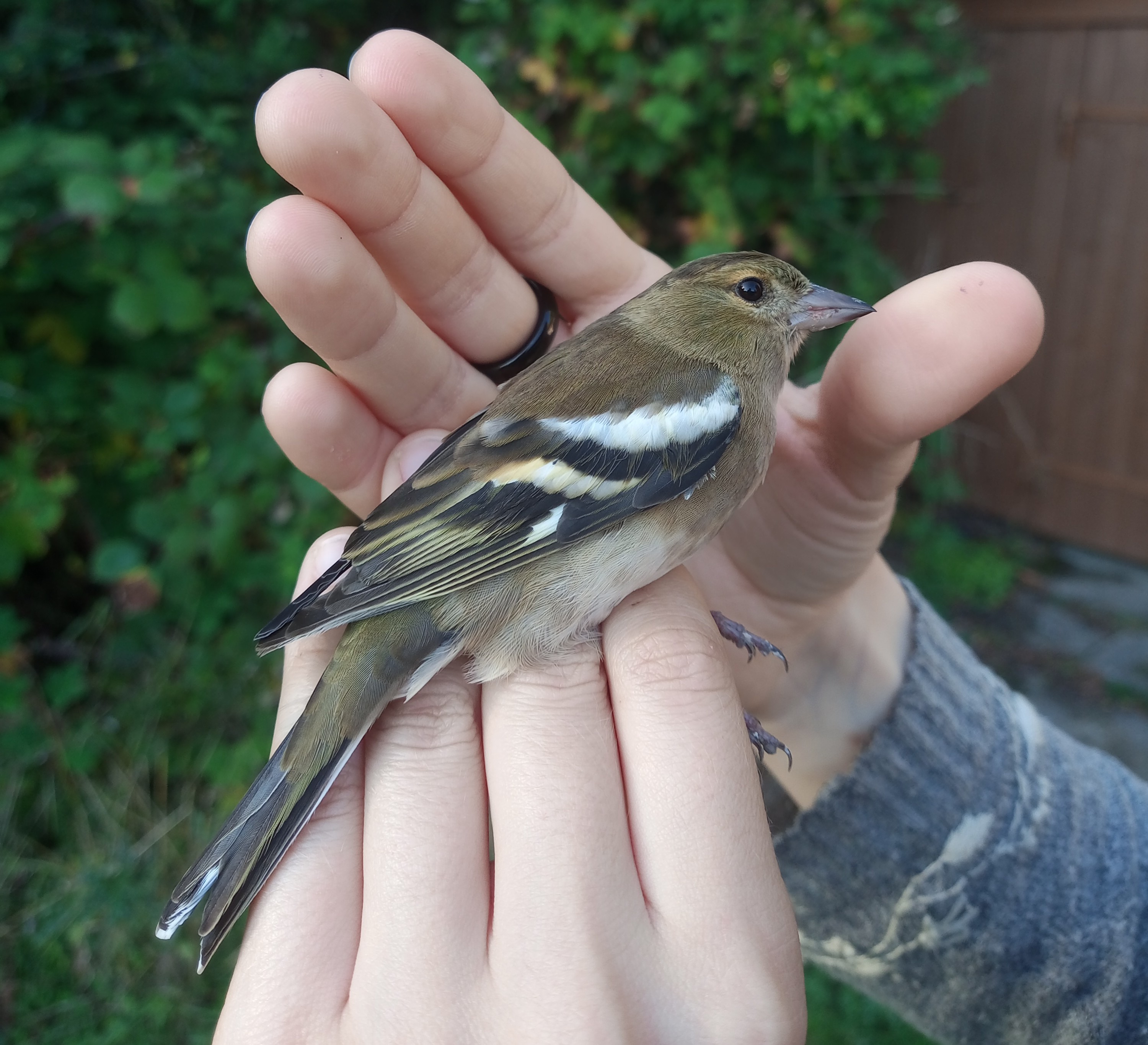
Adult female Common Chaffnch. The scientific name of these birds comes from their habit of gathering in sex-separated flocks in winter. Note the uniformly brown head and breast. Males would have a rose-coulored breast and a blue tinge on the top of the head.
Now everyone is looking forward to an exciting ringing session for the open house. The weather is looking perfect, so we are hopeful!
Trækket på Odden: Today we experienced a rainy, grey, misty day at the Gedser Odde. The sun showed a half-hearted attempt at a sunrise, but a small streak of pink only lasted briefly and that was it!
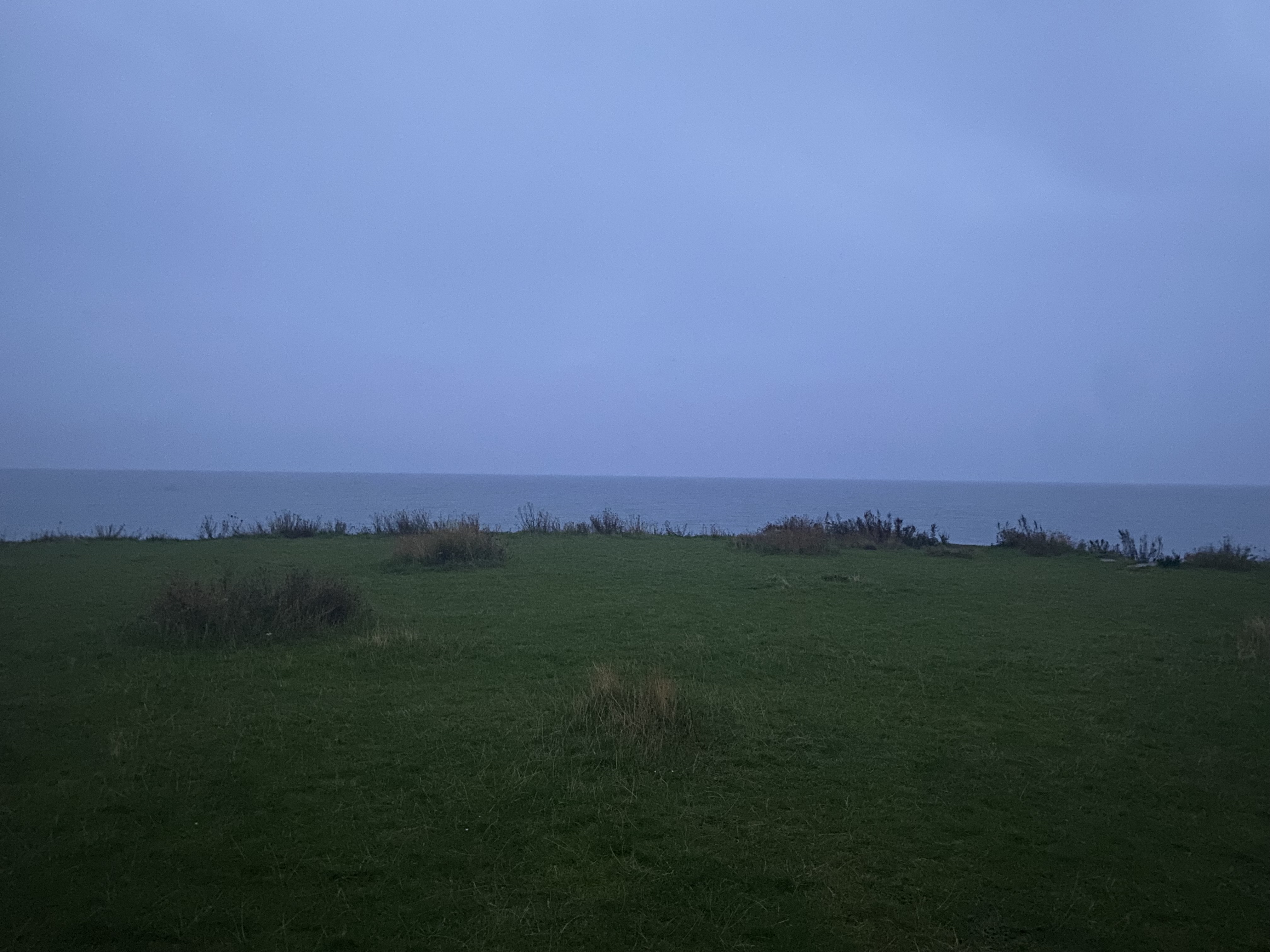 A sad attempt at the otherwise so beautiful sunrises here at the Gedser Odde!
We imagined the day would be slow, already planning to cut the count short to the minimum three hours necessary for a standard count over breakfast. We hurried out and set up camp under a roofed area. It quickly became apparent that we had been mistaken! There were indeed flocks out over the ocean within the mist. The first three hours were busy and thus we decided to continue – first one hour and the of course another.
The day brought a mixture of our usual dominating ducks: Common eiders (Somateria mollissima) and Eurasian wigeons (Mareca penelope). My highlights of the day was finding my first Arctic skua (Stercorarius parasiticus) on my own, a large flock of near 40 Greylag geese (Anser anser) flying right above us and many male Mallards (Anas platyrhynchos) out and about. Some Common pochards (Aythya ferina), Scaups (Aythya marila), Tufted ducks (Aythya fuligula) and Common goldeneyes (Bucephala clangula) added some interesting sights throughout the morning. The raptures were represented by Eurasian sparrowhawks (Accipiter nisus), female Hen harriers (Circus cyaneus), a Eurasian kestrel (Falco tinnunculus) and a merlin (Falco columbarius). Even a Harbour porpoise (Phocoena phocoena) brought some joy during a quiet period. So, even despite rainy conditions, migration continues and I’m glad we stayed out there!
Fugle registreret i standardtiden: 3.002. Arter: 28. Tællingen startet 06:45, sluttet klokken 11:45.
Se alle dagens observationer på Gedser Odde i DOFbasen - af Dansk Ornitologisk Forening.
På stationen: Hannah Schmidt, Alba M. Holmberg, Freya Mørup-Petersen, Ole Friis Larsen, Marek Ebert