-
FORSIDE

- Blog
Gedser Fuglestation Blog
Her på Gedser Fuglestations blog bringes korte nyheder i dagbogsformat om hændelser på fuglestationen.
Seabird diversity - not ready
Ringmærkingen: Xxxxxx
Trækket på Odden: Already on the way out to the tip could we see the fiery-red beginnings of a beautiful sunrise. After this spectacular appearance, the sun hid behind the clouds for most of the day. This light without full sun is pretty good for watching birds, the lack of sun made it quite cold though. After a quiet couple of days, the seabird migration was decent again today. Among the usual numbers of dabbling ducks and Common Eiders (Somateria mollissima, „very soft wool-body“), exceptionally high numbers of Velvet Scoters (Melanitta fusca, „dark black duck“) could be seen migrating south off Gedser Odde. In comparison to their common counterpart, they are noticeably bigger and have big white patches in their wings. Also, the highest numbers of Long-tailed Ducks (Clangula hyemalis, „winter clanger“) of the current season came by. These adorable little ducks should start arriving now in bigger numbers from their high arctic breeding grounds.
Starkly contrasting the comparatively small ducks, we spotted a Whooper Swan (Cygnus cygnus, „swan“). When it slowly flew past us, we could admire its clean white plumage but even after close listening, something was off: it was mute.
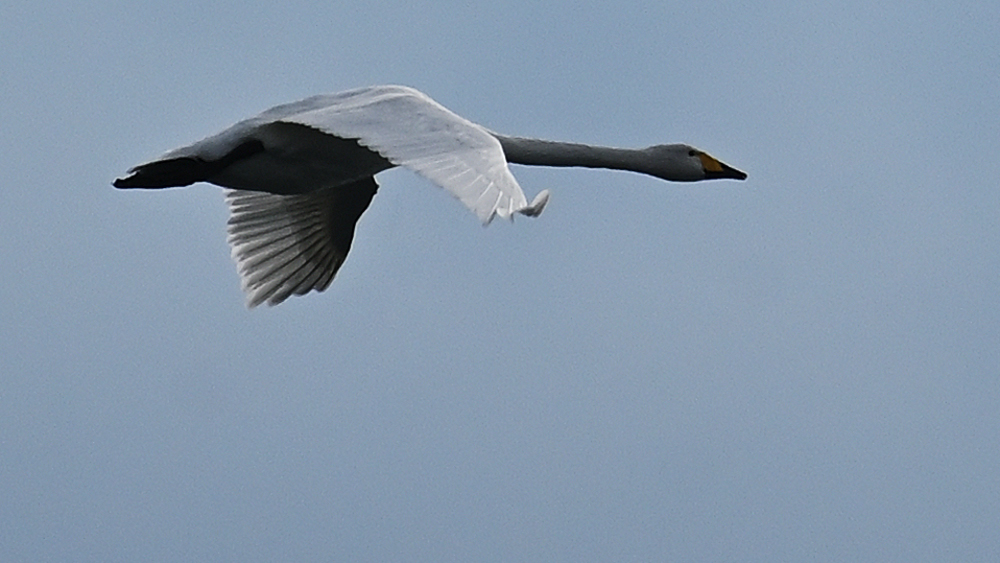
The Whooper Swan can be told from its more common relative the Mute Swan (Cygnus olor, „swan swan“) by the bill. Whoopers have a wedge-shaped bill with a yellow base while the Mute’s is orange and has a knob on top. Helpful are also their calls, as reflected in their English names: Whooper Swans call loudly and often while Mute Swans are, well, mute.
What we really needed for a good waterbird migration, was diverse divers (sorry, I had to). Our wishes were answered not with big diver-sity (sorry again) but instead with very good numbers. In total, 61 Red-throated Divers (Gavia stellata, „starry seagull“) were seen on their way south, making today their best day so far. Their bigger cousin, the Black-throated Diver (Gavia arctica, „arctic seagull“) also came by which allowed us to dive (last one, I promise) into the mine field that is diver indentification.
On land, very few birds were moving. A notable exception here was an adult male Hen Harrier (Circus cyaneus, „dark blue circling one“) that suddenly appeared and without hesitation made its way south.
Fugle registreret i standardtiden: 3.938. Arter: 52. Tællingen startet 06:43, sluttet klokken 11:43.
Se alle dagens observationer på Gedser Odde i DOFbasen.
På stationen: Alba M. Holmberg, Henrik Jørgensen, Ole Friis Larsen, Marek Ebert