-
FORSIDE

- Blog
Gedser Fuglestation Blog
Her på Gedser Fuglestations blog bringes korte nyheder i dagbogsformat om hændelser på fuglestationen.
Secrets of the mist
Ringmærkning:
Trækket på Odden: Sometimes, the time out at the tip seems to pass differently. There are days when time goes by extremely slowly and each minute almost feels like eternity. Then there are days when you start and in the blink of an eye, five hours have passed. Today was one of the latter. Through the mist and light spray, a constant stream of birds flew by. The most numerous species was unsurprisingly the Common Eider (Somateria mollissima, „very soft wool-body“), whose 1.186 individuals made up about a third of all birds registered.
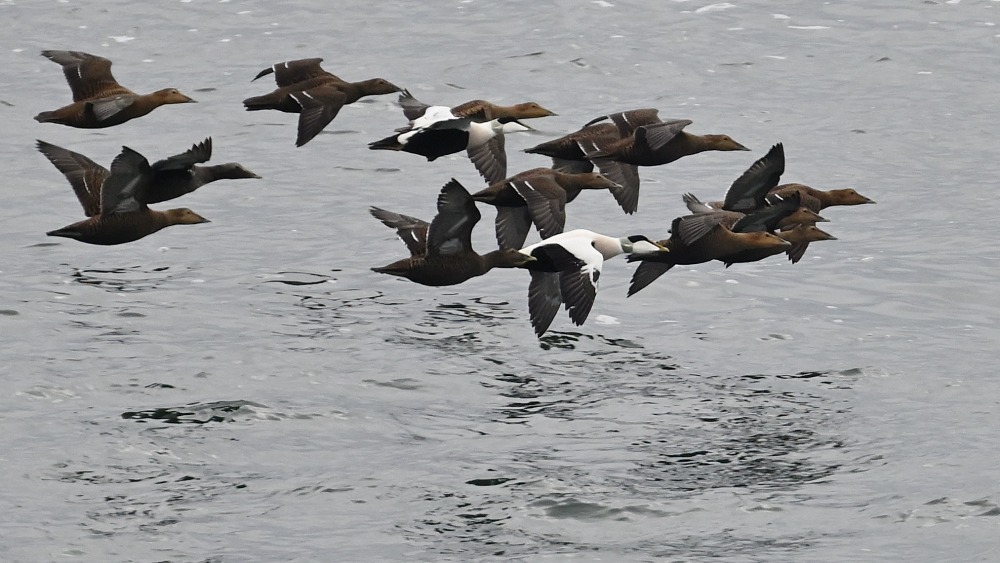
Eiders still dominate the migration counts. Interestingly, the gender ratio has not shifted noticeably since I last wrote about it. Most flocks consist of about one quarter to a third males, the rest „female types“ (females and young males). Picture: Ole Friis Larsen
But Eiders were not the only ducks on the move. Especially the Common Goldeneye (Bucephala clangula, „resounding bullhead“) also performed surprisingly well. Normally we see only single individuals but today brought us a flock of 11 and with 82 a very high total. These spectacularly patterned birds are some of my favourite ducks. Spectacular was also the sighting of huge white birds whose loud calls cut through the grey sky – Whooper Swans (Cygnus cygnus, „swan“)! When they circled a while right over our heads, we could truly admire them and listen to their mournful whooping.
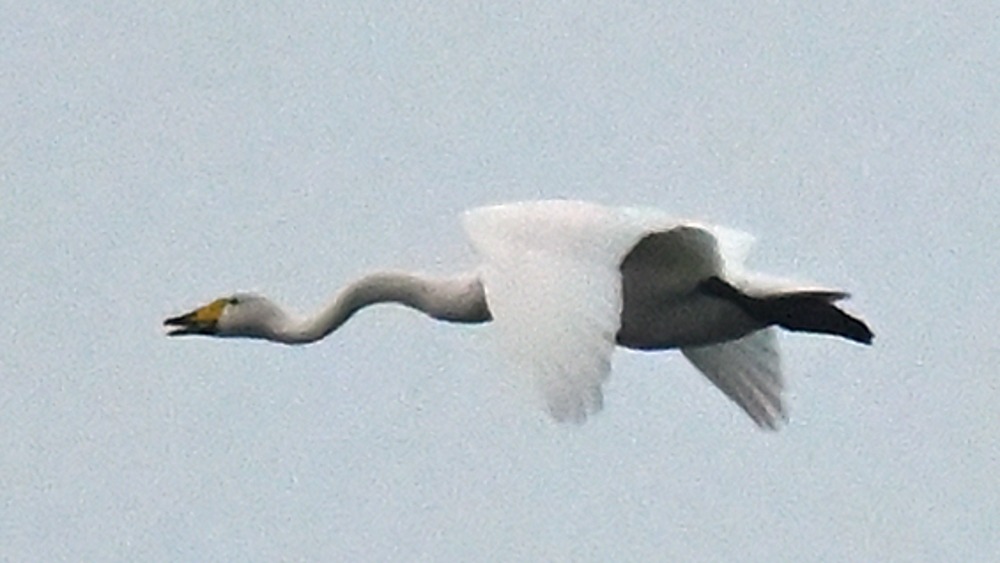
It is not understood why birds fly with their necks extended in such a strange way. The theories reach from temporary injuries or cramps over diseases to individual preferences. It can be seen on swans, geese, ducks and probably also other birds. The birds themselves are probably fine, they don’t seem to be encumbered by it. Picture: Ole Friis Larsen
But enough of „normal“ birds, let’s get to our special sightings. Over the whole count time, a constant flow of divers, especially Red-throated Divers (Gavia stellata, „starry seagull“), could be observed. On my first counts it was special to see one diver and now groups of two to four are normal. At one point, an enormous group of them came flying right over our heads, some even calling in their eery voices (one of my biggest wishes has come true). After the group had passed, we turned towards each other, smiling. A flock of 33 is absolutely not a usual sight down here!
While scoping for another diver, suddenly two small birds flew into my field of view. The diver was quickly forgotten, these birds had white wings! Just like that my first Snow Buntings (Plectrophenax nivalis, „snow-white imposter-spur“) of the season appeared on their way over the sea south. In a similar way, not long before the end, a huge silhouette appeared out of the mist. It had long wings, a short tail and a clearly white underside – a November Osprey (Pandion haliaetus, „pandion the sea-eagle“)! Silently and without any wingbeats it flew right over our heads and disappeared back into the fog as quickly as it appeared in the first place. What a sight!
Fugle registreret i standardtiden: 3.679. Arter: 54. Tællingen startet 06:47, sluttet klokken 11:47.
Se alle dagens observationer på Gedser Odde i DOFbasen.
På stationen: Alba M. Holmberg, Henrik Jørgensen, Ole Friis Larsen, Marek Ebert