-
FORSIDE

- Blog
Gedser Fuglestation Blog
Her på Gedser Fuglestations blog bringes korte nyheder i dagbogsformat om hændelser på fuglestationen.
Loonatics
Ringmærking:
Trækket på Odden: No, I’m not yet done with bad puns based around our most favourite diving birds. Prepare for another month or so of miserable jokes and far-fetched word plays!
Indeed, Divers, or more internationally Loons, played a big part in today’s migration. A total of 122 Divers was seen on migration today, most of them were Red-throated Divers (Gavia stellata, „starry seagull“). Though one of the archetypal marine birds during the winter and rarely seen inland, Divers breed exclusively near freshwater, especially along big lakes. The breeding range of the Red-throated Diver includes Scandinavia, the northern parts of Russia, Alaska and Canada as well as Greenland. The Black-throated Diver (Gavia arctica, „arctic seagull“) is restricted to the Palearctic but also breeds in the northernmost regions of Eurasia. The name „diver“ has its origins in the British Isles and refers to these birds’ hunting style. „Loon“ is used in the US but has reached global importance through various taxonomies, lists and portals. It comes not from the birds’ vocalisations but instead from the Nordic (including Danish!) names for these birds: „lom“, referring to Loons (yes, I am switching to support the Danish language) being clumsy on land.
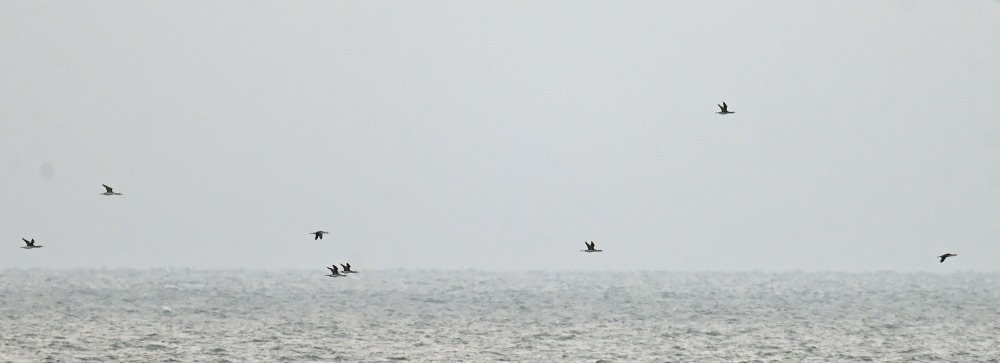
Though clumsy on land, Loons are excellent flyers. Some tagged individuals have been observed flying over 1.000 km in a single day! Over the last weeks, we have successively seen flock sizes changing from single birds towards bigger groups. This flock of eight Red-throated Loons wasn’t even the biggest group today (but the only one that allowed for pictures). Picture: Ole Friis Larsen
Today’s title does not only refer to Loons, however. There were true lunatics out offshore today. Sailing the stiff winds just to suddenly fall down and crash into the surface at break-neck speeds, several birds came by today. Can you guess? Of course I am talking about the Northern Gannet (Morus bassanus, „idiot from bass rock“). I might sound repetitive, but recent records have been shattered again by the 14 migrating Gannets today. At one point, seven individuals could be seen quite close together, probably eyeing out a school of fish. While some of these birds clearly migrated, flying quickly and without detours to the south, others enjoyed the scenery and culinary qualities of the Baltic Sea. Still, even these birds eventually made their way south, joining the others.

A fittingly dramatic picture for one of the most insane birds of the North Atlantic (and the biggest). To identify a Gannet you don’t need more than their silhouette. The combination of extremely long and slender wings, a long tail and the torpedo-shaped body is usually enough to exclude all other possibilities. Picture: Ole Friis Larsen
Fugle registreret i standardtiden: 1.294. Arter: 40. Tællingen startet 07:15, sluttet klokken 12:15.
Se alle dagens observationer på Gedser Odde i DOFbasen.
På stationen: Alba Maria Holmberg, Henrik Jørgensen, Ole Friis Larsen, Marek Ebert