-
FORSIDE

- Blog
Gedser Fuglestation Blog
Her på Gedser Fuglestations blog bringes korte nyheder i dagbogsformat om hændelser på fuglestationen.
A summer day at the beach
Ringmærkning:
Igen var vinden på det bedste net, så jeg satte lyd på det eneste hvor der var læ.
Det var ikke spild selv om der kun blev ringmærket 7 fugle, men uden lyd havde jeg ingen fanget.
Da der var tid mellem runderne fik jeg taget de 2 hejsenet ned for i år, så nu mangler der kun 3 net(og selvfølgelig også de 5 som jeg vil fortsætte med).
I morgen skulle vinden falde og så kan de bedste net bruges igen.
Dagens ringmærkning/Todays ringing:
Gråsisken/Redpoll 7
Trækket på Odden: On this warm, sunny summer (?) day, Alba and I were joined by our guests from Rostock. They left after a bit while Alba and me of course had to stay. I would love to write that we were rewarded with a special bird but sadly, we were not. Most of today’s action happened within the first hours anyways. Actually, we were quite busy, as a lot of finches decided to migrate today. They usually come in big flocks, so exact counts are slightly harder, but numbers rise much quicker. Within the first half hour, Alba announced that we had already over 500 birds, a good result. Surprisingly, it was not the expected Redpolls (Acanthis flammea, „flame-coloured redpoll“), that made up the bulk of the birds. The big numbers today were Bramblings (Fringilla montifringilla, „mountain finch finch“), making us feel more like October. They came by in huge, single species flocks, something I have not seen before. Normally, Bramblings show up in low numbers within flocks of Common Chaffinches (Fringilla coelebs, „unmarried finch“) but today it was the other way around! Interesting were also the vocalisations: Other than the usual call, different sounds could be heard that reminded me almost of Eurasian Starlings (Sturnus vulgaris, „common starling“), though none were in sight.
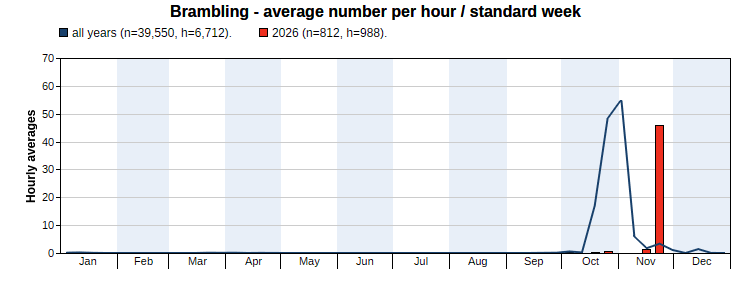
It looks like the Brambling joins the long list of birds that migrate strangely this autumn. Normally, you would expect to see many of these finches during late October while we had almost none this year. It looks like they might have waited further north and all came by today. High temperatures and good food supplies are one of the main theories for why many birds migrate so late or not at all this year. But still, they remain only theories. Blue line: average 2013-2026, red bars: 2026. Source: Trektellen
Another highlight of the morning was a Greater White-fronted Goose (Anser albifrons, white-fronted goose“). This might not seem exciting, but this one had a neck ring! Geese often get colourful neck rings for easier reads but it is quite rare to spot one of those. In fact, Alba had never seen one before while I had only once or twice. Sadly, we were not able to read the code, but just from the colour alone, one project can be identified. This goose was most likely ringed in the Netherlands, but maybe also northern Germany or the Taymyr Peninsula in Russia!
Towards the end of the count, Alba said that she felt like we might see an Albatross today, which would be totally awesome. In fact, just a few minutes later, I spotted a bird that had to be an Albatross. There was no other possibility. Then it turned and it was clearly a young Northern Gannet (Morus bassanus, „idiot from bass rock“), so no Albatrosses so far. We are still working on it. But young Gannets are almost as rare here. Most Gannets we see are adult with a few 3k birds spotted sometimes. From the high amount of brown on the back we could conclude that our bird today hatched last year, so it is a 2k bird. This makes it quite special, almost as special as an Albatross.
Fugle registreret i standardtiden: 2.086. Arter: 38. Tællingen startet 07:24, sluttet klokken 12:24.
Se alle dagens observationer på Gedser Odde i DOFbasen.
På stationen: Alba Maria Holmberg, Henrik Jørgensen, Marek Ebert and our 3 german guests