-
FORSIDE

- Blog
Gedser Fuglestation Blog
Her på Gedser Fuglestations blog bringes korte nyheder i dagbogsformat om hændelser på fuglestationen.
Snow and Buntings
Ringmærkning:
Trækket på Odden: One could describe this morning as the first true winter morning. That is for one based on the freezing temperatures as well as actual light snow fall. And otherwise, the birds were very wintery. This does not necessarily mean less birds, in fact, we had quite a good number. It just means less diversity and big migration of selected species. Today, these were the typically late migrating loons. Over the course of the morning, we counted 301 Red-throated Loons (Gavia stellata, „starry seagull“), a very respectable sum. These birds can be found in two very different places: either migrating very low over the water or very high over our heads, taking a short cut over land. Keeping an eye on both of these possibilities can be quite a challenge, but luckily, the Loons help us. They call. These eerie, otherworldly sounds automatically let your eyes scan the sky and find a group of up to 20 Loons (or Divers, for everyone who hasn’t read the blog from 17.11.). To be fair, the name „Red-throated“ is a bit misleading, as the vast majority of all the Loons we see migrate past have moulted out of their Red-throated breeding plumage and are rather plain grayish-white.
Another species that came surprisingly numerous have a much more fitting, descriptive name. These, the smallest of all the gulls, are of course the Little Gulls (Hydrocoloeus minutus, „little water-jackdaw“). Little Gulls are also quite late migrants and so it comes to no surprise that they only started appearing in bigger numbers after it has become properly cold. They sadly often fly far out, giving us only limited possibilities to admire them. Much more cooperative in that respect was a group of swans, consiting of mostly Tundra Swans (Cygnus columbianus, „swan from the Columbia River“) and one Mute Swan (Cygnus olor, „swan swan“). They flew right above our head, allowing for great views and even very nice pictures.
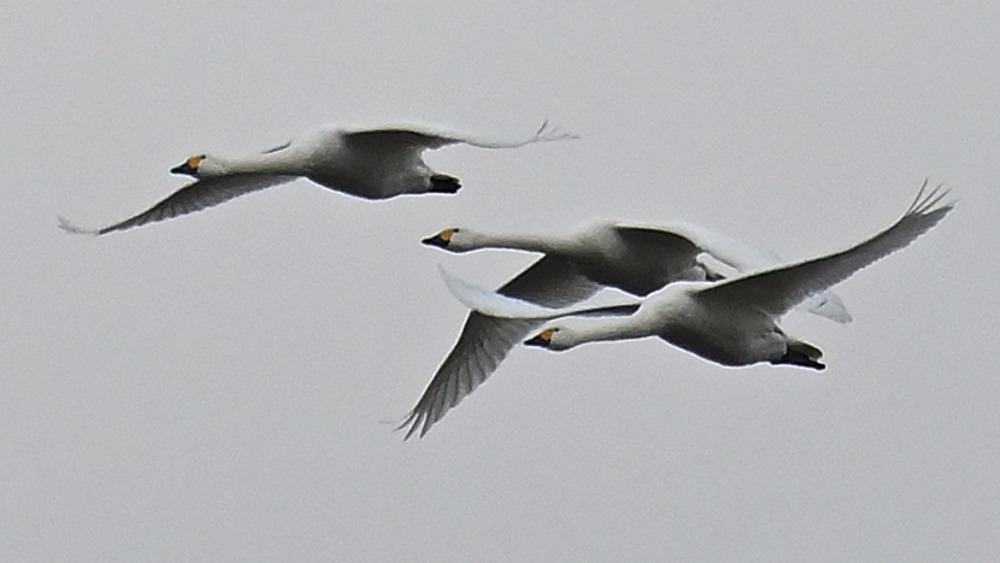
These Tundra Swans have almost finished their migration now. They came from the Russian tundra, at least 2.000 km from here and will winter along the shores of the Baltic and North Seas. In comparison to other swans, note the small size and especially the short neck, which can be seen from far away. On close range, the low amount of yellow on the bill helps to distinguish from the Whooper Swans (Cygnus cygnus, „swan“).
The gathering of winter birds was completed by a group of small birds migrating in from over the sea. These Snow Buntings (Plectophenax nivalis, „snow-white impostor-spur“) have a similar migration to the swans and will also winter not far from here. Already one of these songbirds can make everyone very happy, but a group of eleven of them is even better! I will finish off this blog with a bird that is not bothered by any kind of weather and that probably also does not understand the concept of „migrating“.
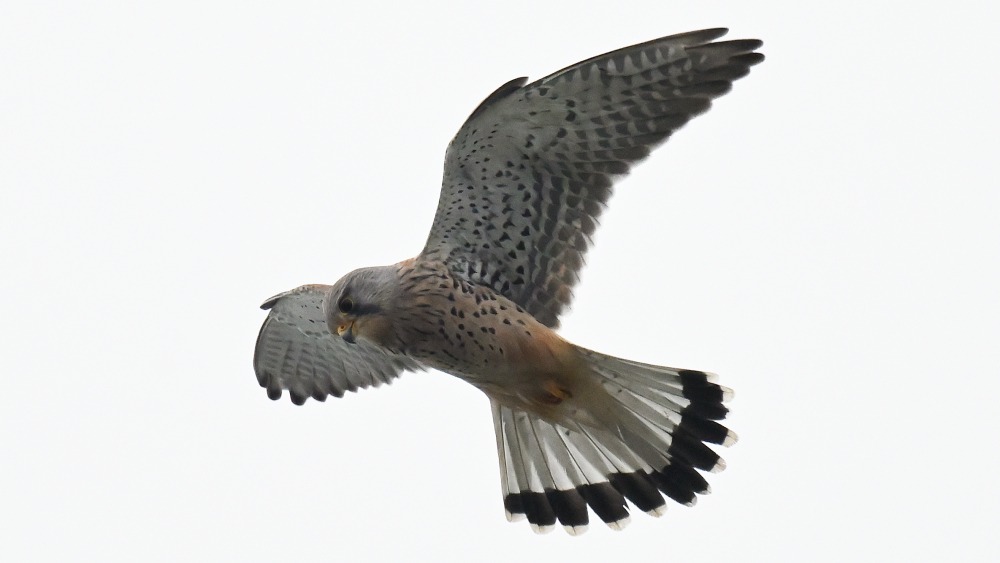
This male Common Kestrel (Falco tinnunculus, „shrieking falcon“) is our local bird. He will hunt in every weather and is seen almost every day. Kestrels have a remarkable adaptation (well, actually, very many) for hunting mice: they can hover in one place, giving them very good vision of the ground below. They accomplish this by flying against the wind, fanning out the tail and flapping the wings quickly – like this bird.
Fugle registreret i standardtiden: 1.855. Arter: 27. Tællingen startet 07:30, sluttet klokken 12:30.
Se alle dagens observationer på Gedser Odde i DOFbasen.
På stationen: Alba Maria Holmberg, Henrik Jørgensen, Marek Ebert, Ole Friis Larsen, Oliver Bøgh Jensen