-
FORSIDE

- Blog
Gedser Fuglestation Blog
Her på Gedser Fuglestations blog bringes korte nyheder i dagbogsformat om hændelser på fuglestationen.
Gulls and other raptors
Ringmærkning:
Vinden var tilbage, men dog ikke så meget at nettene ikke kunne sættes op.
Første runde blev tom, og der var kun de lokale solsorte bag huset som var aktive.
Heldigvis virkede det lyd jeg havde sat ud til både grønsisken og gråsisken. Det var dog meget få som fløj over haven i dag.
En del silkehaler var nede og spise på vores rønnebær, så de var ikke friske på at smage de æbler jeg havde lagt ud til dem.
Dog blev en sjagger fanget, så jeg måtte op og vække Alba som sov lidt længere i dag da hun havde forsøgt at fange ugler til næsten klokken 3 i nat. Det blev en ny ringmærkningsart for hende så hun var glad.
I morgen loves der over 10 m/s vind og temperatur på under nul, så der vil nok ikke kunne ringmærkes der.
Dagens ringmærkning og kontroller/Todays ringing and recaptures:
Solsort/Blackbird 1(1)
Sjagger/Fieldfare 1
Blåmejse/Blue tit (1)
Grønsisken/Siskin 12
Gråsisken/Redpoll 3
Total 17(2)
Trækket på Odden: With the sun shining, this very cold morning promised to get quite good for raptor migration. And indeed, we could see the last remnants of autumn migration pass through. A Eurasian Sparrowhawk (Accipiter nisus, „down-swooping hawk“) made a quick appearance before hurrying south. The same goes for the four Red Kites (Milvus milvus, „kite“) that slowly but steadily flow straight over our heads on their way to warmer places. The last so-called „raptor“ we could see migrating was a young White-tailed Eagle (Haliaetus albicilla, „white-tailed sea-eagle“) on its way to the east. Though not truly migrating, White-tailed Eagles can fly huge distances during their teenage years. Ringed individuals from Germany are regularly recorded as far north as northern Norway when they seek food and a territory to settle down. It seemed as though this bird also just wanted to take a look at northern Germany or Poland, judging from its direction.
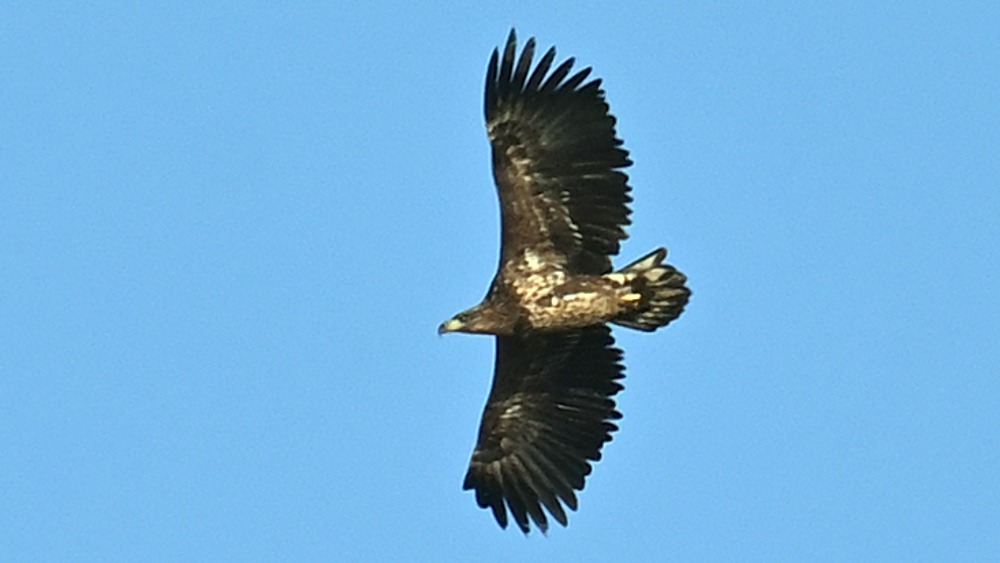
Ageing slow-maturing birds can be quite a challenge, as plumages can mix and some individuals may take a year longer than others. I this case though, it is relatively straightforward. This bird’s bill is already not as dark as you would expect from this year’s birds. Also, the very light feathers on the belly are a good indicator for it being in its second plumage, meaning a 2k bird.
Sadly for many a lot of small animals, Accipitriformes are not the only birds of prey that made a big appearance today. Not only fish need to be careful – these birds feed on anything they can catch: gulls. Normally, we see a few gulls every day, foraging or resting on the water. For some reason, there were more of them flying around today. This could be because of the stronger wind, creating waves that beach various sea creatures. One particular gull got an especially big catch and showed it off (or unsuccesfully tried to swallow it) for several minutes. To me as a non-ichthyologist, it looks like a Common Dab (Limanda limanda, „the dirty one“), but definitely some kind of flatfish. After taking a close look at the pictures, it seems as though this bird is colour-ringed and is the bird we have been seeing for at least two months now. It’s nice to see it doing well for itself.
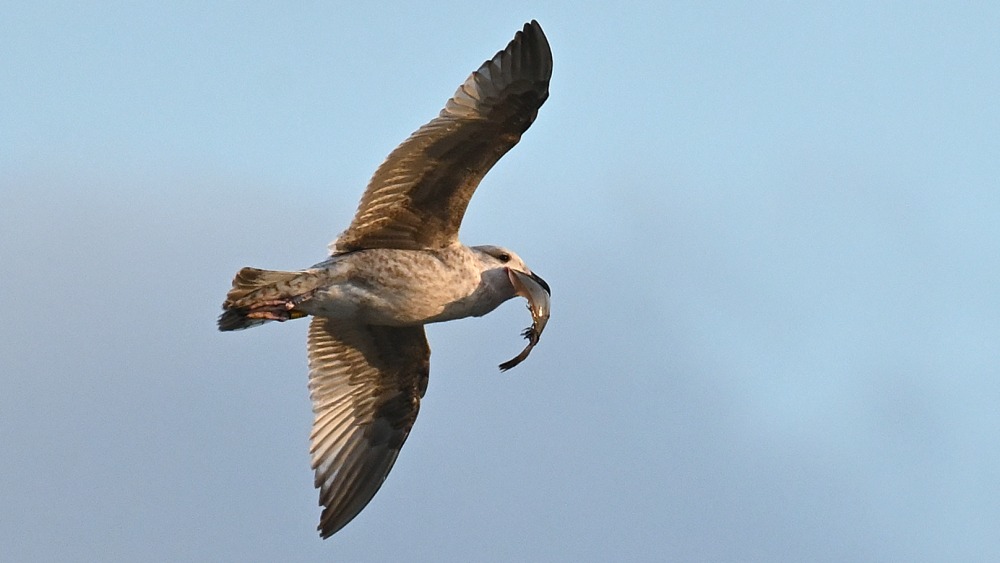
Gulls. Most birder’s biggest nightmare and greatest joy. From previous observations we are quite sure that this bird is a young European Herring Gull (Larus argentatus, „silver-decorated gull“). Its general brown colour is also a good indicator for this, but not a sure giveaway. Young Herring gulls often have quite dark heads and heavy bills (unfortunately partially obscured by a big fish), contrasting to Caspian Gulls’ (Larus cachinnans, „laughing gull“) often white heads and slender bills. But there is a lot of variation and overlap already, only reinforced by frequent hybridisation. So a lot of birds are best left unidentified.
Much more easy to recognise are Black-headed Gulls (Chroicocephalus ridibundus, „laughing painted-head“), just because they are smaller. These birds are surprisingly migratory, with Denmark’s birds leaving in winter and more northern gulls replacing them. Today we counted a good migration of these small, cute gulls with over 100 flying by. They too feed on anything they can catch, but as they are smaller, this often includes invertebrates.
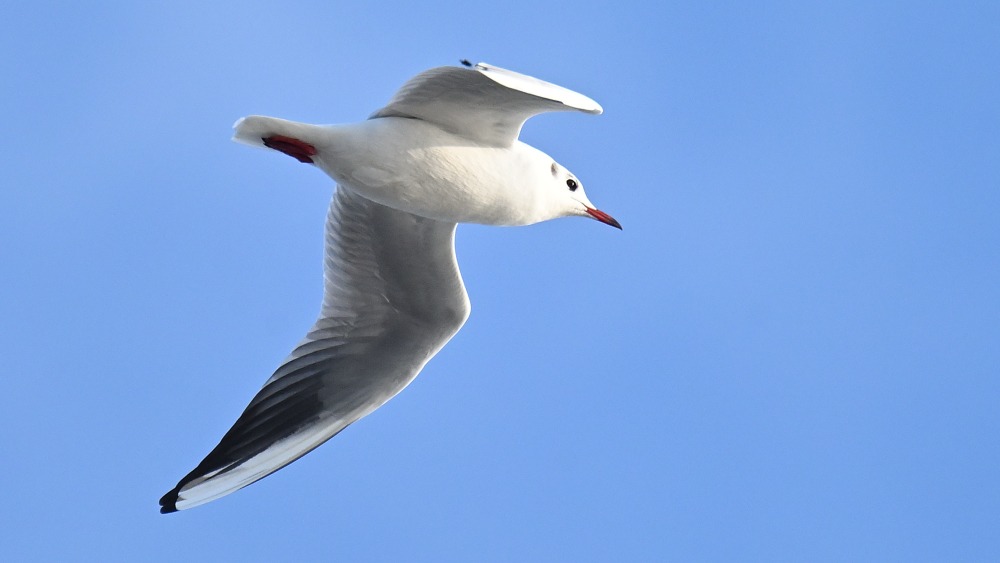
Most of the time, their small size should be enough to distiguish Black-headed Gulls from everything else. But sometimes, when this is hard to judge, a quick look at the wings should help. Black-headed Gulls (like all Chroicocephalus gulls) have a bright white triangle on the leading edge of the wing, formed by the first primaries. From underneath, the wingtip is also very dark. This can be used to distinguish them from their closest relatives.
(I have to mention it. From a phylogenetic standpoint, all birds should be considered as „raptors“, not just the big scary-looking ones.)
Fugle registreret i standardtiden: 1.506. Arter: 26. Tællingen startet 07:35, sluttet klokken 12:35.
Se alle dagens observationer på Gedser Odde i DOFbasen
På stationen: Alba M. Holmberg, Henrik Jørgensen, Ole Friis Larsen, Marek Ebert