-
FORSIDE

- Blog
Gedser Fuglestation Blog
Her på Gedser Fuglestations blog bringes korte nyheder i dagbogsformat om hændelser på fuglestationen.
Record for Wryneck
Ringmærkningen: This morning started out rather slow, and it did not get much better throughout the day. With only 13 new birds but 28 recaptures, this suggests that most of the birds currently in the garden have been stationary here during the last few days, with very few new arrivals to spice things up (at least of the species that regularly fly into our nets). Among the recaptures were a few species that I have not seen in the hand many times, such as the Redwing (Vindrossel), and the Black redstart (Husrødstjert) from yesterday, which were nice to see. We also caught a female Blackcap (Munk), which had been ringed in Gedser in the summer of last year, as well as two blue tits, one new and one recapture.
As we neared the last rounds, we were beginning to worry that we would not have much more interesting to write about in the blog (compared to the last, rather eventful, days), but the birds must have sensed our plight, as on the second-to-last round, Anne found a Wryneck (Vendehals) in one of her nets. Since Anne and Théo both had already ringed that species, I got the pleasure of putting a ring on my first one. As soon as I took it out of the bag, it began to wring its head around from side to side, imitating a snake in a futile attempt to scare me off. Instead, all it managed to do was impress the onlookers who had arrived soon after we invited them to come see it, some of whom had never seen a Wryneck before.
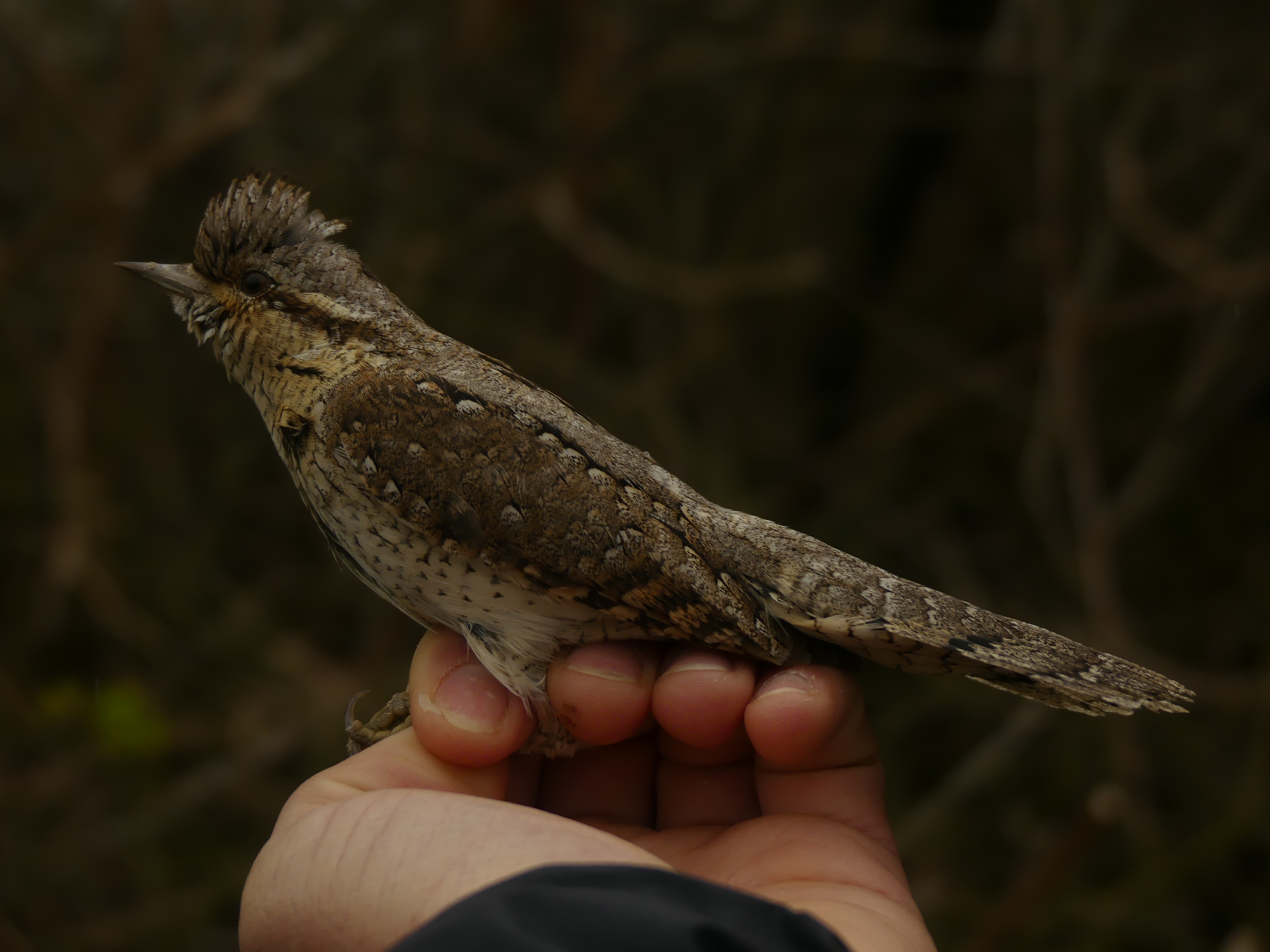
Wryneck (Vendehals), the bird that saved the day ! Foto : Théophile Fontaine
After closing and typing in the ringing-data for today, we looked up previous instances of Wrynecks being caught at Gedser Bird Station in spring, and found that this one beat the previous record for earliest catch by four days (the previous record being the 18. of April). So, all in all, it turned out to be an eventful morning after all.
After ringing and typing data, Théo started looking through old nets in order to find candidates to be put up around the pond just outside the Station garden, and I helped with fixing some of the holes in one of them, which was great practice, since I don't have that much experience in this vital part of taking care of ringing equipment. Then, we put up said nets, and now we hope to use them to maybe catch a wagtail or two in the coming days. We will be sure to write on the blog if we suceed!
Below is an overview of the birds caught today: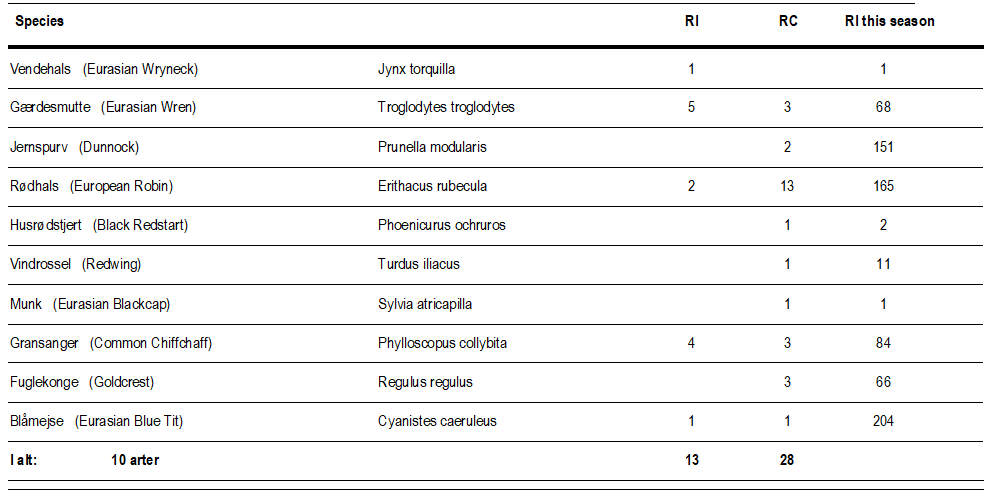
Trækket på Odden: We went off to the tip in a cloudy weather, with a few raindrops which would soon intensify, forcing us to seek shelter under the building. It rained for a while, and unfortunately from this point of view we barely saw any migrating birds, except for the Sandwich Terns (Splitterne) coming in big number over the water, and for the Eiders (Ederfugl) which seemed to go the wrong way for most of them.
When the rain stopped, we decided to change location so we could have a better overview of the migration close to the shore. The location was not the only reason why we saw so few birds, and the numbers stayed low all morning long. We started the day by betting how many birds we would see, and how many of them would be Eiders. With ours bets of 120 Eiders and 750 birds in total, we underestimated a bit the Eider migration, and clearly overestimated the overall migration…
All morning long, we could see the wagtails (Hvid vipstjert) partying in the field next to us, in a group of up to 15 individuals. Suddenly, their calls got more intense. When we turned our head to see what was going on, we first saw a Sparrowhawk (Spurvehøg), soon followed by some wagtails bullying it. This unusual sighting let us laughing at the poor Sparrowhawk’s face, which took the decision to carefully avoid the field on its way back inland.
As the ringing was also very quiet, Theophile joined us at the tip for a small amount of time. He spotted a Common Sandpiper (Mudderklire), so we took some time to look into the clues of the different sandpipers and other relatives. The Danish names are pretty confusing for this group of species, but I am happy to learn new Danish names every day, and to actually remember them ! Even though I am still unsure of some pronunciations…
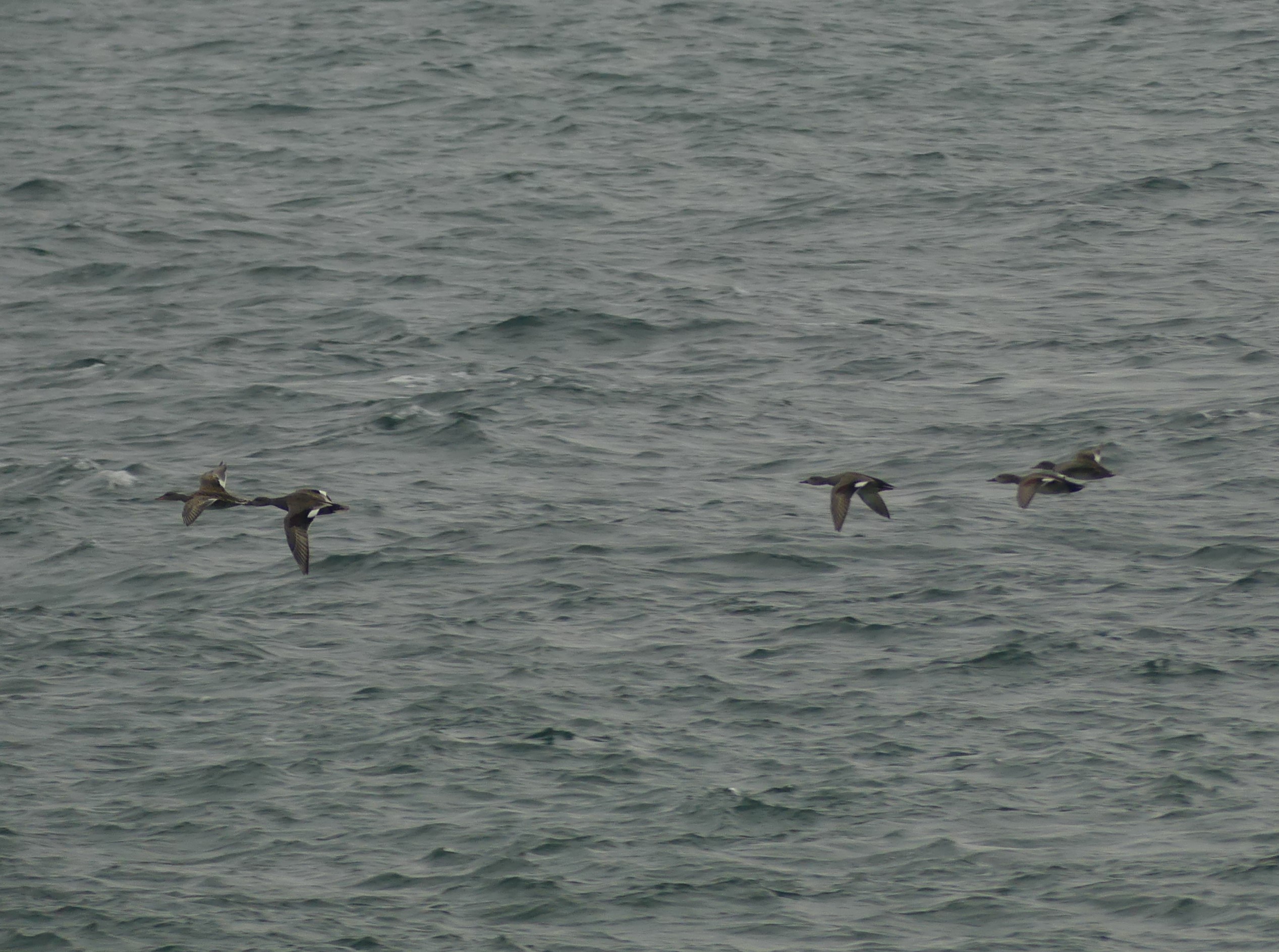
5 Gadwalls (Knarand) came just after the Common sandpiper (Mudderklire) Foto : Théophile Fontaine
Less than an hour before the end of the standard time, we got a call from Theophile (who was back in the garden). We obviously had to have a break on the migration count and rush back to the station to get to see the Wryneck !! When we came back to the tip, it was raining again… We stayed a little longer to make up for the time we spent on the Wryneck observation, but sadly the last 15 minutes didn’t help us to reach our 750 birds goal...
Despite the low numbers, the rain and the cold, we stay in good spirits and keep on going out there with an open mind. Hopefully tomorrow will be better !
Se alle dagens observationer ved Gedser Odde i DOFbasen.
Folk på stationen: Cyann Ménard, Mathilde Sif Eiby, Sjoerd van Baal, Théophile Fontaine, Alba Maria Holmberg, Anne Ramskov Hermanns