-
FORSIDE

- Blog
Gedser Fuglestation Blog
Her på Gedser Fuglestations blog bringes korte nyheder i dagbogsformat om hændelser på fuglestationen.
Se indlæg fra måned: jan. (2)feb. (26)mar. (31)apr. (30)maj (31)juni (20)juli (27)aug. (31)sept. (14)
Rekordstort træk af Hvepsevåger
Ringmærkningen: Xxxxx
Trækket på Odden: Meteorologerne havde lovet os masser af solskin fra solopgangen, men sådan gik det ikke. De første tre af dagens fem standardtimer måtte vi finde os i et mere efterårsagtigt overskyet vejr, før det klarede op, og vi blev varmet op af noget solskin. Til gengæld blev det en fin dag med tre fra fuglestationen, to af de faste lokale, nemlig Orla Jakobsen og Flemming Pagh Jensen. Desuden fik vi spontant selskab af to fuglefolk fra autocamperne på parkeringspladsen. Først kom nederlandske Henny Woons og spurgte, om hun måtte gøre os selskab, lidt senere kom Hank Verstralen fra Belgien med sit teleskop og sluttede sig til os.
Det er altid godt med flere øjne, men det var ikke kun derfor, at vi fik sat en ny rekord for træk af Hvepsevåger (Pernis apivorus) ved Gedser Odde med 113 i standardtiden. Fuglene var der selvfølgelig, og det var noget af et arbejde at finde og bestemme prikkerne, for rovfugletrækket foregik meget højt. Det næstbedste dagstal er nu 108, som blev talt 2. september 2019. Trækket af Hvepsevåger har i det hele taget været usædvanligt fint i dette efterår med 401 indtil nu. Det er allerede det suverænt bedste i de år, vi har arbejdet med standardtællinger, langt over det nu næstbedste samlede efterårstal i standardtiden på 230 i 2021. Vi kunne både bestemme nogle til adulte/voksne fugle og til unger fra i år, men langt fra alle på grund af højde og afstand.
Det hører med til billedet, af trækket af Hvepsevåger aldrig har været stort om efteråret ved Gedser Odde. De fleste trækker ud mod syd ved Saksfjed/Hyllekrog på Lolland.
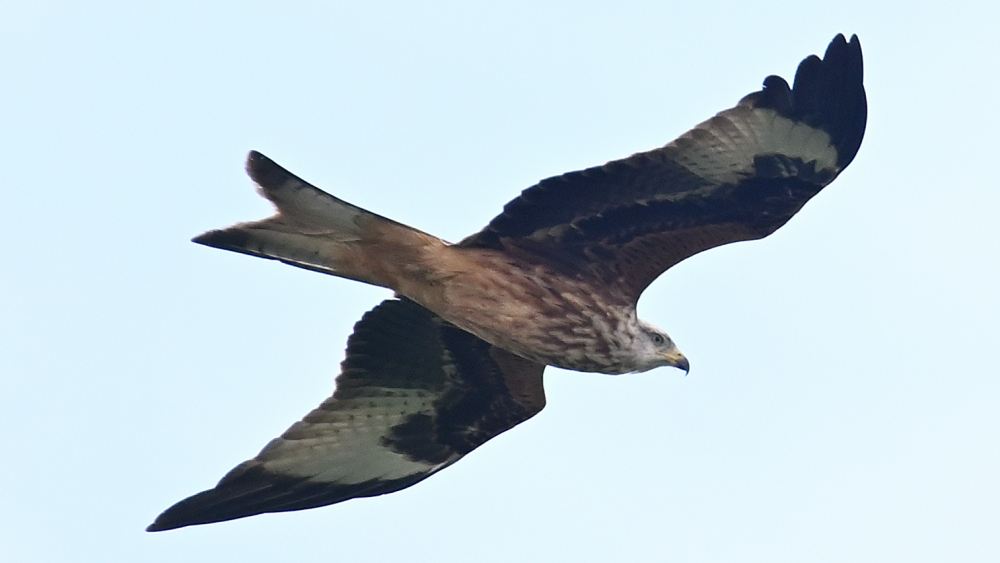 Rød Glente (Milvus milvus) i dagens træk. De hvide stænk på undersiden viser, at det er en ung fugl fra i år. Foto: Ole Friis Larsen/GFU
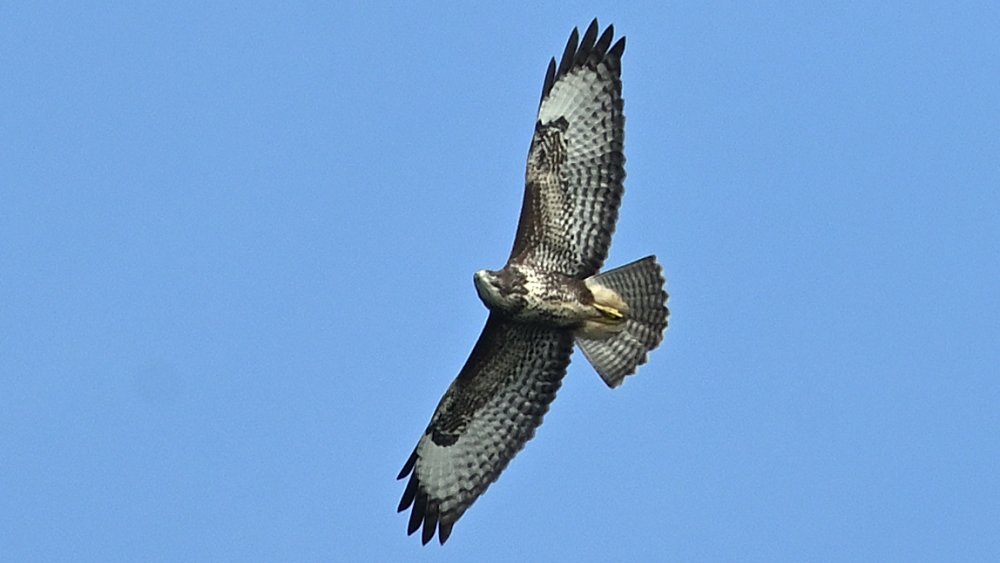 Musvåge (Buteo buteo) i dagens træk. De unge fra i år er begyndt at dukke op, som det fremgår af denne fugl, der mangler de adulte/voksnes kraftige mørke bånd yderst på halen. Foto: Ole Friis Larsen/GFU
Mens vi koncentrerede os om trækket på havruterne og rovfuglene, tog Marek sig af småfuglene, som var domineret af næsten tusind Landsvaler (Hirundo rustica), og nogle af de rovfugle, der dukkede op højt over svalerne. Det er en luksus at have en mand med speciale i småfugle med ude fra fuglestationen, så vi får en fin dækning af hele trækket lige for tiden.
På ruterne ud af Østersøen var trækket mere beskedent, men bød dog på flere flokke af Sortænder (Melanitta nigra), svømmeænder, Splitterner (Thalasseus sandvicensis), Skarver (Phalacrocorax carbo) og lidt Dværgmåger (Hydrocoloeus minutus).
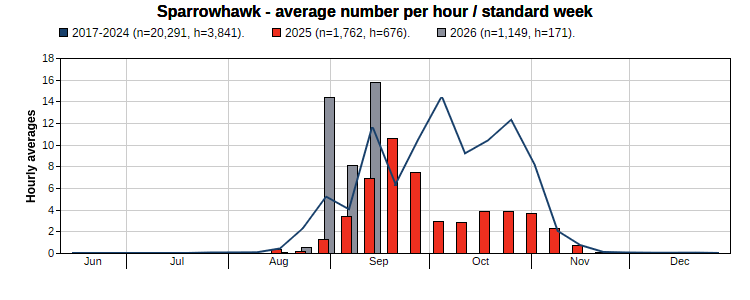 Dagens 130 Spurvehøge hjalp godt på efterårets tal, som blev bragt på 1.149 stadig. Det er stadig langt under sidste års 1.764, som er det hidtil laveste antal, og gennemsnittet på 2.900, men trækket af Spurvehøge plejer at fortsætte langt ind i oktober, og de seneste tre uger tegner stadig lovende. Grafikken viser, at de seneste tre ugers timegennemsnit (gråblå søjler) har ligget langt over sidste år (røde søjler) og gennemsnittet for årene 2017, som var det første år med standardtælling, til 2024. Kilde: Trektellen
Fugle registreret i standardtiden: 2.837 . Arter: 45. Tællingen startet 06:12, sluttet klokken 11:12.
Se alle dagens observationer på Gedser Odde i DOFbasen.
På stationen: Hannah Schmidt, Storm Hauris Borum, Lua Koplin, Mads Elley, Ole Friis Larsen, Marek Ebert
Flagermus i skuret
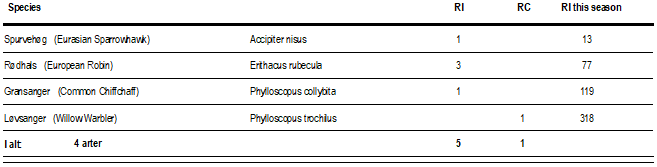
Ringmærkningen: Grundet en ordenlig omgang øv-vejr blev kun få net åbnet i morges. Vind og trusler om regn holdt fuglene i buskende og vi endte med en fangst på blot 5 fugle i standardnettene. Tre rødhals (Erithacus rubecula), en gransanger (Phylloscopus collybita) og en genfanget løvsanger (Phylloscopus trochilus).
Mens Hannah og Søren tog sig af de få net vi havde åbne, brugte Lua og jeg tiden på at reparere spurvehøg-nettene, der efter flere sæsoner er blevet møre og havde flere huller. Mens nettene var oppe og under reparation lykkedes det faktisk Lua at fange en spurvehøg - en god overraskelse på en ellers meget kedelig dag!
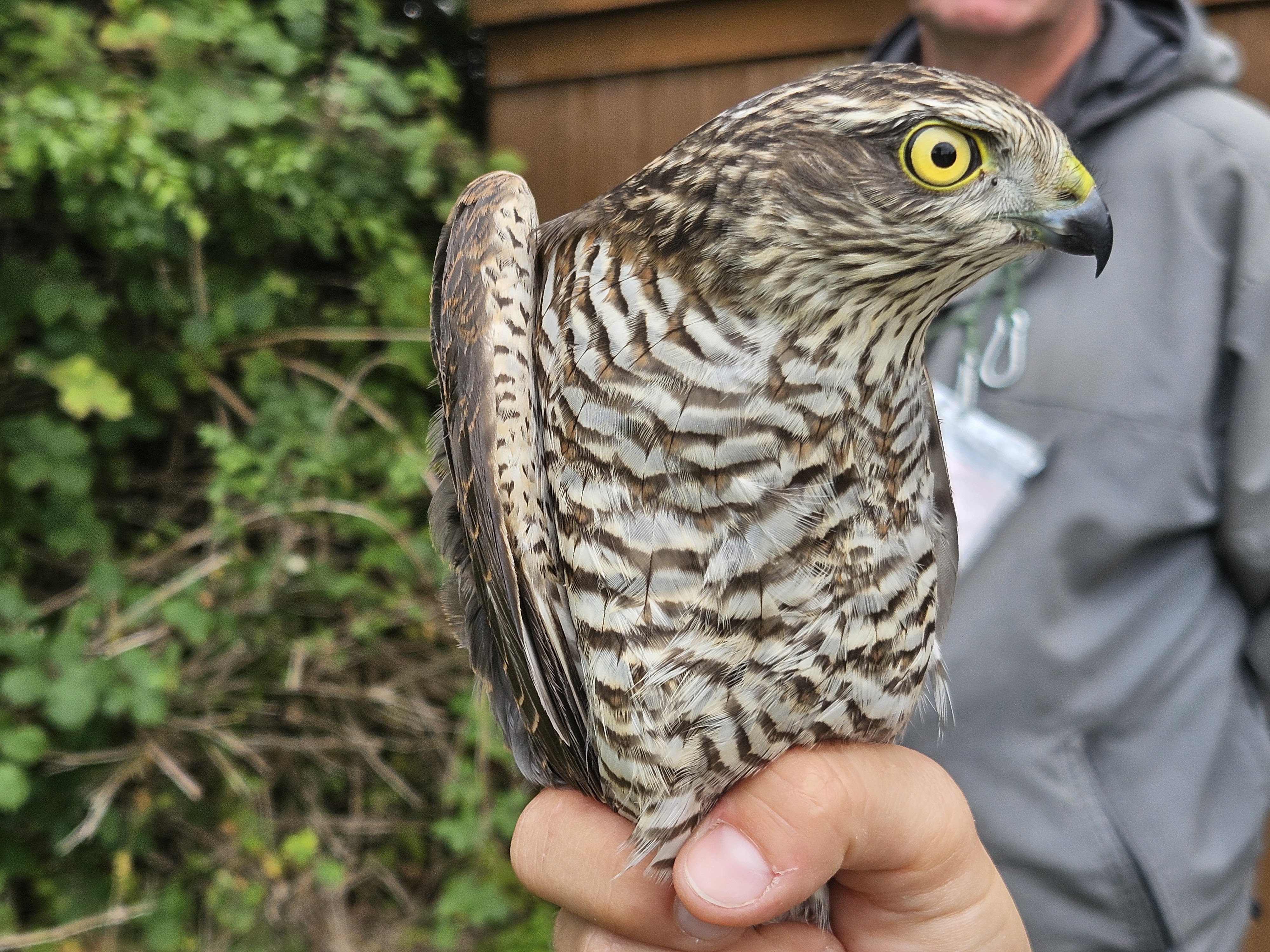
Dagens ene højdepunkt: en spurvehøg-hun. Læg mærke til de trekantede/hjerteformede tegninger på bryst og undervinge, der afslører at det er en ungfugl. Med tiden vil disse aftegninger bliver til vandrette bånd.
Vores anden overraskelse var en flagermus, der havde hængt sig til at sove i redskabsskuret, og blev vækket da vi åbnede døren. Den satte sig lige i døråbningen, så vi kunne kigge godt på den. Vi lod døren stå åben, og lidt senere havde den flyttet sig, muligvis ind under opslagstavlen hvor vi har set flere flagermus gemme sig i købet af dagen. Vi er mener at det nok er en Pippistrellus-art, men er ikke helt sikre på om det er en trold-, dværg- eller pipistrelflagermus. Vi modtager gerne bud på hvad det kan være for én!
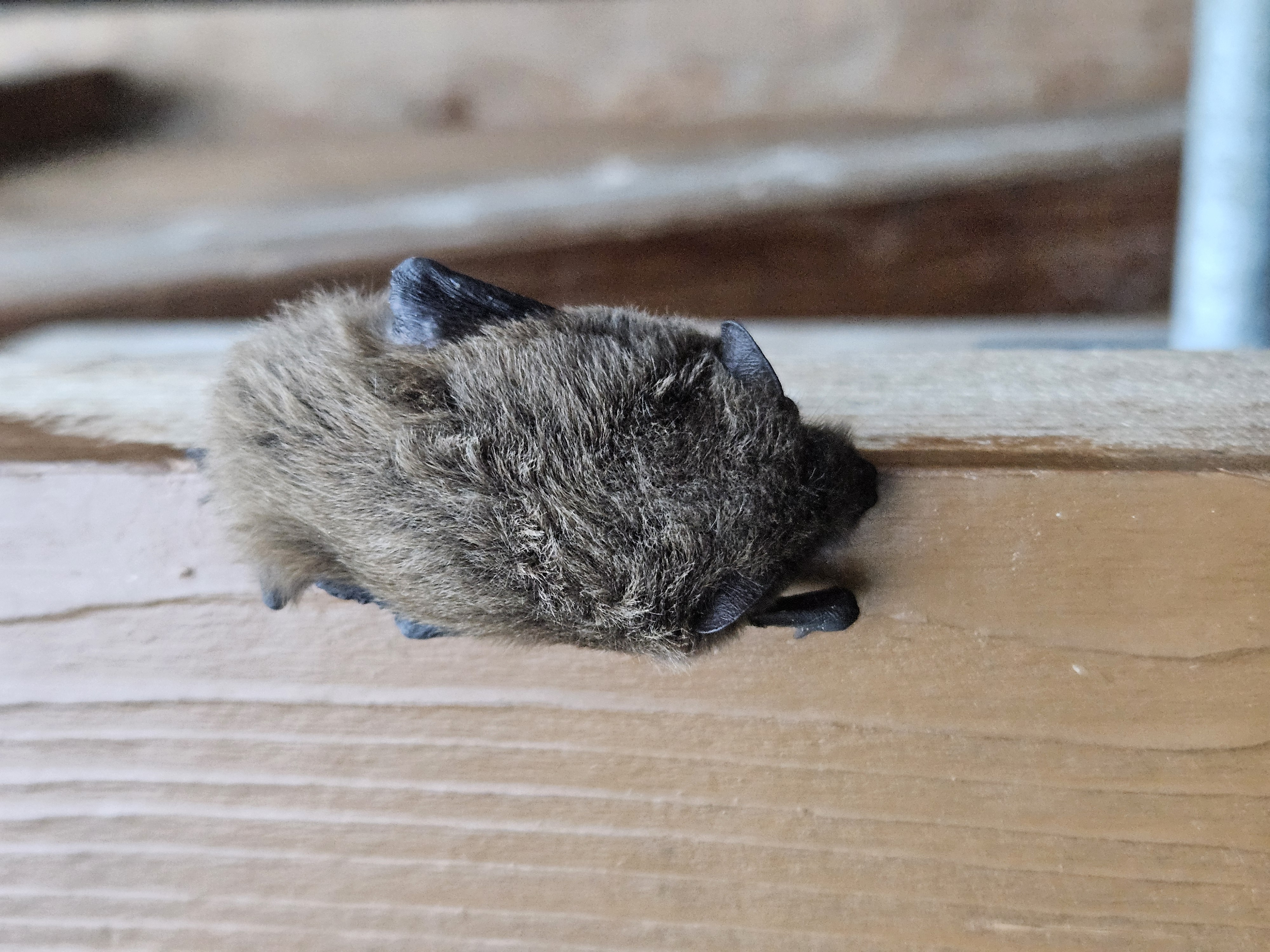
Dagens andet højdepunkt: en flagermus på døren til skuret. Vi er usikre på arten, men det var nok en Pipistrellus-art. Den var ca. 6 cm lang, ensfarvet støvet brun, relativt små afrundede ører og et ræve-agtigt trekantet hovede med en flad snude.
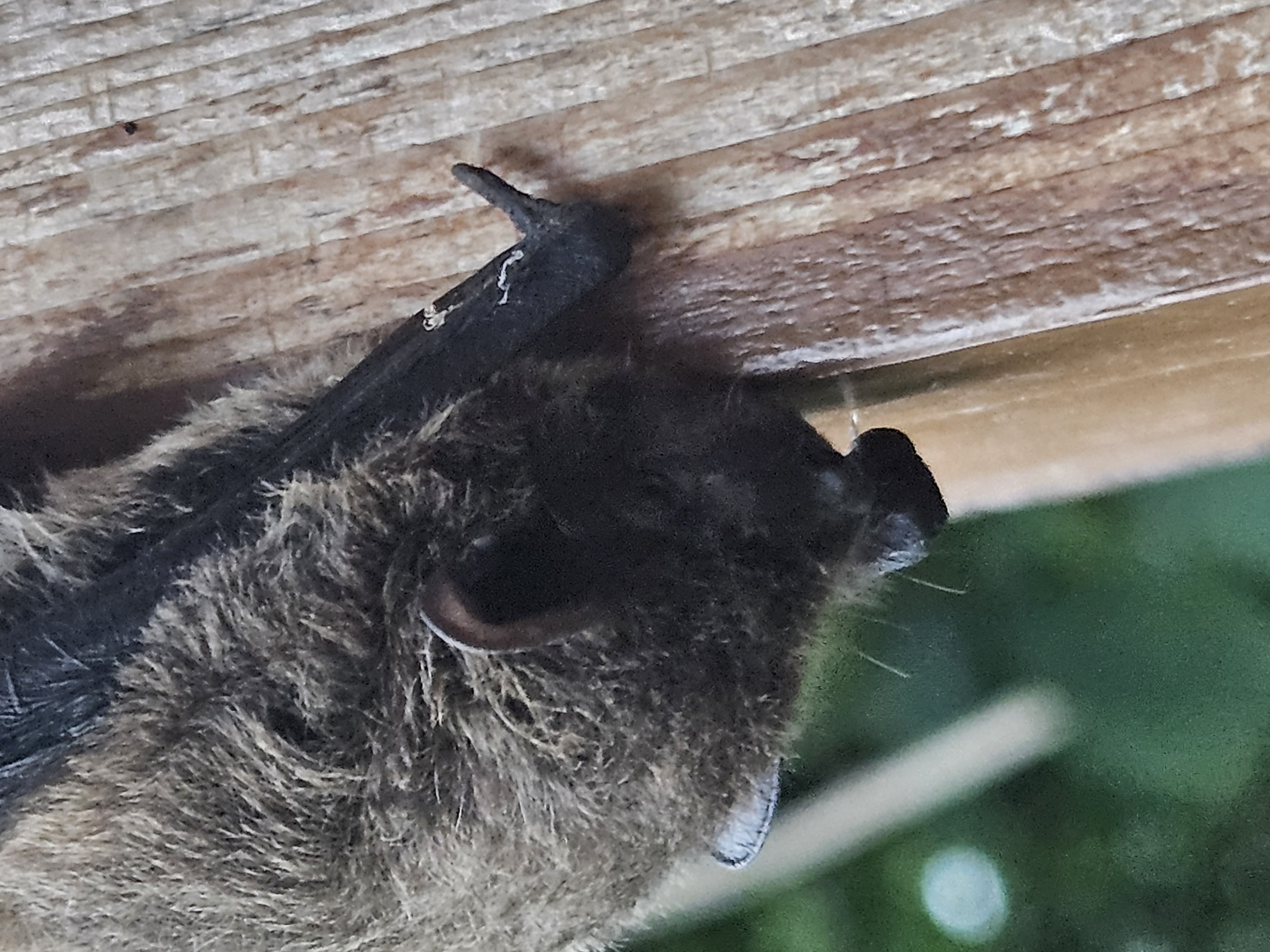
Nærbillede af flagermusens hovede. Hvilken art kunne det være?
Trækket på Odden: This morning, the sky was completely grey and it was just not getting light. Combined with quite some wind, it was not too pleasant to sit out at the tip. It must also have been unpleasant to fly as a bird, because during our first hour we only got around 50 birds. But as the wind died down and no rain fell, the birds decided to move again. As if they had to make up for the lost time, big flocks of Barn Swallows (Hirundo rustica) and House Martin (Delichon urbicum) migrated over and all around us, an amazing sight. Among the swallows was also a Common Swift (Apus apus). We always try to enjoy their sight as much as possible because you never know if there will be another one until May next year…
On the sea, the ducks woke up too. Today, mainly Common Scoters (Melanitta nigra) and Eurasian Wigeons (Mareca penelope) were seen, with a few of the others mixed in. It also was interesting to see the Common Eiders (Somateria mollissima) start moving. In a few weeks, we should get loads of them on migration. I’m looking forward to that. Joining the ducks were a few Black-throated Divers (Gavia arctica). They too should be joined soon by their smaller red-throated cousin (Gavia stellata).
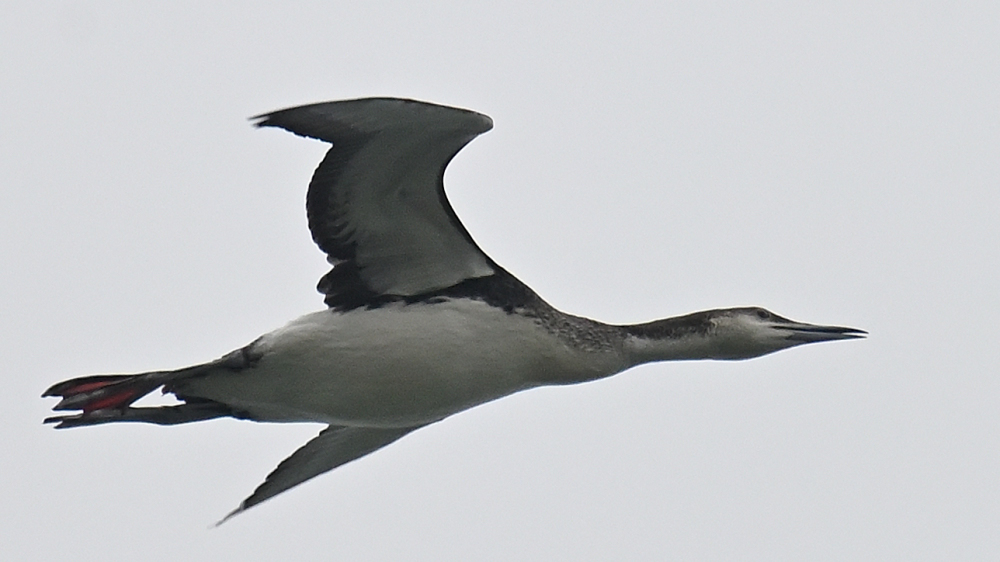
Look closely! This diver seems to be black-throated, even though there is no black throat which can only be seen in the breeding plumage. Instead, we look for the amount of white on the belly, the size and the shape of the head to separate it from the Red-throated Diver.
Later in the day, after the air heated up a bit, the migration of raptors increased. We had several Harriers (Circus sp.) and a few Sparrowhawks (Accipiter nisus). When on migration, these birds seem to forget everything around them and don’t care about us observers. They often come very close. One even perched on Ole’s chair for a few seconds until it flew off towards Germany. Speaking of raptorial birds, one group known for their notorious stealing behaviour made an appearance too: the Skuas. Four Arctic Skuas (Stercorarius parasiticus) flew by, one of them an 2k+ bird of the light morph. This was a pleasant change from the usually completely brown birds of this species. It was accompagnied by one of those completely brown birds which thus got very little attention. It should have, because it was a Long-tailed Skua (Stercorarius longicaudus), which we could tell afterwards based on (very bad) pictures. The „Little Skua“ (Lille Kjove) as it is called in Danish, is considerably smaller than its Arctic counterpart which can be visible in direct comparison.
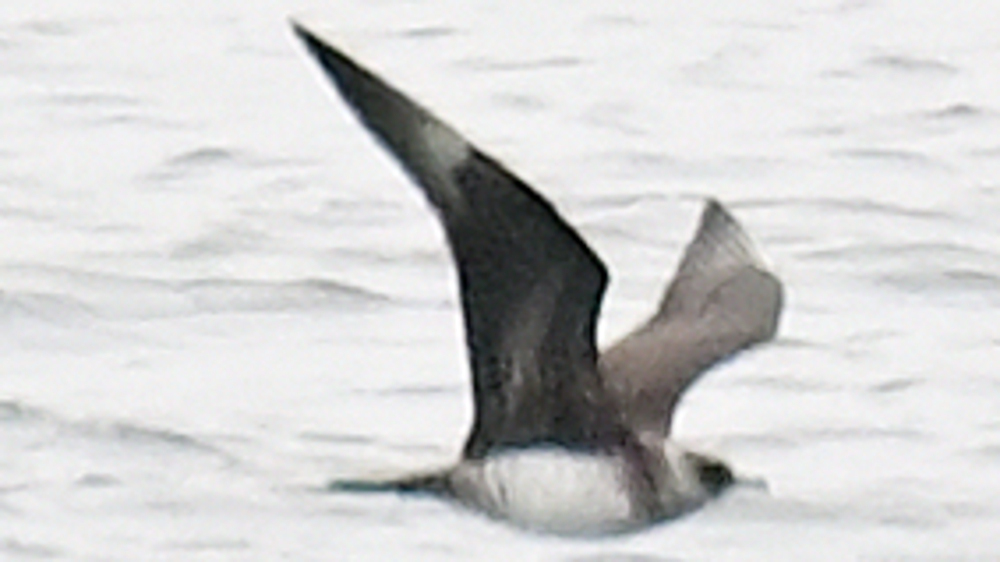
This beautiful Arctic Skua (Stercorarius parasiticus) stole all the attention from its rarer little cousin. The Long-tailed Skua was clearly smaller and more compact over the sea. It is not so easy to document, but look at the two pictures below. In one of the pictures both are visible, the smaller one in top left over the bigger Arctic Skua
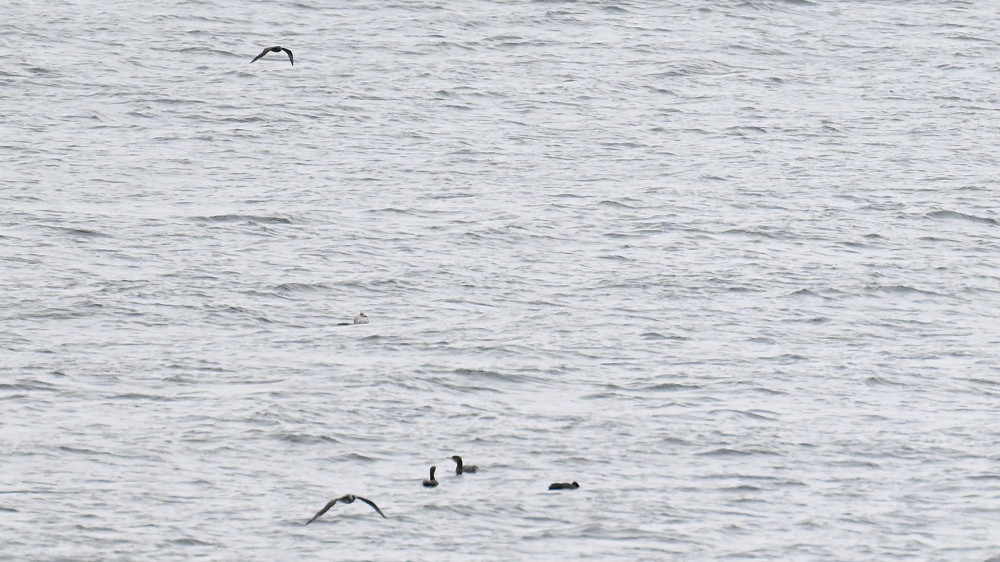
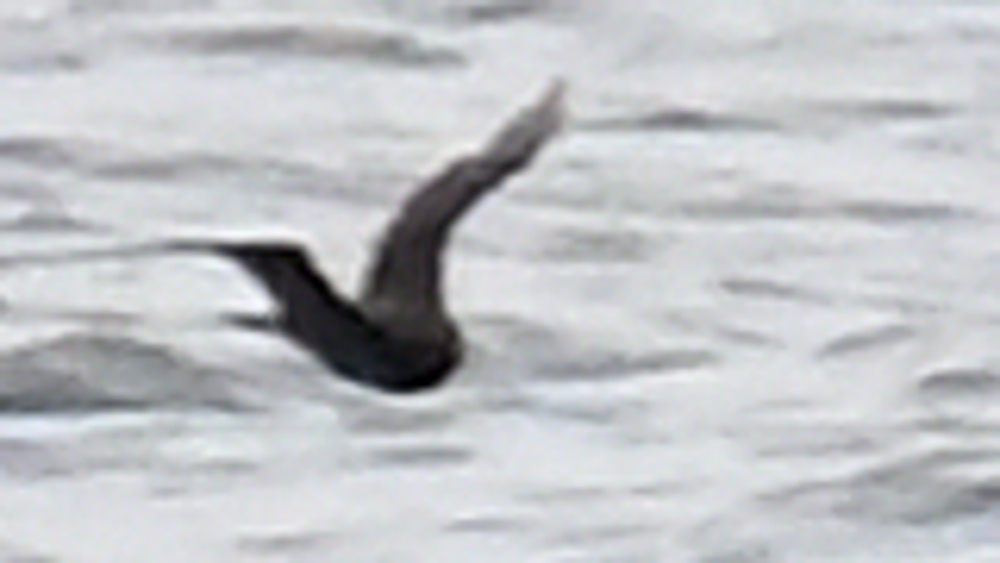
Fugle registreret i standardtiden: 4.643 . Arter: 45. Tællingen startet 06:10, sluttet klokken 11:10.
Se alle dagens observationer på Gedser Odde i DOFbasen.
På stationen: Hannah Schmidt, Storm Hauris Borum, Lua Koplin, Ole Friis Larsen, Marek Ebert, Søren Mygind
Blue Devil on one shoulder, olive/greyish/greenish/brownish Angel on the other!
Ringmærkningen: Today was a very nice and calm day, with a few showers inbetween good weather. With Søren leading the first part of ringing and then me (Lua) taking over after 8am, we all had a good chance to relax and look calmly at each bird. With the day growing longer and the rounds getting shorter due to less birds, you often feel quite inspired to fill the time waiting inbetween with silly little jokes. So today, when it was just Hannah, two birds in the last hour, and myself, we both started to hear the birds talk to us a bit to much! Hannah ringed her first blue tit, also known as "blue monster" or just simply "demon spawn straight out from hell", which is an important ride of passage for every ringer!
0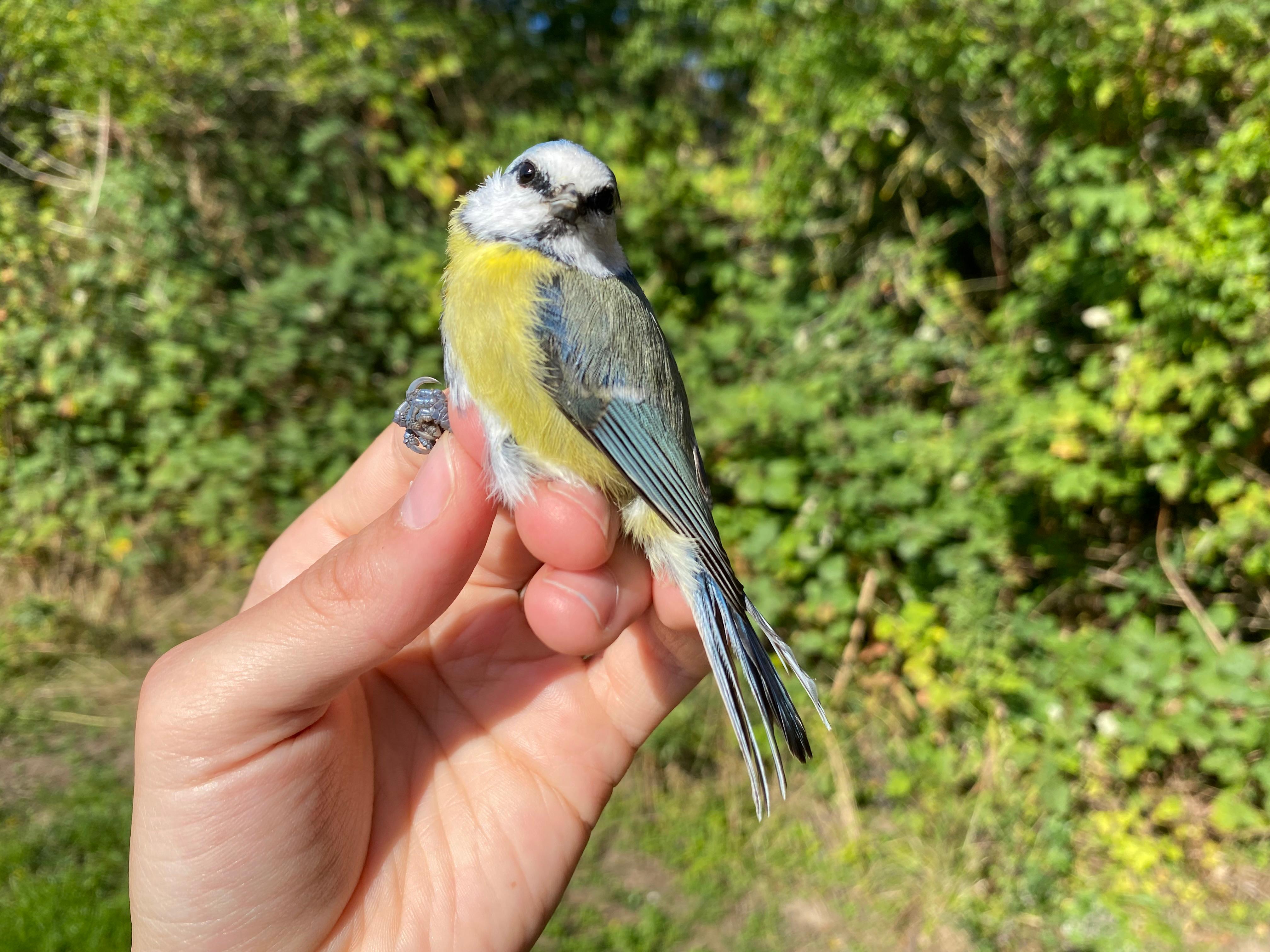
Image 1: Devilish blue tit
I then ringed the cutes and most angelic bird of the day. A very delicate chiffchaff. The direct contrast to the blue tit, therefore we nicknamed them our devil and angel on our shoulders!
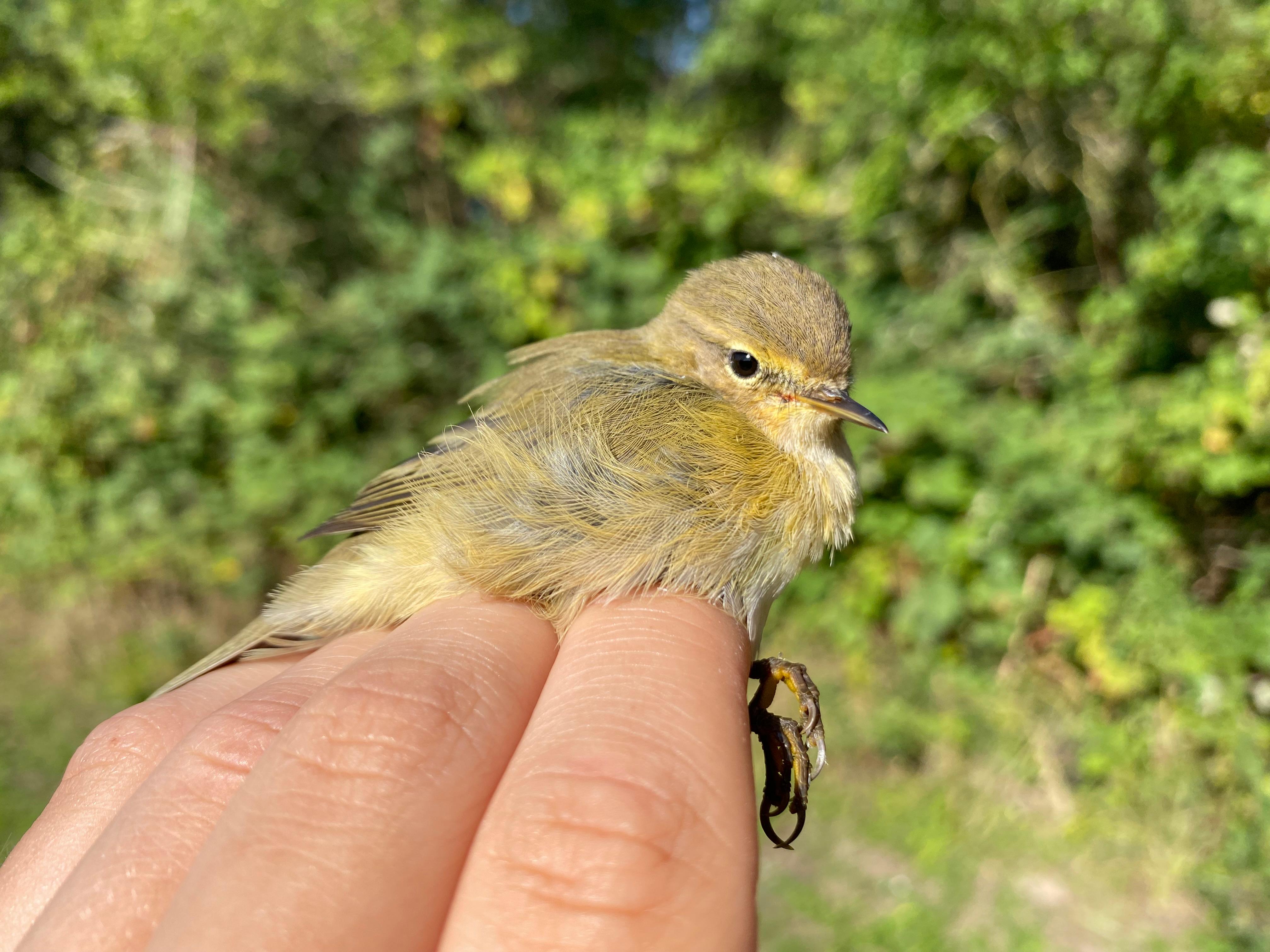
Image 2: Angelic looking Chiffchaff
With a total of 47 birds, it has been a pretty good day !
Trækket på Odden: På grund af et møde i fuglestationens styregruppe, fik vi ikke talt trækket denne lørdag, men der har været andre på Odde, så det er stadig muligt at få et indtryk af dagens træk ved at kigge i DOFbasen.
Se alle dagens observationer på Gedser Odde i DOFbasen.
Nyt fra fuglestationen: Styregruppen holdt et af sine faste møder, hvor vi især ser på fuglestationens økonomi og planlægger arrangementer, blandt andet Åbent Hus lørdag 3. oktober som vores bidrag til EuroBirdWatch-dagen med fokus på trækfugle. Desuden evaluerede vi vores fuglestationsuddannelse og så på bemandingen til ringmærkning og træktælling i 2027. Økonomien tegner i år til et underskud på omkring 50.000 kroner, mens de fleste andre punkter så positive ud. Vi diskuterede også vores indsats for at få engen ved fuglestationen udpint og omdannet til bedre natur for insekter og fugle. Græsset bliver slået og kørt væk om nogle dage. Derefter vil vi tilså en stykke af engen med en blanding af frø, som vi har fået anbefalet fra Aage V. Jensen Naturfond efter et besøg på fondens område ved Søholt Storskov/Maribosøerne.
Referater fra vores styregruppemøder er frit tilgængelige på fuglestationens hjemmeside, når de er godkendt af alle deltagere i det pågældende møde.
På stationen: Hannah Schmidt, Storm Hauris Borum, Lua Koplin, Mads Elley, Tina Elley, Hans Lind, Bo Kayser, Henrik Jørgensen, Anne Marie Reith, Søren Mygind, Gert Juul Jeppesen, Ole Friis Larsen, Marek Ebert
Nu kommer Grønirisk!
Ringmærkningen: Whilst the weather seemed perfect (low wind, no rain), there was little movement around our garden. Most likely, the southerly wind made for a bad day for migration.
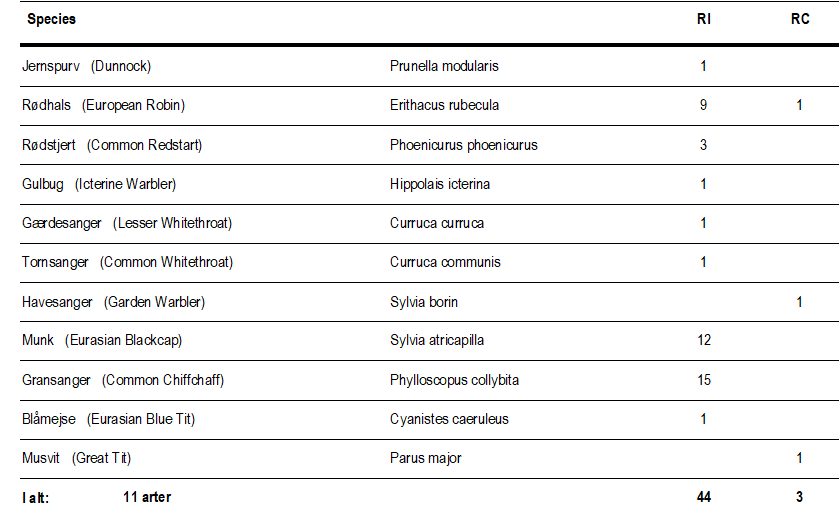
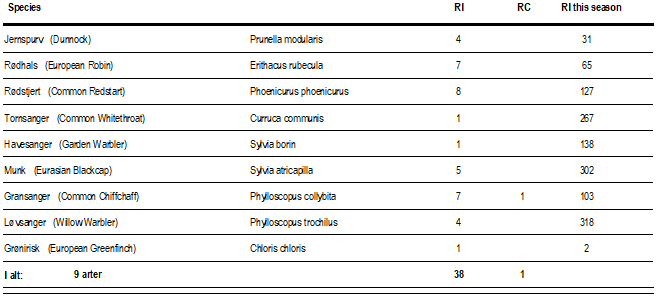
Mainly, we caught a mixture of Dunnocks (Prunella modularis), European robins (Erithacus rubecula), Common redstarts (Phoenicurus phoenicurus), Eurasian blackcaps (Sylvia atricapilla), Common chiffchaffs (Phylloscopus collybita), and Willow warblers (Phylloscopus throchilus). One Willow warbler stood out to us! It had a coloration that reminding us more of a chiffchaff's.
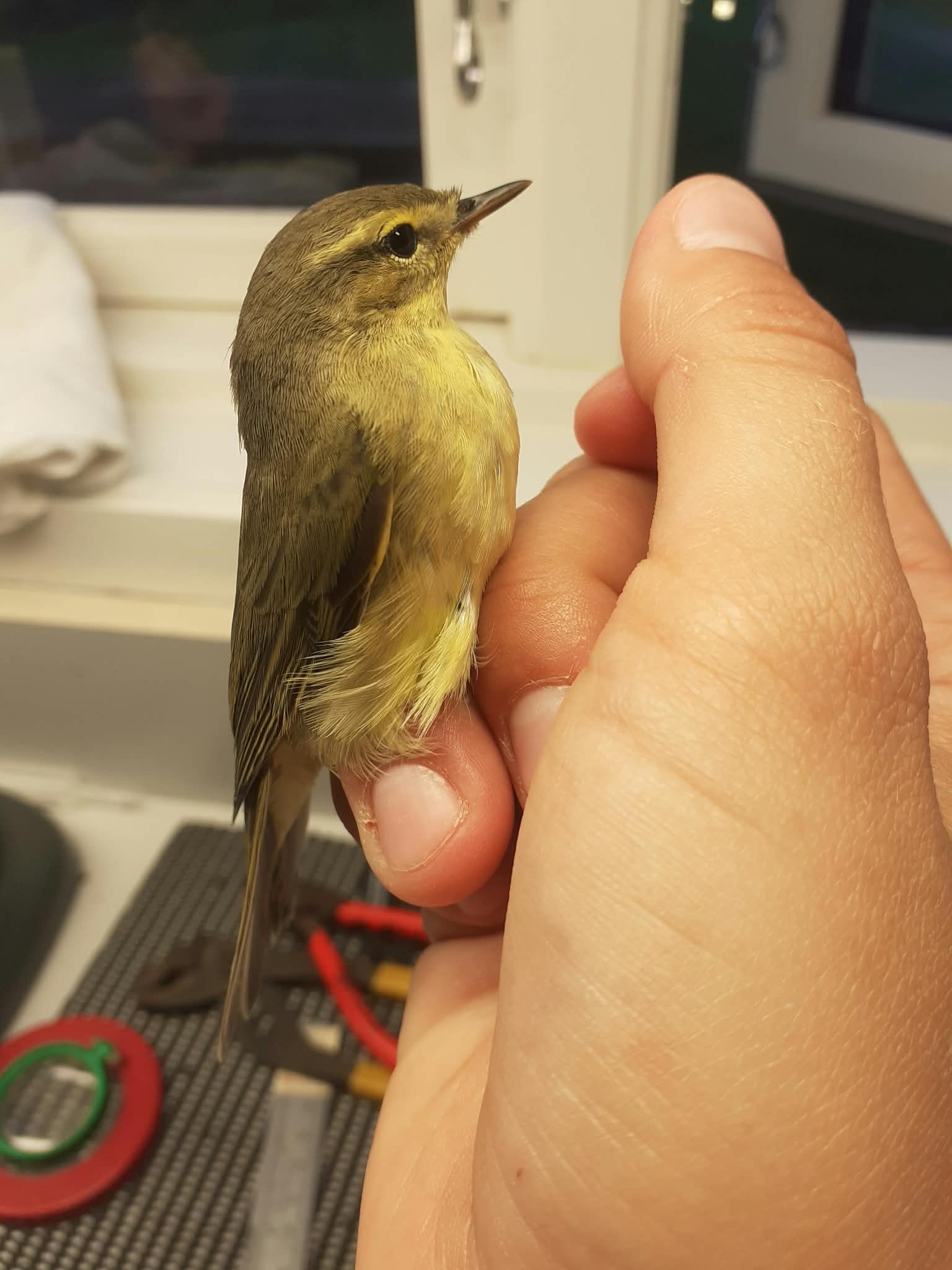 A Willow warbler (Phylloscopus throchilus) with the characteristics of a Common chiffchaff (Phylloscopus collybita).
Og nu kommer Grønirisk! We’ve seen them around the garden, but today was finally the day we caught a juvenile European greenfinch (Chloris chloris) in our nets. Whilst not yet as green as it will once be, we admired its feathers and yellow patterns on the wings and tail. Its stout bill revealed the reason for paying our garden a visit: the greenfinch had blackberry stains all over!
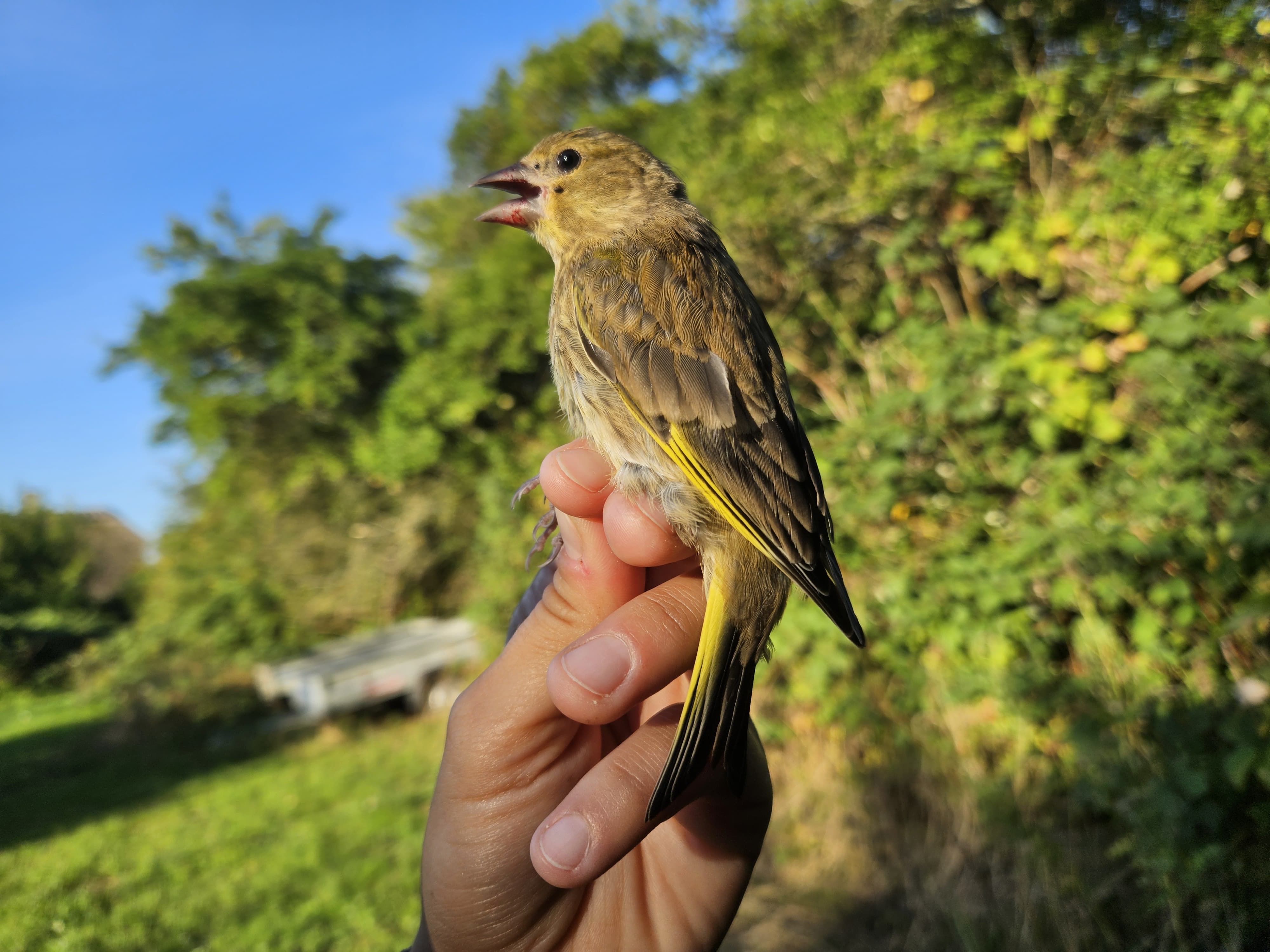 Finally, a European greenfinch (Chloris chloris) in our nets – a nice change among all the blackcaps and whitethroats!
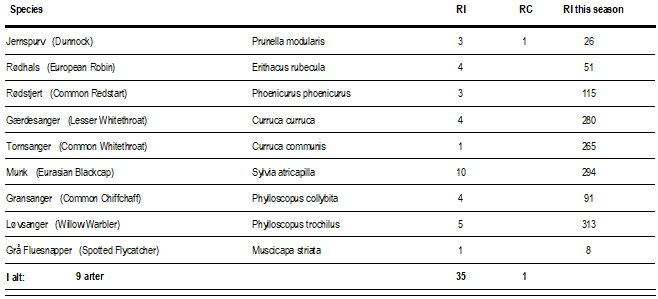
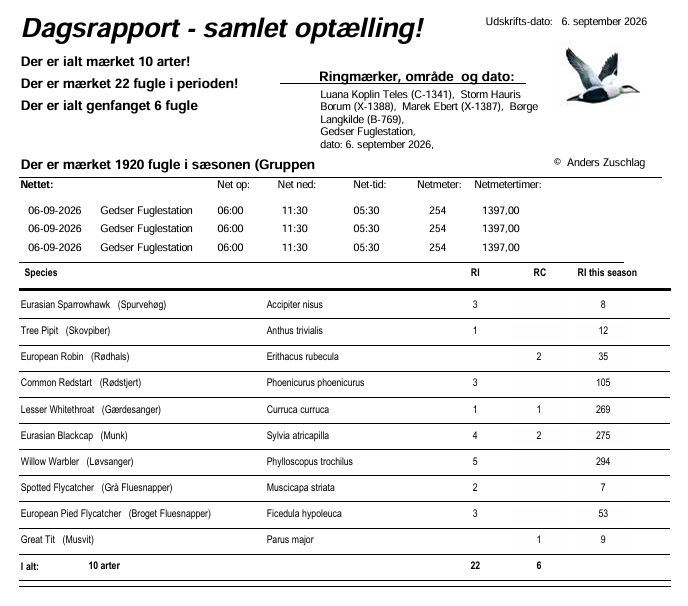
Today, we caught a total of 39 birds belonging to 9 different species.
Trækket på Odden: En af de mere stille efterårsdage i standardtiden, og beretningen bliver kort på grund af andre opgaver. Vejret var mildt og tørt. Trækket af rovfugle udeblev næsten, men indeholdt dog to Dværgfalke (Falco columbarius). Vinden flyttede nok en del af trækket væk fra Odden. Dagens Hvepsevåger (Pernis apivorus) og Rørhøge (Circus aeroginosus) så ud til at trække ud ved havnen et stykke nord for fuglestationen.
 Pibeænder tidligt på færde i lyset før solopgang. Foto: Ole Friis Larsen/GFU
 En blandet flok svømmeænder i det flotte vejrs modlys. De langstrakte med tynde halse er Spidsænder (Anas acuta), resten er Pibeænder med en mere kompakt form. Foto: Ole Friis Larsen/GFU
På havruten var der op mod 1.500 andefugle, mest Sortænder (Melanitta nigra), Pibeænder (Mareca penelope) og Krikænder (Anas crecca), men også et par af de arter, der egentlig først kommer senere, nemlig Bjergand (Aythya marila) og Hvinand (Bucephala clangula). Værd at nævne er også trækket af terne og Dværgmåger (Hydrocoloeus minutus).
Fugle registreret i standardtiden: 2.934 . Arter: 50. Tællingen startet 06:06, sluttet klokken 11:06.
Se alle dagens observationer på Gedser Odde i DOFbasen.
På stationen: Hannah Schmidt, Storm Hauris Borum, Lua Koplin, Mads Elley, Hans Lind, Ole Friis Larsen, Marek Ebert
The raptors are rising! (in the thermals)
Ringmærkning:
Det blev endnu en vindblæst dag i ringmærkningen hvilket betød at vi ikke kunne åbne næsten halvdelen af nettene. Dagen bragte dog stadig sæsonens første bogfinke (Fringilla coelebs)! Efter at have set de første flokke af trækkende finker over haven de sidste mange dage, var det skønt at se den første i nettet. Bogfinkehunnen er ikke så farverig som hannen, men har stadig flotte mønstre på vinger og halefjer. Blandt andet ses de karakteristiske hvide vingebånd og kontrastrige sort-hvide halefjer tydeligt i hånden.

Sæsonens første bogfinke, en ung hun. I hånden ses mønstret, der danner de to hvide vingebånd i mellem- og store dækfjer.
Vi havde en god dag for spurvehøge i dag. I standardmærkningen røg én i nettet og Hannah prøvede at ringmærke denne art for første gang. Senere på eftermiddagen åbnede vi spurvehøgenettene igen og efter lidt tids venten ved nettene fik vi endnu en spurvehøg. Vi ringmærkede den og viste den frem til besøgende turister. Vi havde kun lige sat den fri, før den næste spurvehøg sad i nettet. Denne nåede vi knap at tage op til ringmærkningslaboratoriet, før vi fik besked på at der altså var endnu én i nettet. Endnu to turister havde set den i nettet fra vejen, og fik derfor mulighed for at se begge spurvehøge på én gang. Dette gav god mulighed for at sammenligne en han og en hun.
Ligesom andre rovfugle, er hunnen en del større end hannen. Faktisk er spurvehøge-hunnerne ofte dobbelt så store som hannerne! Størrelsesforskellen mellem kønnene er ikke helt menes at være grundet arbejdsfordelingen hos rovfuglene i yngletiden. Hunnen bruger mere tid på reden med at ruge og beskytte den mod andre rovdyr og derfor er det en fordel et være stor og intimiderende. Hannen bruger derimod mere tid med at jage og har lettere ved at manøvrere rundt i tæt skov med sin mere kompakte størrelse.

Spurvehøg han og hun. Her ses størrelsesforskellen tydeligt. Hunnen til højre er mindst en halv gang større end hannen! De er begge ungfugle, hvilket ses på 'hjerterne' på brystet - de brune aftegninger, der danner trekanter eller hjerteformer - mest tydeligt på hannen, hvilket betyder at det er en yngre fugl end hunnen.

Trækket på Odden: It is very interesting to see how different days at the migration count can be. After yesterday’s cold and wet weather, we had a lot of sunshine but still chilling wind today. Also the birds were very different. As usual, we focused on the seabirds, however, there was almost nothing to focus upon. A few Sandwich Terns (Thalasseus sandwichensis) migrated by and we had a grand total of 16 ducks for the whole of the count. Still, three Arctic Skuas (Stercorarius parasiticus) made a quick stop on their way south to congratulate me on my birthday (probably rather to harass some terns…). They were the first special guests, but certainly not the last. After looking at an almost empty Baltic Sea for the first hour, we turned by 180° for the rest of the count and focused our attention on the skies. In the warming air, an amazing migration of raptors was picking up. The first sign of that came in the form of two Sparrowhawks (Accipiter nisus), still in the dark. They were followed by 127 more Sparrowhawks alone – and these birds were not the only raptor species on the move today. There also were European Honey-Buzzards (Pernis apivorus), 76 in total. Most of them migrated alone, though some decided to get some company and created a group of 27!
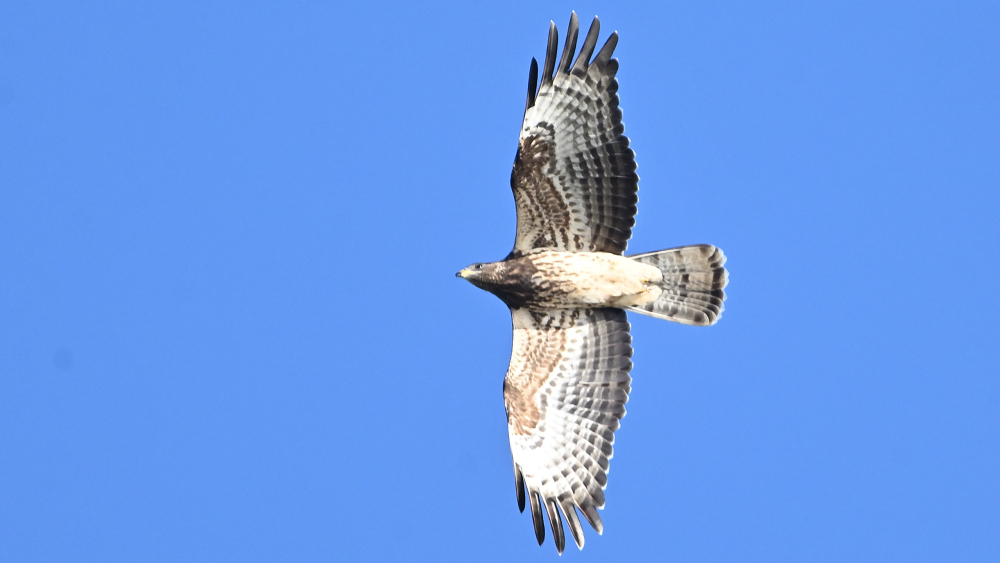
European Honey-Buzzard. If the birds show themselves nicely, we can age and even sex the Honey-Buzzards based on several criteria. This one is a juvenile identified by the dark eye (adults have yellow eyes) and the black beak.
The raptor party was joined by a few Common Buzzards (Buteo buteo), some Eurasian Kestrels (Falco tinnunculus) and several Eurasian Marsh-Harriers (Circus aeruginosus). Apart from the Marsh-Harriers, these birds are not really known for being migratory. They just move around to where they can find enough food. The Marsh-Harriers though winter in central Africa. The raptor-bird-day-party didn’t really start though, until the big bullies arrived: Three White-tailed Eagles (Haliaetus albicilla) made an impressive appearance. Only one of them was brave enough to attempt the crossing to Germany, the other two decided to stay in Denmark for a bit. However, the real special guest joined the party quite early, hid for most of the time and made a quick appearance again towards the end of the count. Escorted by two crows and with its typical swaying flight style, a Short-eared Owl (Asio flammeus) suddenly appeared it made a few rounds over the field, before disappearing as quickly as it came. The deep gaze of its bright yellow eyes stayad with us for a long time after the owl itself had already left.
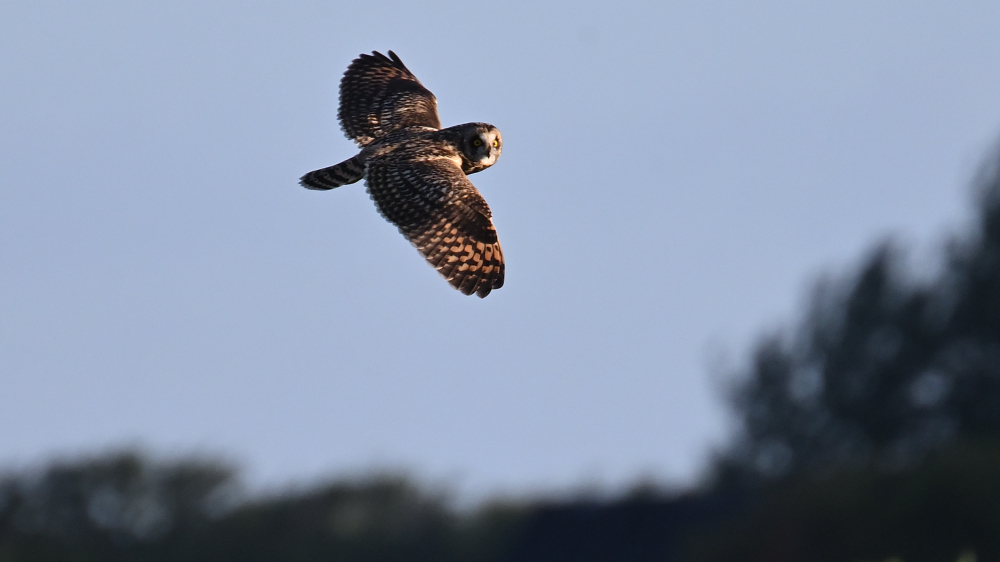
Short-eared Owl (Asio flammeus). In owls, an interesting correlation between the eye colour and the time of activity can be observed. As a rule of thumb, the eye colour is the same as the colour of the sky when the owl is most active. Different from most owls, Short-eared owls can often be seen during the day hunting over meadows, fields and marshy areas.
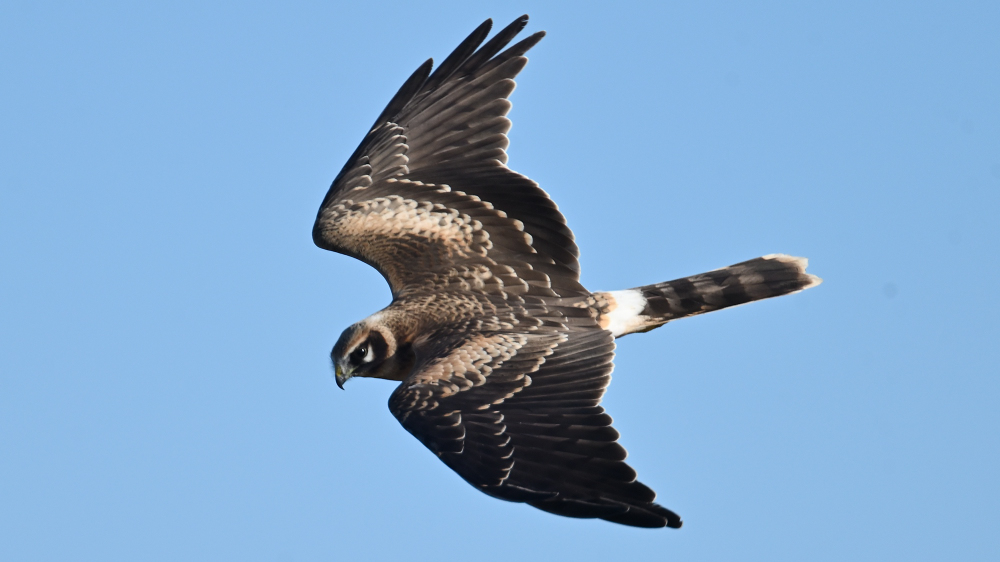
As promised, we had a real party today. Logically, seven species are not yet enough, so more came to greet us. A Red Kite (Milvus milvus) was showing off itself, however everyone only had eyes for its cousin, the Black Kite (Milvus migrans). It is likely that the individual we saw yesterday mustered finally enough courage to cross the scary blue. It was joined by another Black Kite later that tried to be brave but returned quickly. But the real star (arguably even better than the owl) came just calmly soaring over the grass, when it discovered us observers speechless a few metres in front of it. It then made a quick turn, so we could all see the reddish underside, the four-fingered hand, the light necklace and even the colour of its eyes! Have you figured out who made this spectacular show? Of course, it was a Pallid Harrier (Circus macrourus), giving some of the best views anyone has ever had on this species. Just to make sure everyone got their perfect pictures, views and incredible lifer experiences (me!), it circled over our heads several times before heading out over the sea. These birds have become more common over the last few years, probably at least partially due to climate change. Still they are an amazing species, especially at this range!
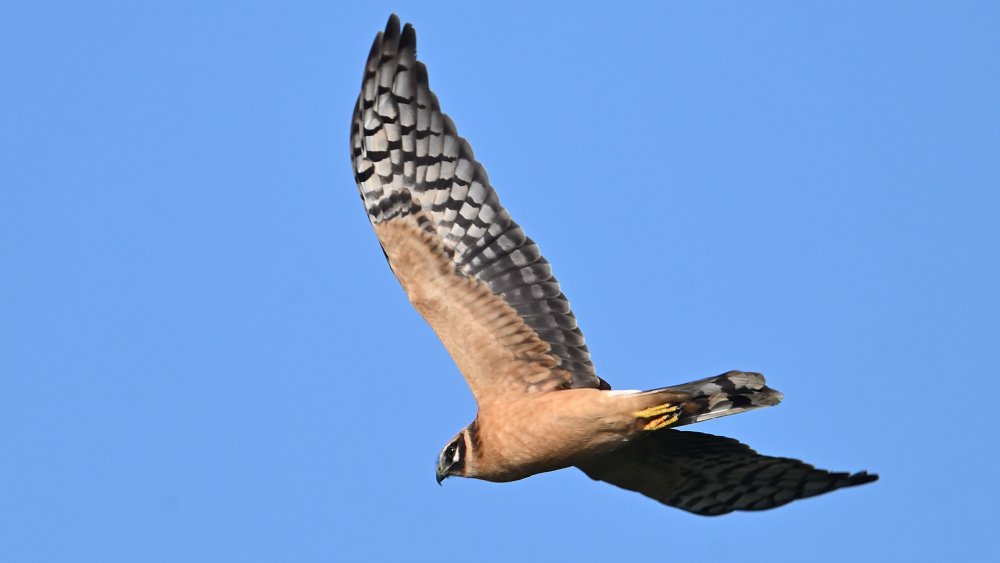
Pallid Harrier (Circus macrourus). As in all the other Harriers, young Pallid Harriers look nothing alike the adults. They are more colourful and grow their patterns only with age. The pale eye also tells us that this is a young female.
In the afternoon, Tina came by with some delicious cake and we celebrated my birthday and the amazing observations a little. Thank you to everyone for all your congratulations, best wishes, songs and presents. It was an amazing birthday and I am so grateful for being able to celebrate it here, surrounded by all the great other ringers, observators and, most importantly, friends!
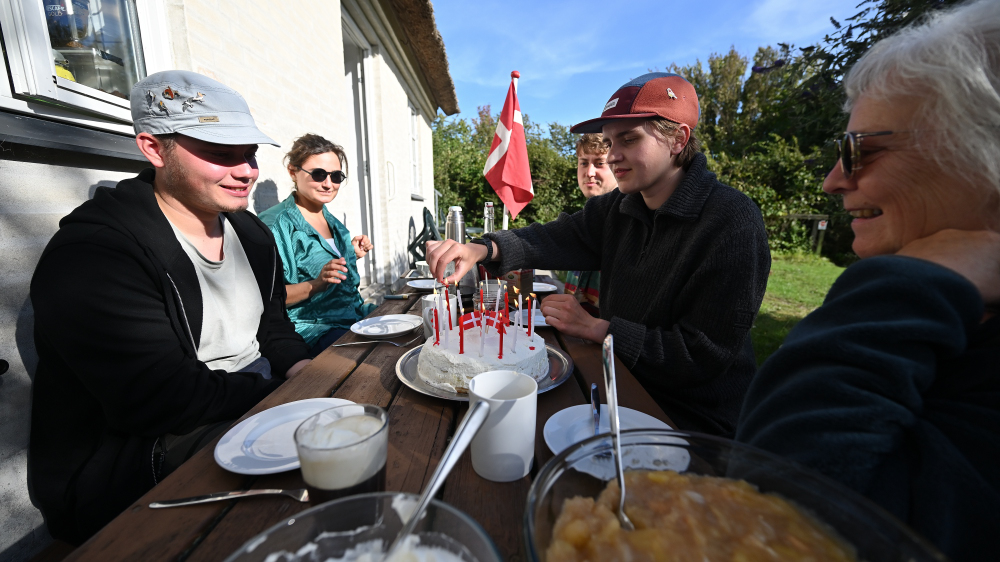
The Danish birthday cake
Fugle registreret i standardtiden: 1584. Arter: 37. Tællingen startet 06:04, sluttet klokken 11:04.
Se alle dagens observationer på Gedser Odde i DOFbasen.
På stationen: Hannah Schmidt, Storm Hauris Borum, Frederikke Dufke, Lua Koplin, Tina Elley, Ole Friis Larsen, Marek Ebert
Third time's the bird band!
Ringing: As we have lost our trust in weather forecast apps, every morning starts the same, I go out, look at the clouds, smell the rain, judge the wind and decide from my surrounding if we go out and today we did!
As it was still a bit wet from the nights rain, we did more frequent rounds with a healthy amount of panic, but soon the weather turned out to be very pleasent and he had a pretty good day afterwards!
With all of our favourite common birds, we notice one funny pattern of today, its trio day! Several nets one after the other had three of the same species, with nothing else for each round!
We jokingly called these our bird bands and joked about what type of music each of these would make, first we had this lovely chiffchaff assortment, then these gentle dunnocks and at last the boyband of male blackcaps.
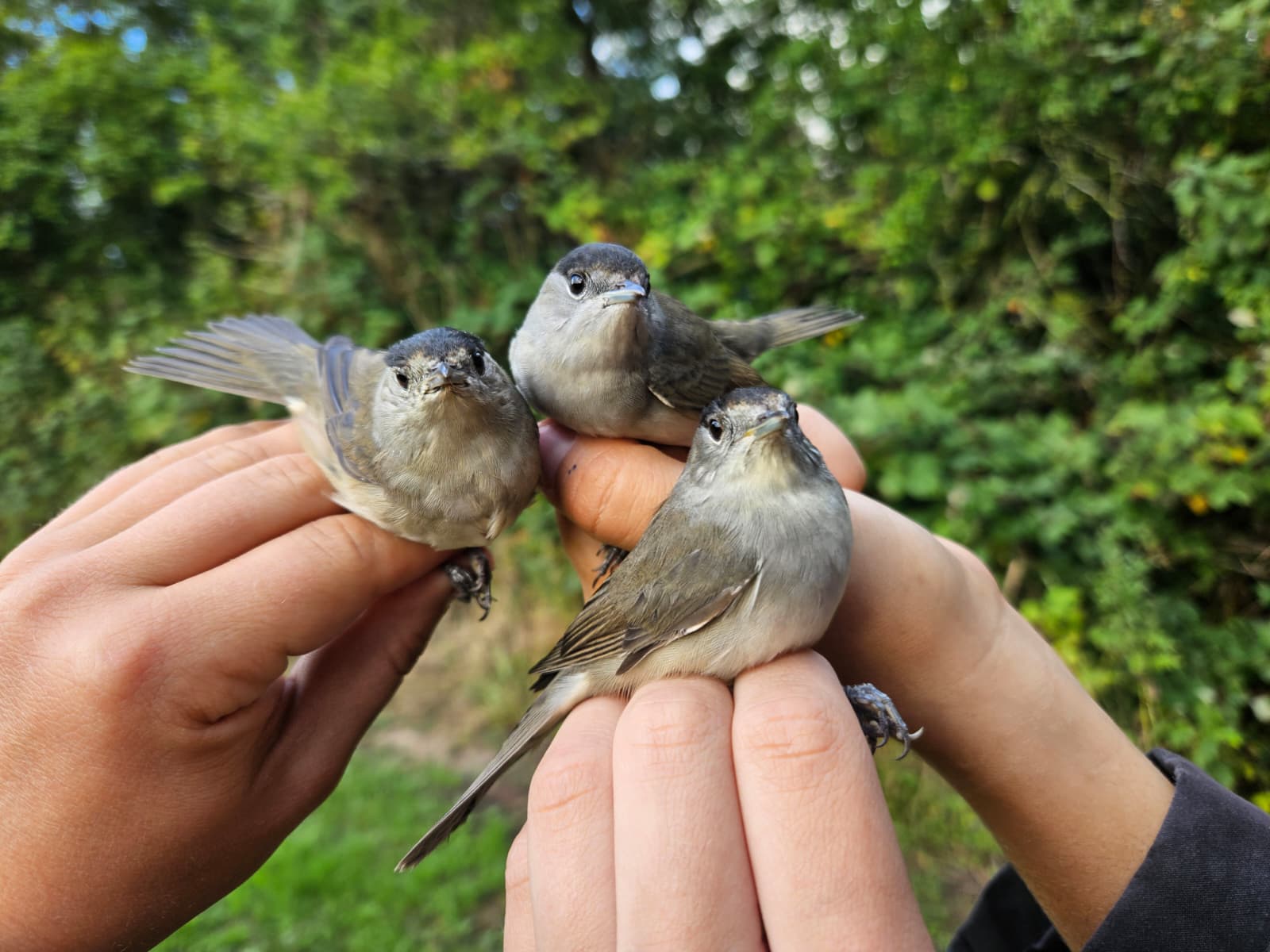 Image 1: Blackcap boyband
For the blackcaps we have decided that they most likely would make sad rock, or alternative rock music!
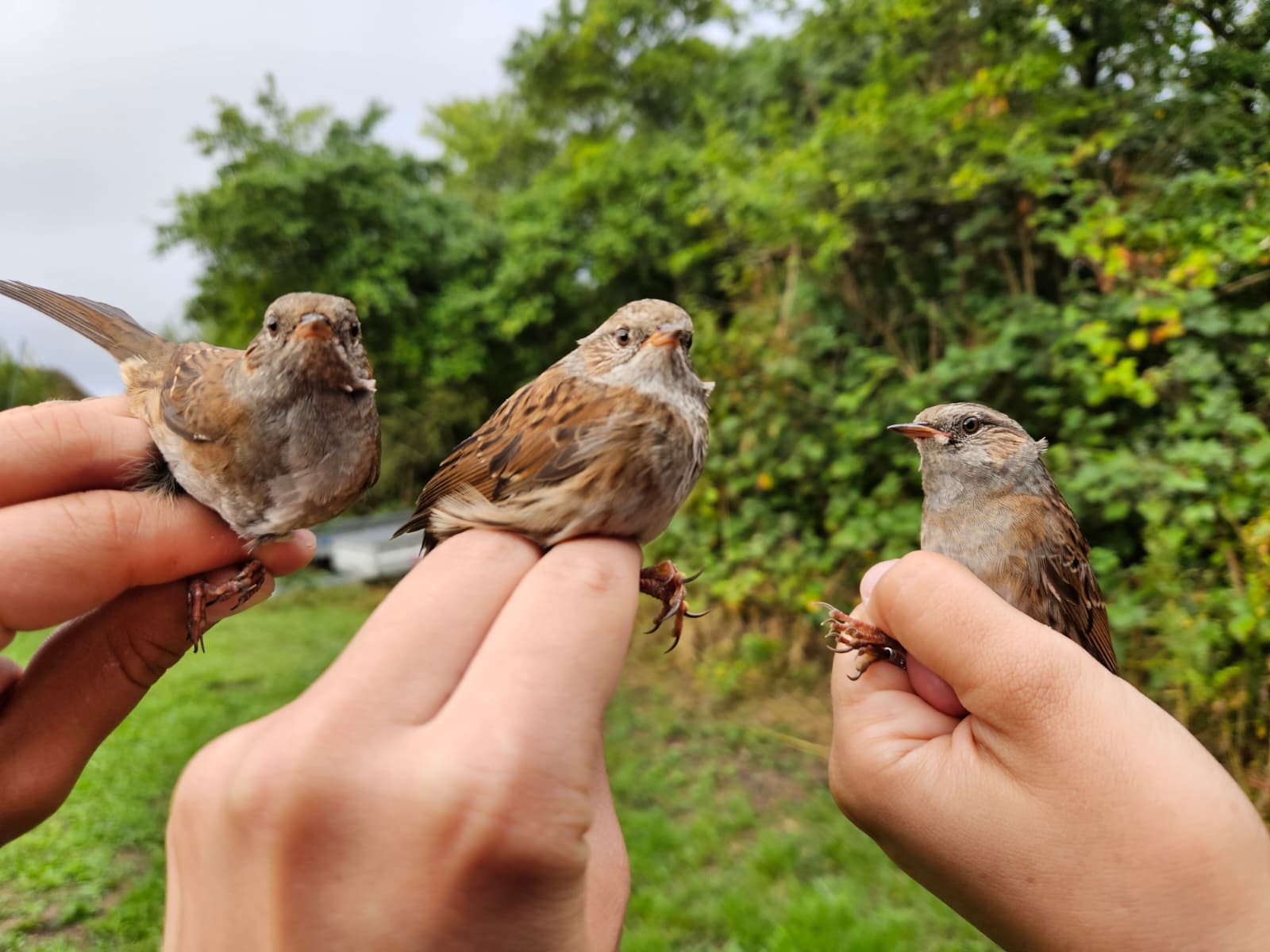 Image 2: Indie Folk trio of Dunnocks
And lastly for the Chiffchaffs we were actually not sure about what genre they would be, some people leaned towards classical, others towards Rap, what do you think??
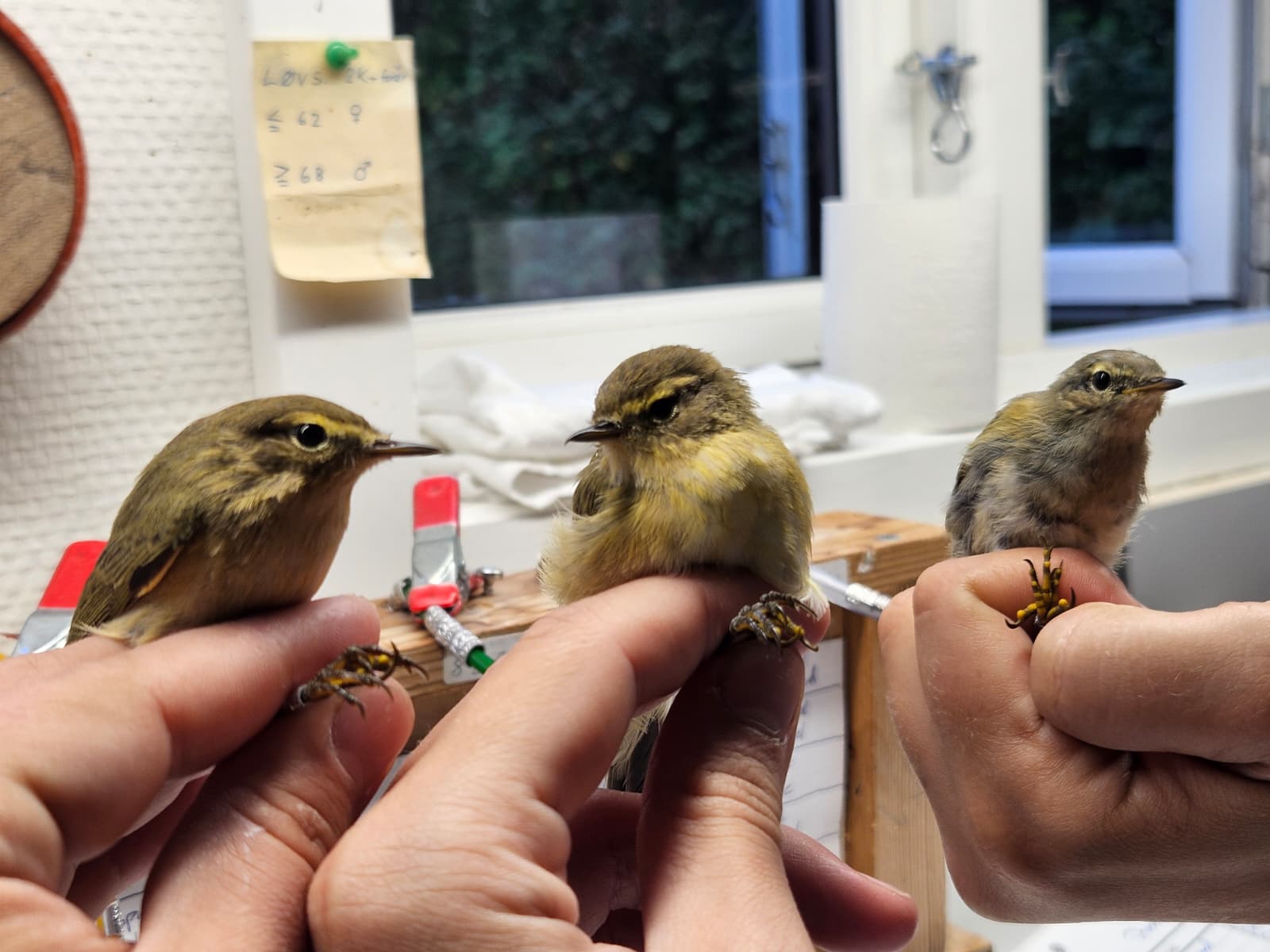 Image 3: Young Chiffchaff trio that still has to find their distinct style
The rest of the day countined fairly quiet, but good! With 37 birds, not bad regarding we were in doubt of even beeing able to open nets in the first place!
Trækket på Odden: En mærkelig morgen med først tre timers efterår med overskyet himmel og en lind strøm af byger for de to sidste timer at byde på noget blå himmel og solskin, men også tiltagende vind fra sydvest. Vi var to fra fuglestationen ude at opleve et par nyheder i dette efterårs træk ved Gedser Odde. Tre flokke af Grågæs (Anser anser) var et signal om, at trækket af gæs er begyndt, og i dagens træk af bare 12 Ederfugle (Somateria mollissima) var halvdelen voksne/adulte hanner. Indtil nu har vi kun set brune fugle, altså hunner og deres unger fra i år.
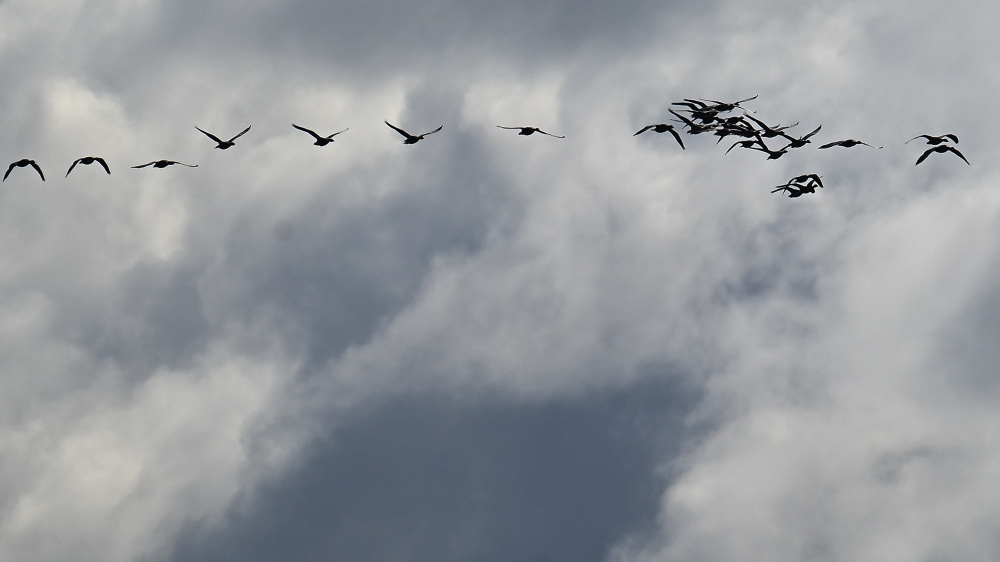 Efterårets første rigtige træk af Grågæs ved Gedser Odde foregik i gråvejr, og gæssene klumpede sig, så de var lidt af en udfordring at få tal på. Foto: Ole Friis Larsen/GFU
22 Hvepsevåger (Pernis apivorus) bragte det samlede antal i dette efterår op på 204. Det er det højeste antal i de seneste fem år, og deres trækperiode er slet ikke over stået endnu. Marek talte stadig svaler i tusindvis, men ellers var dagens træk noget dæmpet, hvilket måske skyldtes de mange regnbyger. Vi kunne i hvert fald konstatere, at såvel svaler som Spurvehøge (Accipiter nisus) holdt op med at trække ud i tiltagende vind fra sydvest og med udsigt til regnbyger over havet.
Beretningen om trækket bliver ikke længere i dag, for hele holdet holdt fri om eftermiddagen for at tage på ekskursion til Maribosøerne, hvor vi især gerne ville se Rovterner (Hydroprogne caspia) både for oplevelsen af verdens største terne og for at blive bedre til at bestemme den art i forhold til andre arter af terner, som vi ser på trækket. Det lykkedes med to over Hejrede Sø. Vi så endda deres enorme røde næb i fint lys. Glade var vi også for to Fiskeørne (Pandion haliaetus) over Maribo Søndersø og flere andre fugle i området.
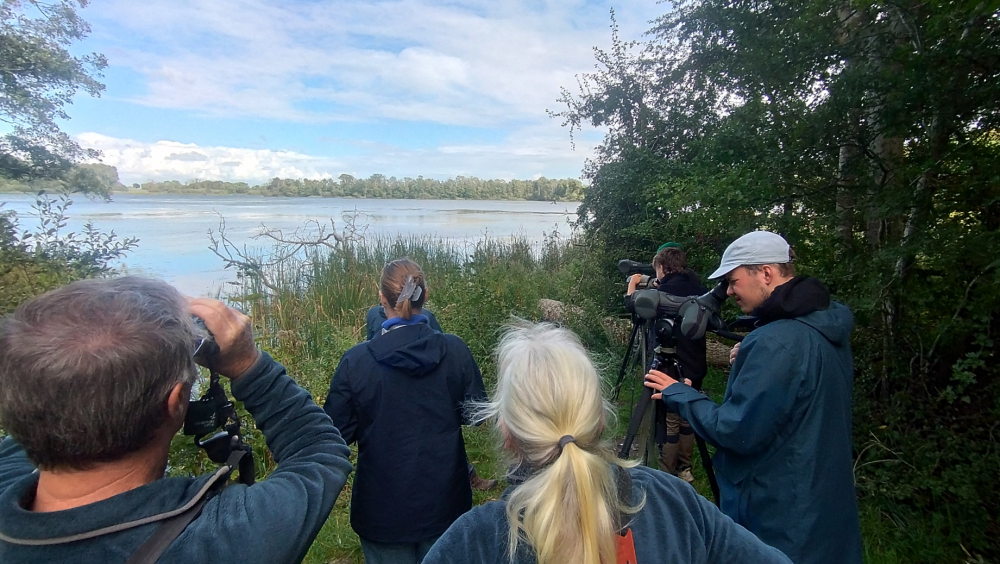 Fuglestationens personale på studietur ved Hejrede Sø. Foto: Ole Friis Larsen/GFU
Fugle registreret i standardtiden: 3.733 . Arter: 38. Tællingen startet 06:03, sluttet klokken 11:03.
Se alle dagens observationer på Gedser Odde i DOFbasen.
På stationen: Hannah Schmidt, Storm Hauris Borum, Frederikke Dufke, Lua Koplin, Tina Elley, Mads Elley, Gert Juul Jeppesen, Ole Friis Larsen, Marek Ebert
Completely SWALLOWed
Ringmærkningen:
Our prediction of the day was far off from what we expected. Increasingly better days after the past week of bad weather, along with low winds and cloud coverage but no rain, made for perfect conditions.
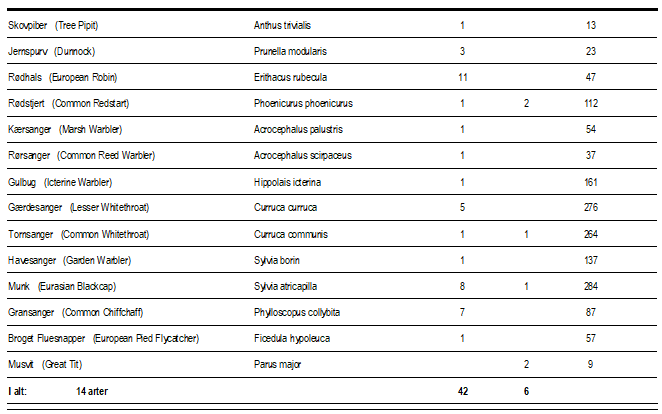
Of course, at 05:30 a.m. our hopes were high. We were able to open all nets and crossed our fingers. Whilst the first two went quite alright, several rounds brought only one, two or even zero birds at times. Overall, the day brought a mixture of European robins (Erithacus rubecula), Lesser whitethroats (Curruca curruca), Eurasian blackcaps (Sylvia atricapilla) and more. Here is a round-up of the most memorable ones! Whilst yesterday was the day for Willow warblers (Phylloscopus trochilus), today was the day for Common chiffchaffs (Phylloscopus collybita). These two species look extremely similar, but a small detail makes the differentiation easy. Willow warblers have an emargination to the 6th primary, whilst chiffchaffs have it to the 5th.
Whilst numbers are decreasing here in the garden, several Dunnocks (Prunella modularis) and Common redstarts (Phoenicurus phoenicurus) made their way into our nets.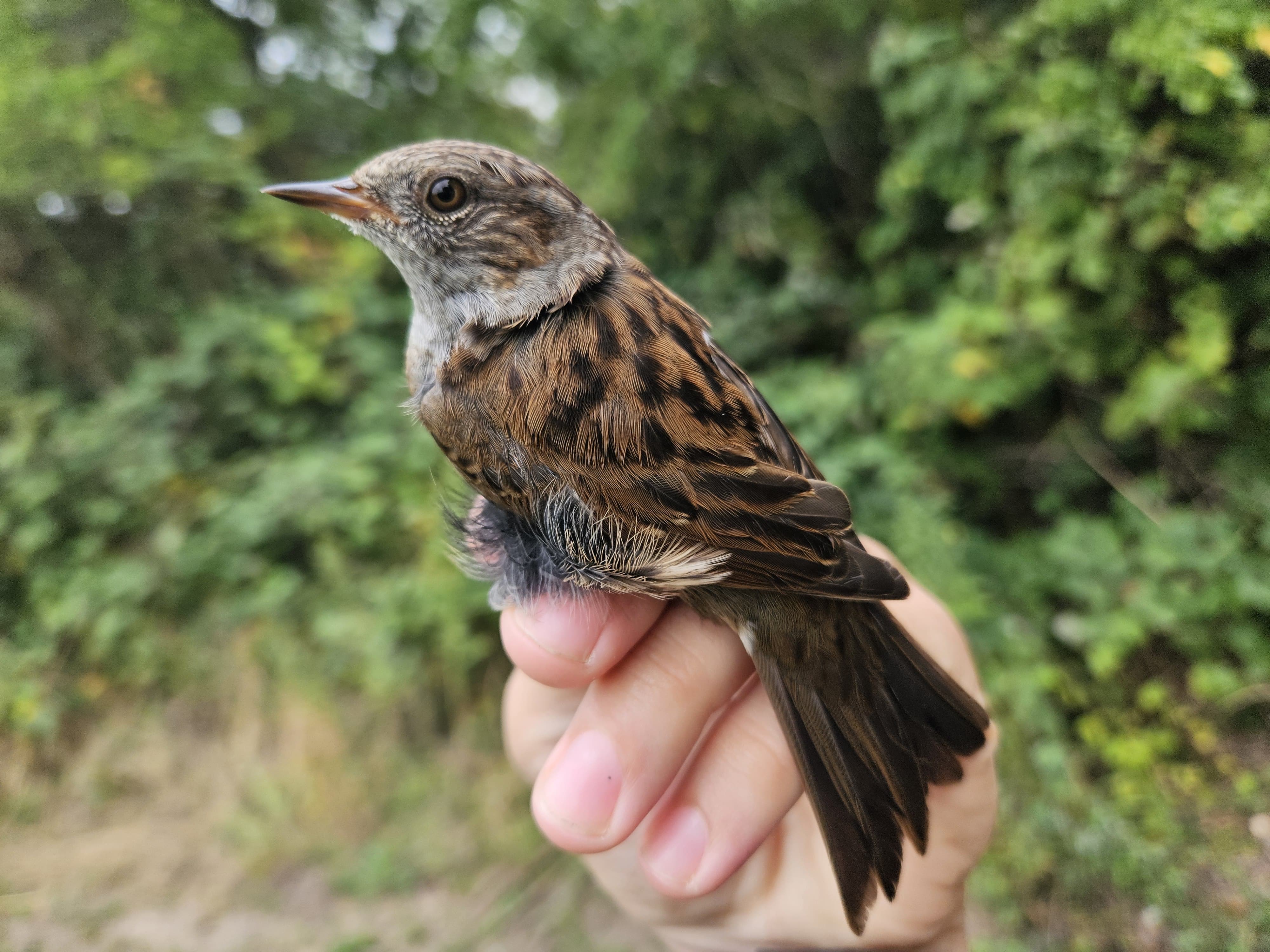 A Dunnck (Prunella modularis).
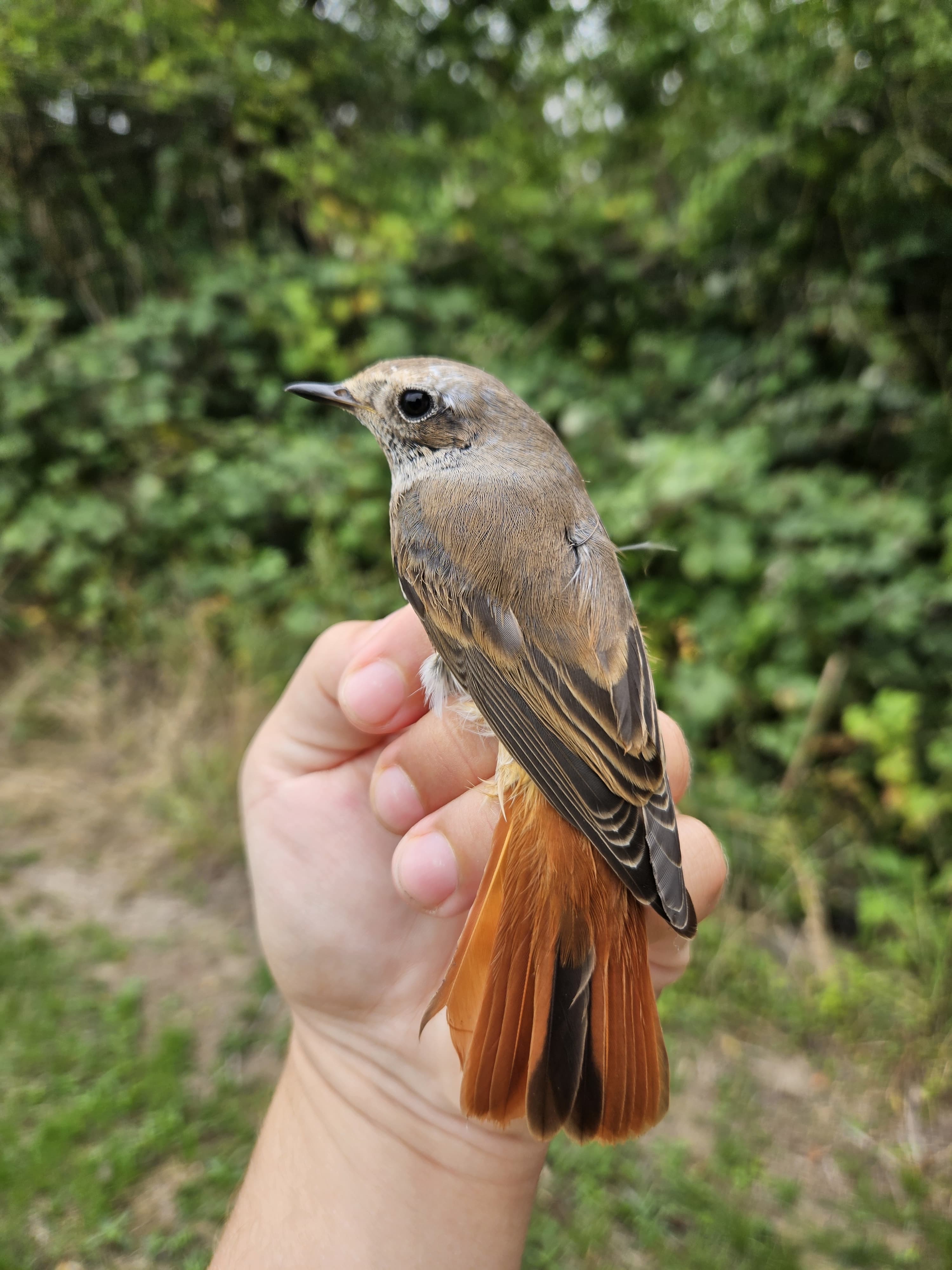 A Common redstart (Phoenicurus phoenicurus).
Although disliked by many, a personal favorite of mine are the Great tits (Parus major). Today, we recaptured two individuals. Why are they so disliked by many, you may ask. Although unexpected of such cute birds, Great and Blue tits are rather “aggressive” and like to nip at your fingers when they get the chance. So far, I’ve not had the pleasure of extracting whole flocks of these species, and my experience remains rather pleasant – if not exciting!
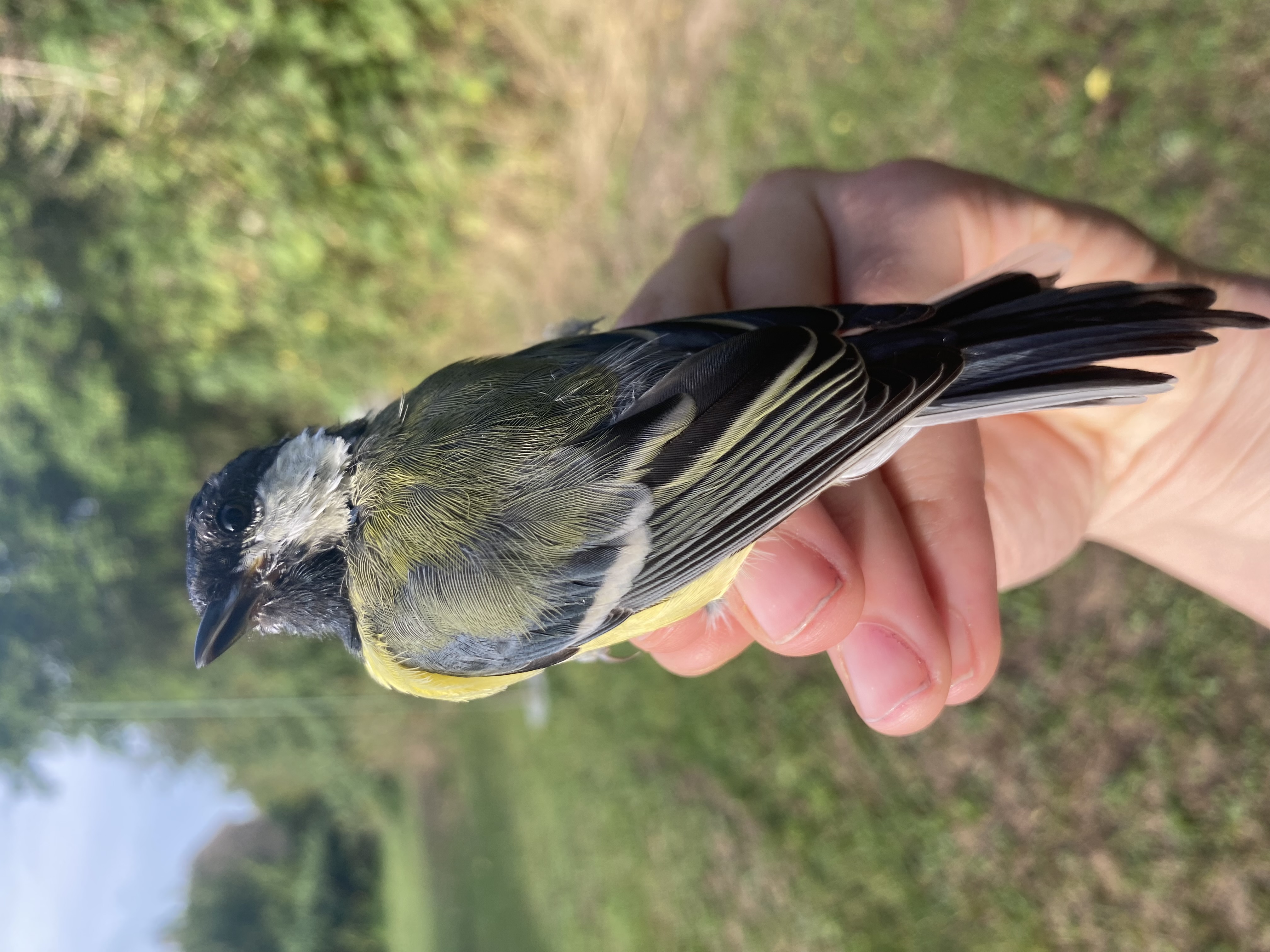 A Great tit (Parus major).
In total, we caught 48 birds of 14 species.
Trækket på Odden: This morning at the tip promised to be good, after yesterday’s incredible numbers. However, we did not expect it to become that good. The migration of Common Scoters (Melanitta nigra) continued to be good, though we did „only“ count 872 birds. A nice addition were the obligatory mixed duck flocks. It is common for ducks to travel in groups for company and protection from predators. However, they don’t seem to care whether their flocks consists of the same species as themselves. One notable group of ducks was not really big, only 19 birds. However there were several Green-winged Teals (Anas crecca), Eurasian Wigeons (Mareca penelope), Pintails (Anas acuta), Mallards (Anas platyrhynchos) and Northern Shovelers (Spatula clypeata) in this flock, which makes it five species in one small flock!
A similar problem occured in a completely different group of birds, the migrating passerines. Among the huge flocks of Barn Swallows (Hirundo rustica), the other swallow species hid in smaller numbers. It is very difficult to tell them apart only from a small glimpse and maybe a silhouette. Other migrants in the swallow flocks included some finches, Tree Pipits (Anthus trivialis), and Wagtails (Motacilla flava/alba). These occur in even smaller numbers, but are somewhat more easy to separate, because of their distictive flight styles. And, importantly, they are often heard before they are seen. Learning flight calls can be worth so much! But I have to return to the swallows quickly. We counted 5391 swallows of the three species, 5099 of them were Barn Swallows. This number is incredible and so was their migration too. It felt like a constant stream of swallows and indeed, the number equals to almost 18 swallows every minute!
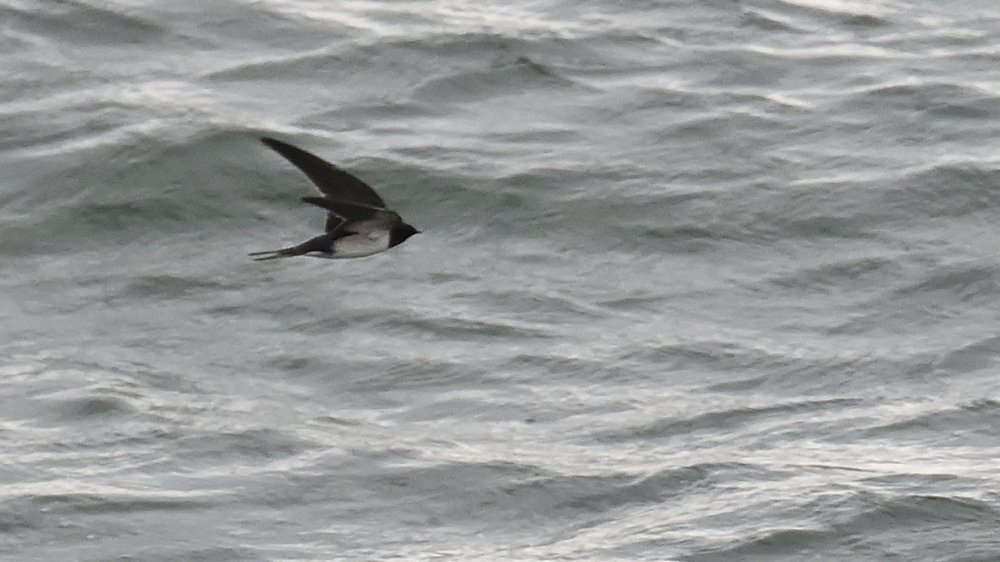 One of today’s many Barn Swallows, on its way across the Baltic Sea. Swallows migrate to southern Africa, so its journey has just started.
Not only the migration over land was good, the maritime migration was more than decent too. We recorded migration of Common Gulls (Larus canus) and Black-headed Gulls (Chroicocephalus ridibundus). These birds were interrupted by a total of four Skuas, all of which were first considered to be Arctic Skuas (Stercorarius parasiticus). However, after taking a look at the photos, two of them turned out to be Long-Tailed Skuas (Stercorarius longicaudus) instead. These birds breed in the high arctic (as do all Skuas) and we don’t see a lot of them in Gedser. It also turned out to be a lifer for me and completed the Skua trio!
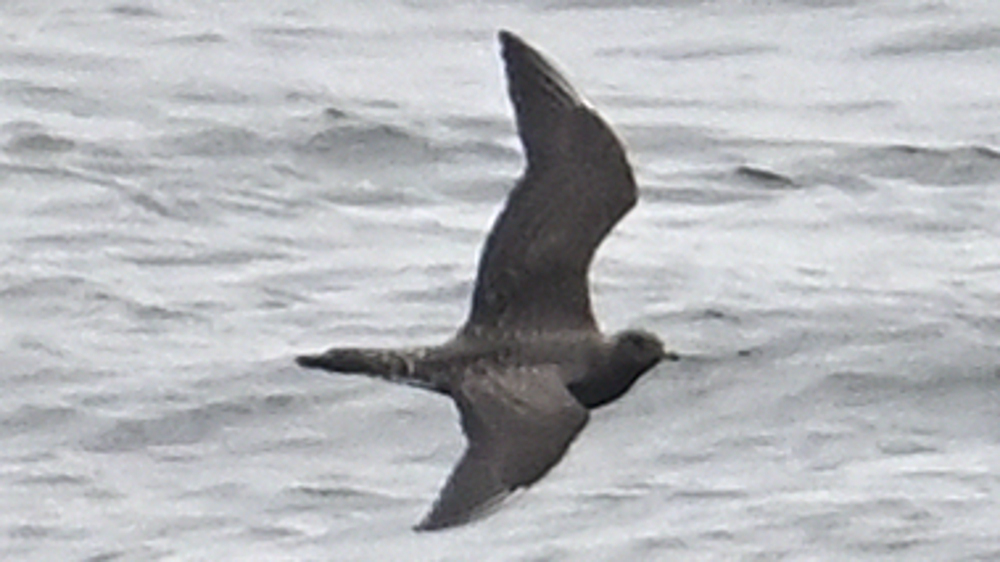 This picture allowed us to confirm the identity of one of today’s Skuas – it’s a Long-tailed Skua! The features we look out for are the amount of white in the primary feathers (very little in this bird), the shape of the tail, a very small and round head and the short bill that has a clear distinction between a paler base and a dark tip. The brown plumage of this bird also reveals its age: 1k.
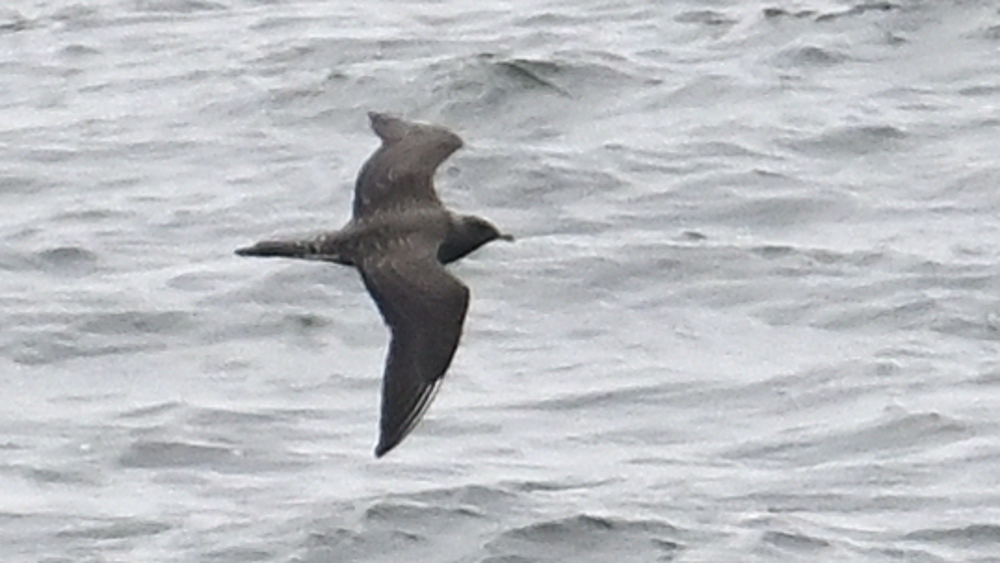
Skuas can catch their own food, but they prefer to steal it from other birds, a behaviour known a „cleptoparasitism“. Among their favorised victims are terns, that also appeared in reasonavly high numbers today. Most of them were Sandwich terns (Sterna sandwichensis), with some Common Terns (Sterna hirundo) mixed in.
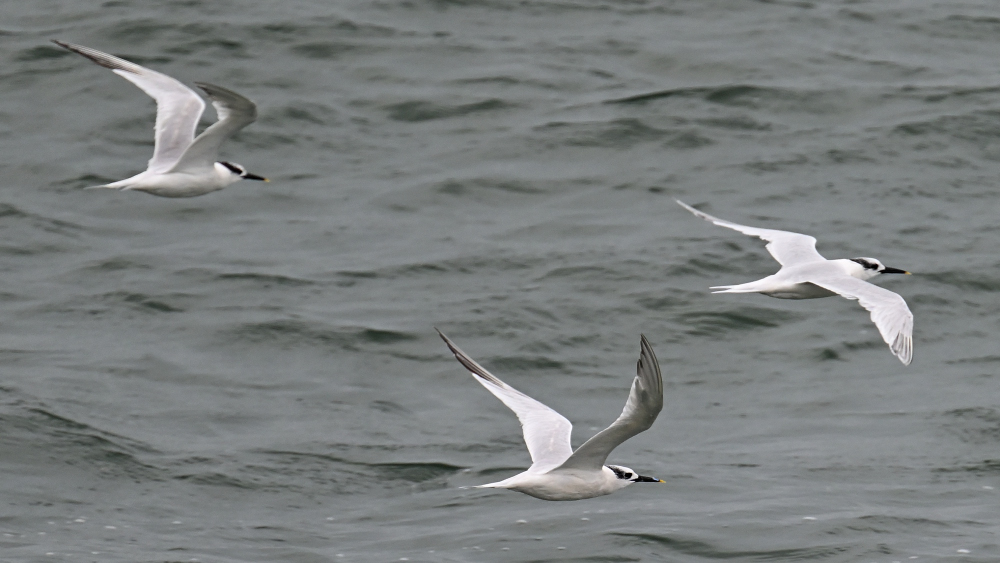 Sandwich Terns. Different from other terns, this species winters along the shores of Europe and northern Africa. It does not fly to the Antarctic, as Arctic Terns do it.
Finally, we had a surprisingly good migration of waders too. There were not many birds, however the diversity was with six species quite high. There were Golden Plovers and Grey Plovers (Pluvialis apricaria /squaterola). Though these species are always nice to see, my personal highlight was a small group of waders that first looked like another group of Dunlins (Calidris alpina). After seeing their white upper tail however, we concluded them as being Curlew Sandpipers (Calidris ferruginea), another lifer for me. This wraps up a very succesful morning at the migration count. I am looking forward to the specialties tomorrow will bring!
Fugle registreret i standardtiden: 7.658 . Arter: 44. Tællingen startet 06:01, sluttet klokken 11:01.
Se alle dagens observationer på Gedser Odde i DOFbasen.
På stationen: Hannah Schmidt, Storm Hauris Borum, Lua Koplin, Hans Lind, Ole Friis Larsen, Marek Ebert
Pludselige Sortænder i tusindvis
Ringmærkningen: Efter flere dages øv-vejr håbede vi på at dagen ville bringe lidt flere fugle i nettene. Fuglene havde dog andre planer, og der var kun et par fugle på hver runde. Vi havde dog stadig lidt forskellige arter, bl.a. en af sæsonens nok sidste kærsangere (Acrocephalus palustris) og dagens fugl, en rødtoppet fuglekonge (Regulus ignicapilla). Dette er sæsonens anden rødtoppet fuglekonge og forhåbentligt et tegn på at fuglekongerne snart er på vej.
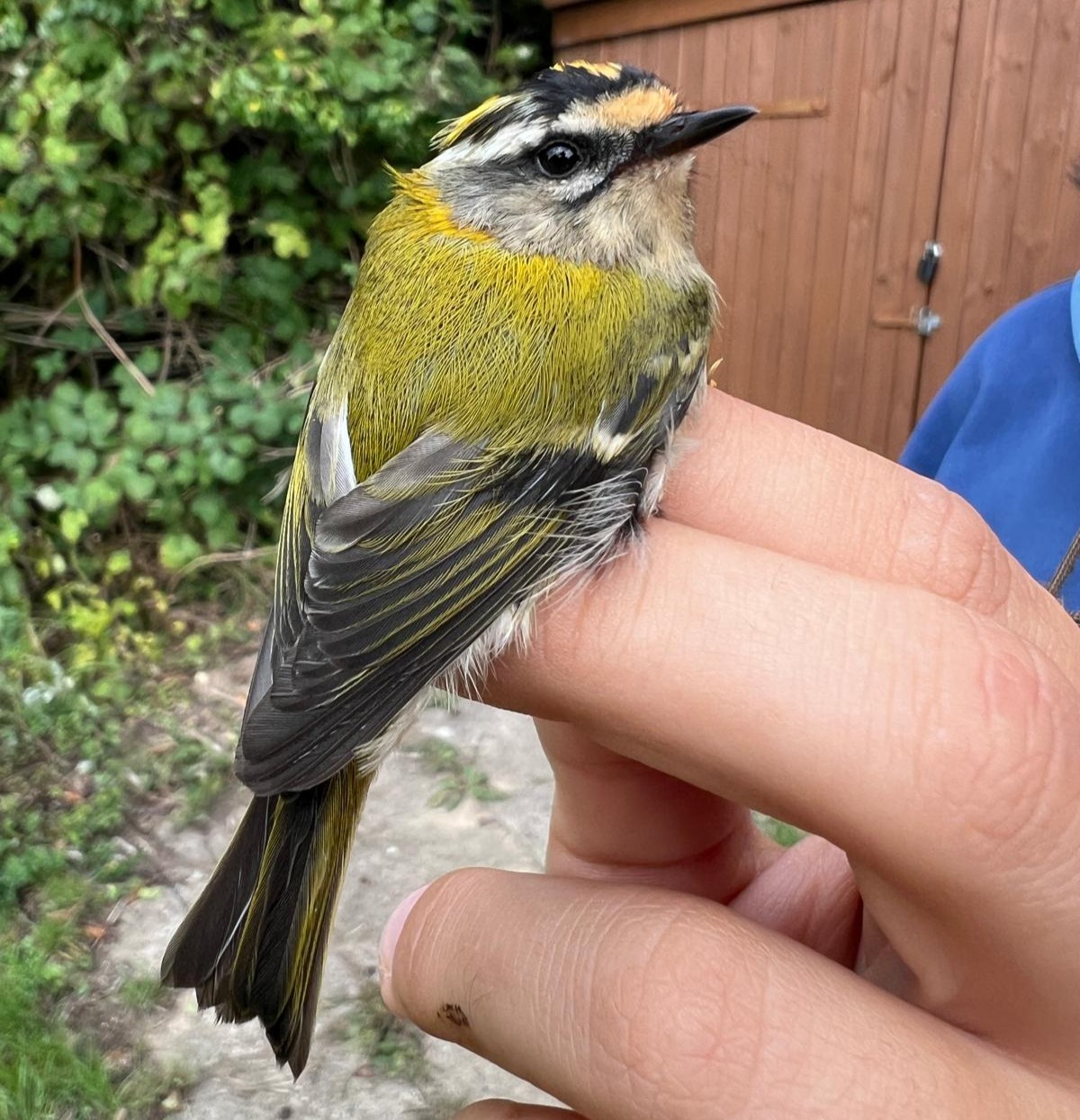
Rødtoppet fuglekonge, ungfugl (1k) han. En helt anden størrelse at arbejde med: en vingelængde på 50mm og kun 4,9 gram!
En stillere dag betød at vi havde mere tid til at kigge på hver fugl. Det gjorde det derfor nemmere at kunne sammenligne forskellige træk mellem fugle af forskellig alder. Specielt løvsangere (Phylloscopus trochilus) kan være svær at aldersbestemme, da ungfuglene hurtigt kommer til at ligne de voksne. Vi kigger derfor på flere træk som kan pege i retning af enten en ung- eller vosken fugl. De unge er typisk mere gullige og med gule striber hele vejen ned ad bugen. De har ofte mere gule ben og så kan kanten på næbbet samt 'mundvigen' også være gule - det vi ofte kalder 'babymund'. De voksne løvsangere har hvid bug og mørkere ben og næb.
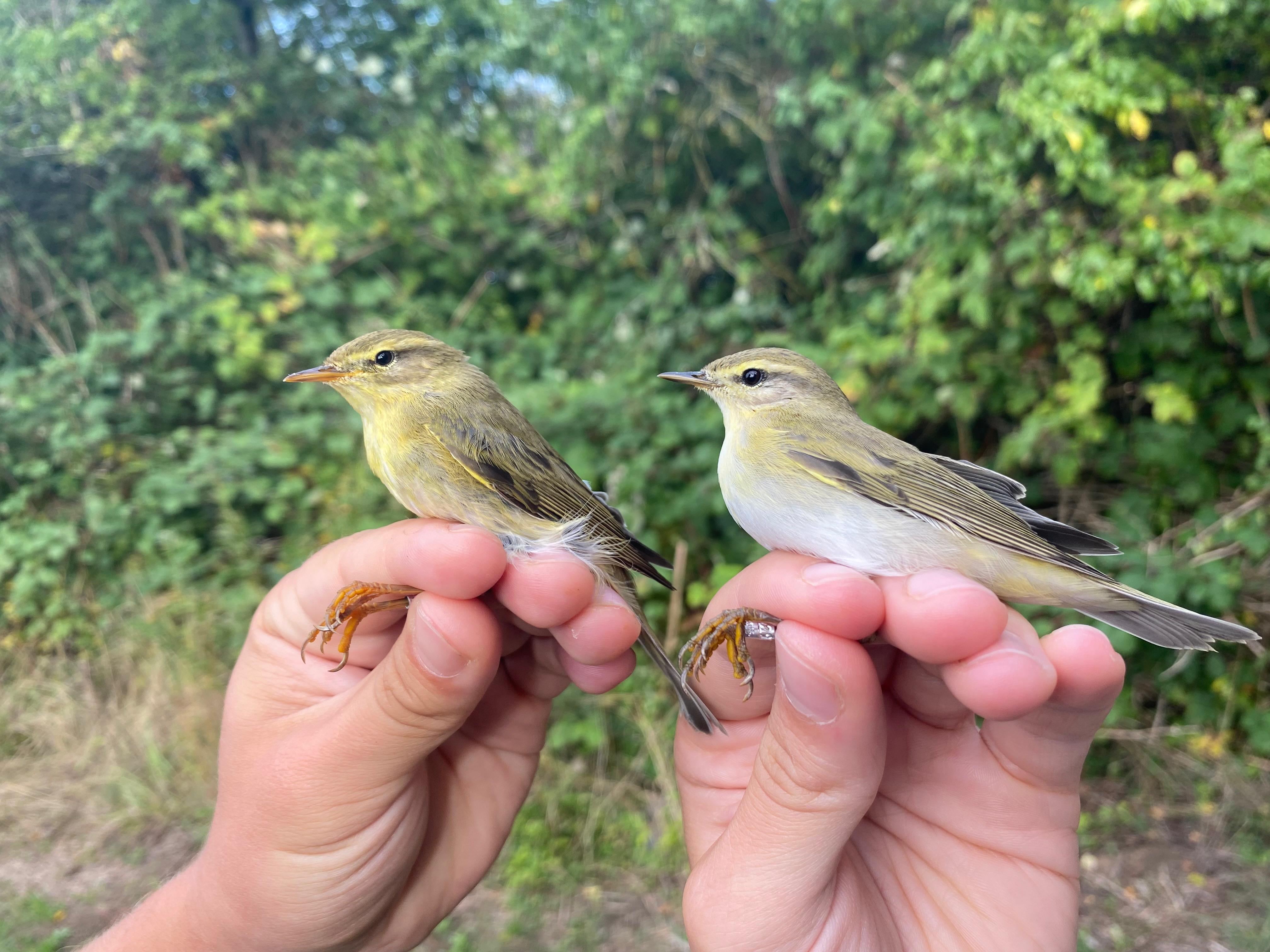
Løvsangere. Til venstre: ungfugl (1k) og til højre: adult/voksen (2k+). Læg mærke til hvor gul ungfuglen er både på undersiden og hovedet i forhold til den voksne. Læg også mærke til forskellen i benfarve og næbfarve.
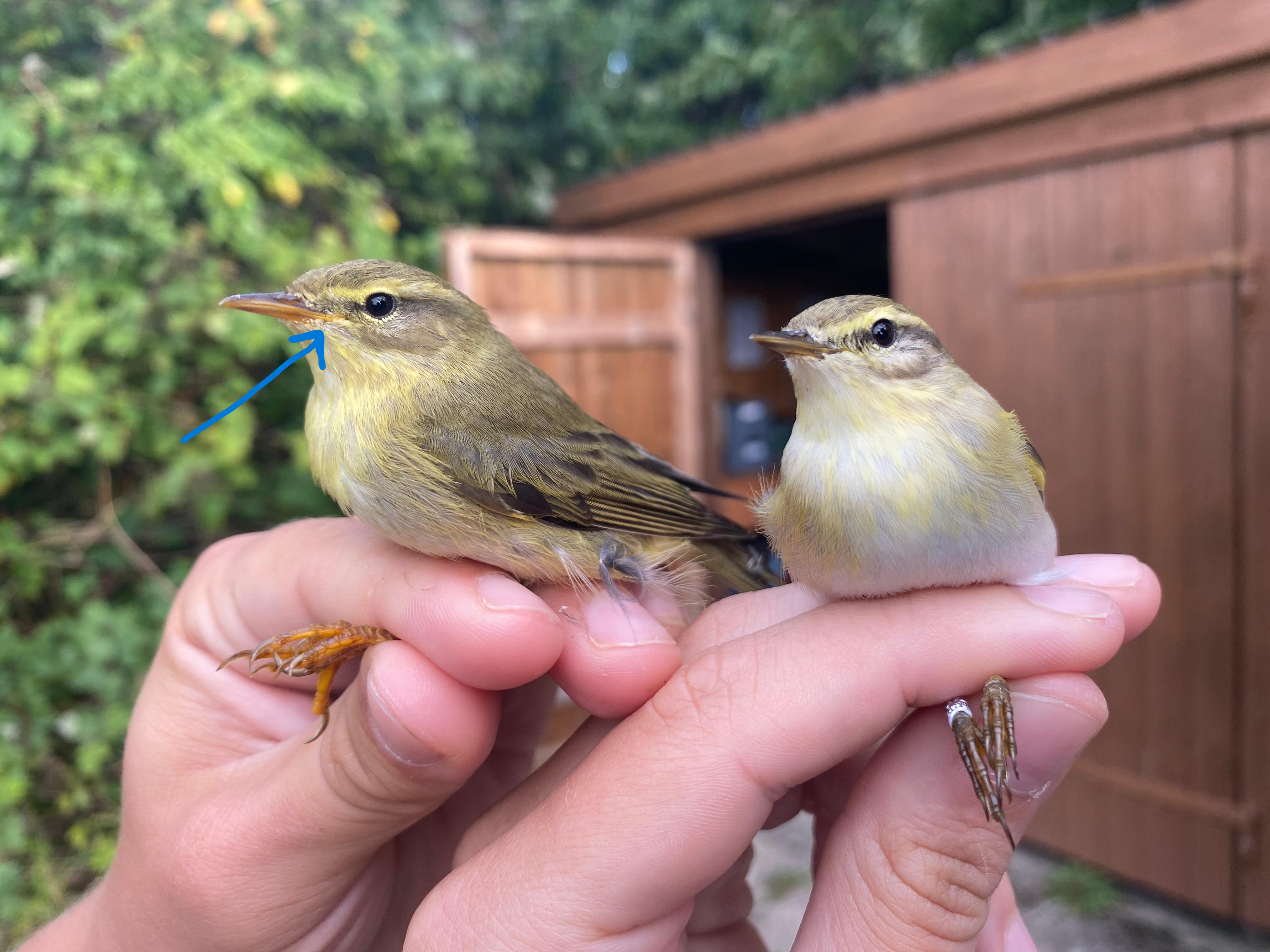
Ungfuglen har 'babymund' - det inderste af mundvigen er stadig gult, et træk vi ofte bruger for at bestemme fugle som er fra i år.
Derudover var jeg utrolig glad for at genfange en jernspurv, ringmærket af mig den 3. august da den stadig var ganske ung og ikke havde voksendragt endnu. Det er altid dejligt at se at en fugl, man selv har ringmærket, klarer sig godt og er vokset op på bare et par uger.
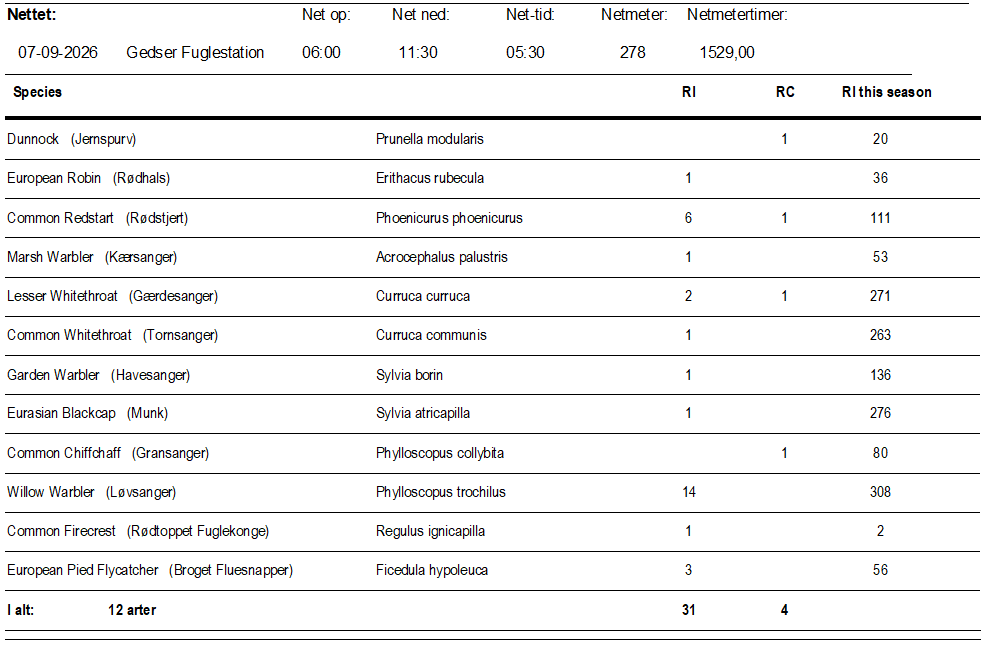
Trækket på Odden: Vores kolleger på lokaliteten Põõsaspea neem i Estland registrerede 3. september et voldsomt ryk af Sortænder (Melanitta nigra) med 19.708 mod sydvest, og dagen efter var der endnu et stort træk med 13.994 Sortænder. Det var nok en del af det træk, der mandag morgen var nået til Gedser Odde, da vi efter flere dage med under 100 Sortænder per standardtid pludselig registrerede 3.761 af dem. De kom i store flokke på over 100 fugle og fløj tættere på land, end vi er vant til at se de sorte ænder.
Fra Põõsaspea neem til Gedser Odde er der i luftlinie 800 kilometer. Vi kan ikke regne med at se præcis det samme træk, som vores kolleger der, men deres tællinger er gode pejlinger for, hvad der er gang i længere inde i Østersøen, og hvad vi kan forberede os på.
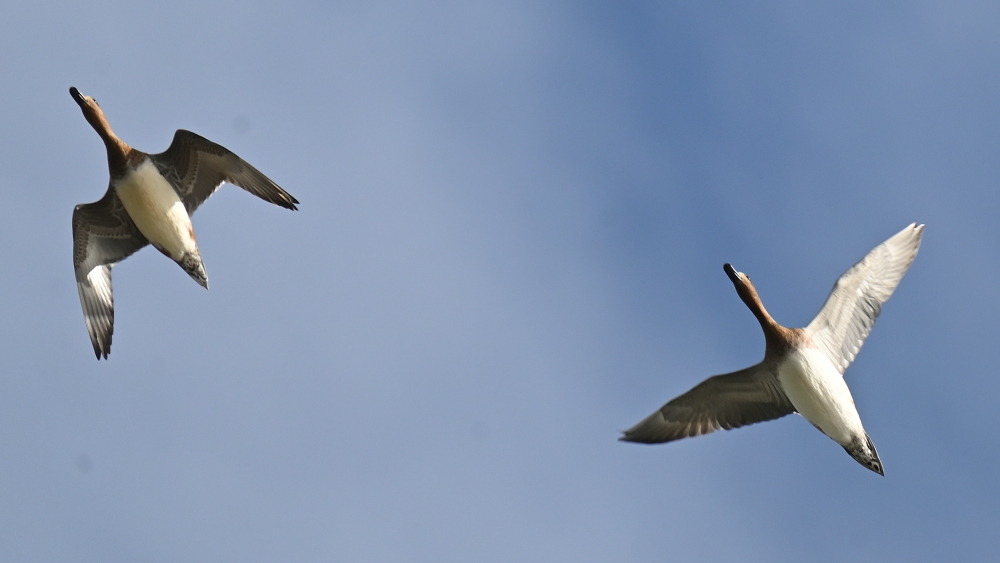 Nogle af dagens ænder skød genvej ind over observationspladsen på Odden. Pibeænder kendes nedefra på kombinationen af brun hals og hvid mave. Foto: Ole Friis Larsen/GFU
Det var ikke bare Sortænder, der kom mange af i mandagens standardtid. Vi havde også et livligt træk af svømmeænder i blandede flokke af Spidsænder (Anas acuta), Skeænder (Spatula clypaeta), Pibeænder (Mareca penelope) og Krikænder (Anas crecca). Vi fik bestemt over 900 af dem og måtte lade yderligere 260 flyve som ubestemte ’prikker’ langt ude over havet.
Marek var med for første gang i vores vagtplan og sørgede for, at vi fik godt tjek på trækket af småfugle, som han er vant til at arbejde med i trækket over Berlin, hvor der er en gruppe unge, som dyrker den disciplin, flere af dem efter ophold på danske fuglestationer.
Mens vi mandag havde et fint træk over havet, hvor der også var et ryk af terner, kom der uventet få rovfugle fra land. Vi så en Lærkefalk (Falco subbuteo) trække ud lige omkring solopgang, men ellers var det stort set kun Spurvehøge (Accipiter nisus), vi så, og ikke ret mange i forhold til nogle af de foregående dage. Trækket af Spurvehøge tegner dog stadig til at blive fint i dette efterår.
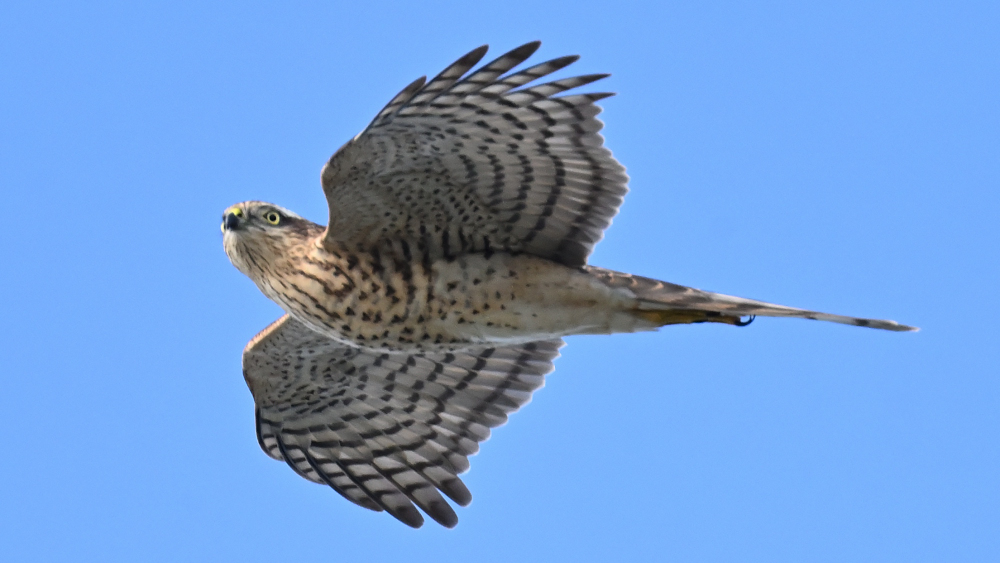 En pudsig variant af Spurvehøg dukkede op på Odden tyve minutter over ni og trak ud over havet et kvarter senere. I stedet for de normale mørke bånd på tværs af undersiden havde den pletter. De gule øjne viser, at det var en ung fugl i sit første kalenderår, 1k. Foto: Ole Friis Larsen/GFU
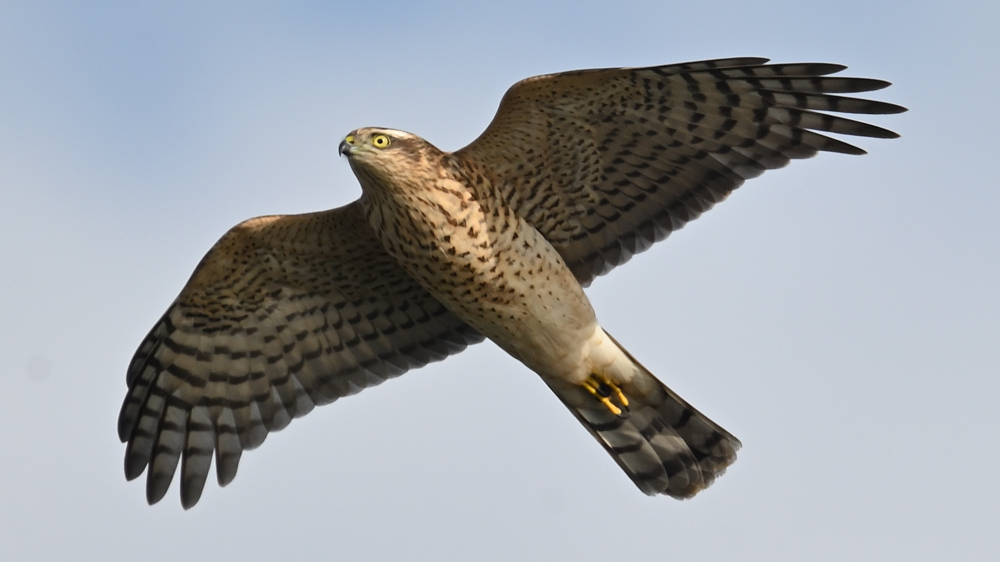
Vores interesse for, hvad det bliver talt af træk i Estland, gælder også andres interesse for, hvad vi tæller ved Gedser Odde. Alle vores data bliver både indtastet i DOFbasen, hvor vi antager, at danske interesserede kigger, og i den hollandske database Trektellen som en service for nysgerrige i udlandet. Vi kan se, at der er mindst et par hundrede daglige opslag på Gedser Odde. I de første syv dage af september har vi haft 1.837 opslag på Trektellen på vores tællinger.
Fugle registreret i standardtiden: 8.164 . Arter: 37. Tællingen startet 05:59, sluttet klokken 10:59.
Se alle dagens observationer på Gedser Odde i DOFbasen.
På stationen: Hannah Schmidt, Storm Hauris Borum, Lua Koplin, Hans Lind, Ole Friis Larsen, Marek Ebert, Børge Langkilde
Mellemkjove og Sorte Glenter
Ringmærkningen: Finally, after many days of rain, clouds and simply miserable weather, we got sunshine again. Thus, we could open almost all nets (the wind was still quite strong) and our spirits were high. We were joined by our guests Laura and Rasmus, who wanted to experience bird ringing. Quickly, we got a good diversity of species, with both Pied Flycatcher (Ficedula hypoleuca) and Spotted Flycatcher (Ficedula striata) appearing in our nets. This made us hope for the third species, the Red-Breasted Flycatcher (Ficedula parva) that has recently been caught in Falsterbo (Sweden).
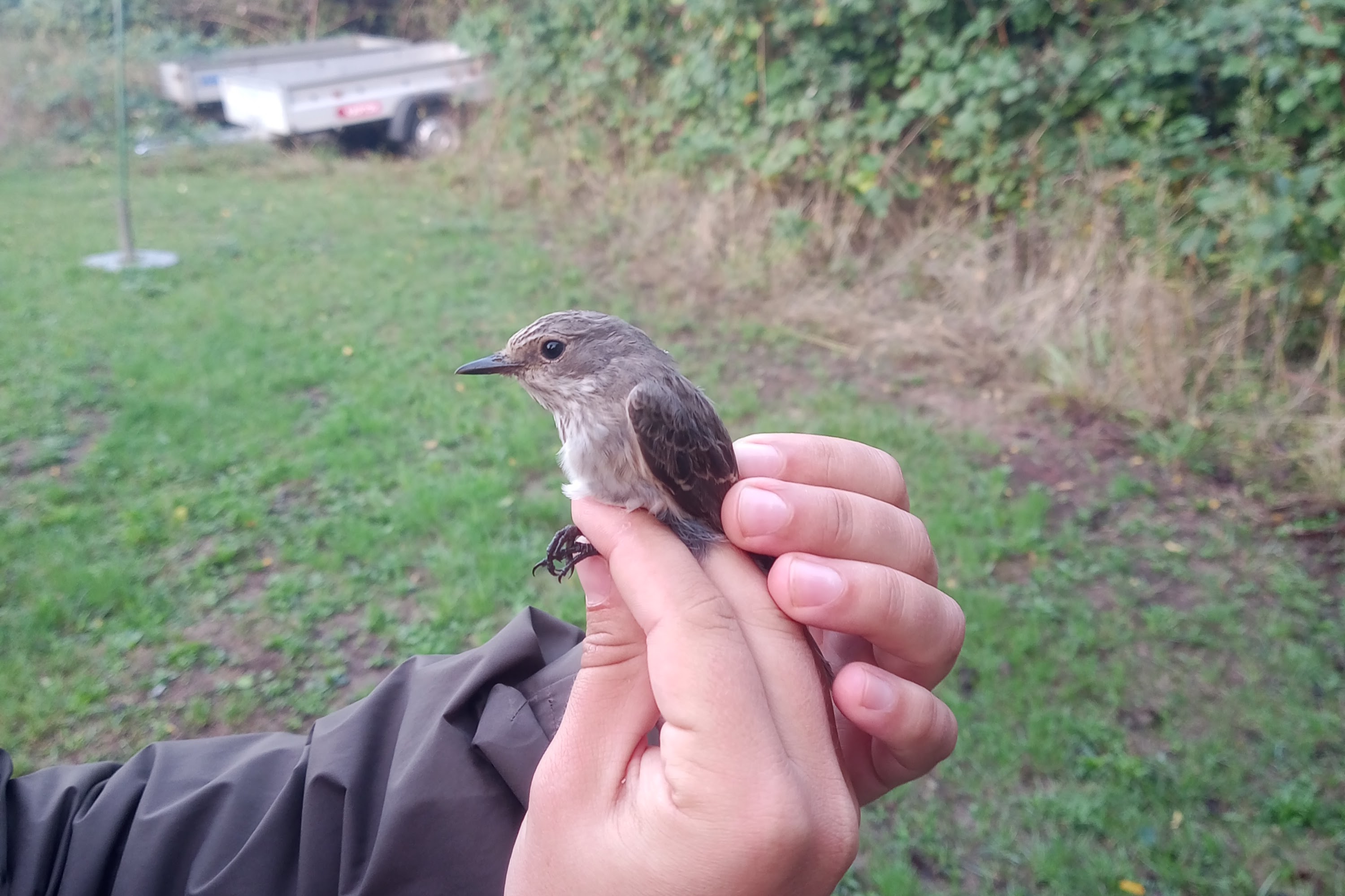
Spotted Flycatcher (Ficedula striata). I personally don't get the English (or the scientific, for that matter) name of this species. I prefer the Danish or German names, that simply translate to "Grey Flycatcher", which makes the bird no less amazing!
Another bird that surpised us, was a Tree Pipit (Anthus trivialis), a pleasant change from the usual Blackcaps (Sylvia atricapilla). We still got a good number of them and with several other species, they round up a succesful ringing morning.
All morning, we noticed good migration over the garden. Yellow Wagtails (Motacilla flava), Dunnocks (Prunella modularis) and Chaffinches (Fringilla coelebs) migrated in good numbers and kept our hopes high for the whole morning. Additionally, a flock of around 20 Siskins (Spinus spinus) kept appearing, before settling down in this species' favourite tree, an alder tree. These passerines were joined by again a lot of Sparrowhawks (Accipiter nisus) and even some Honey-Buzzards (Pernis apivorus). Of course, we tried to catch some of the Sparrowhawks and opened their special nets. Soon enough, we caught one that was joined by two more over the course of the day (one of them was in the so-called "Snipe nets" by the pond). In order to better understand the spreading of Avian Influenza ("Bird Flu"), we were told to catch Sparrowhawks and take samples, as these birds through their prey come into contact with a lot of other birds. Today, we finally were able to start this work, although it was a bit of a struggle to find the Sparrowhawk's cloaca at first. These samples will be tested for the virus and can be very helpful to combat its spread.
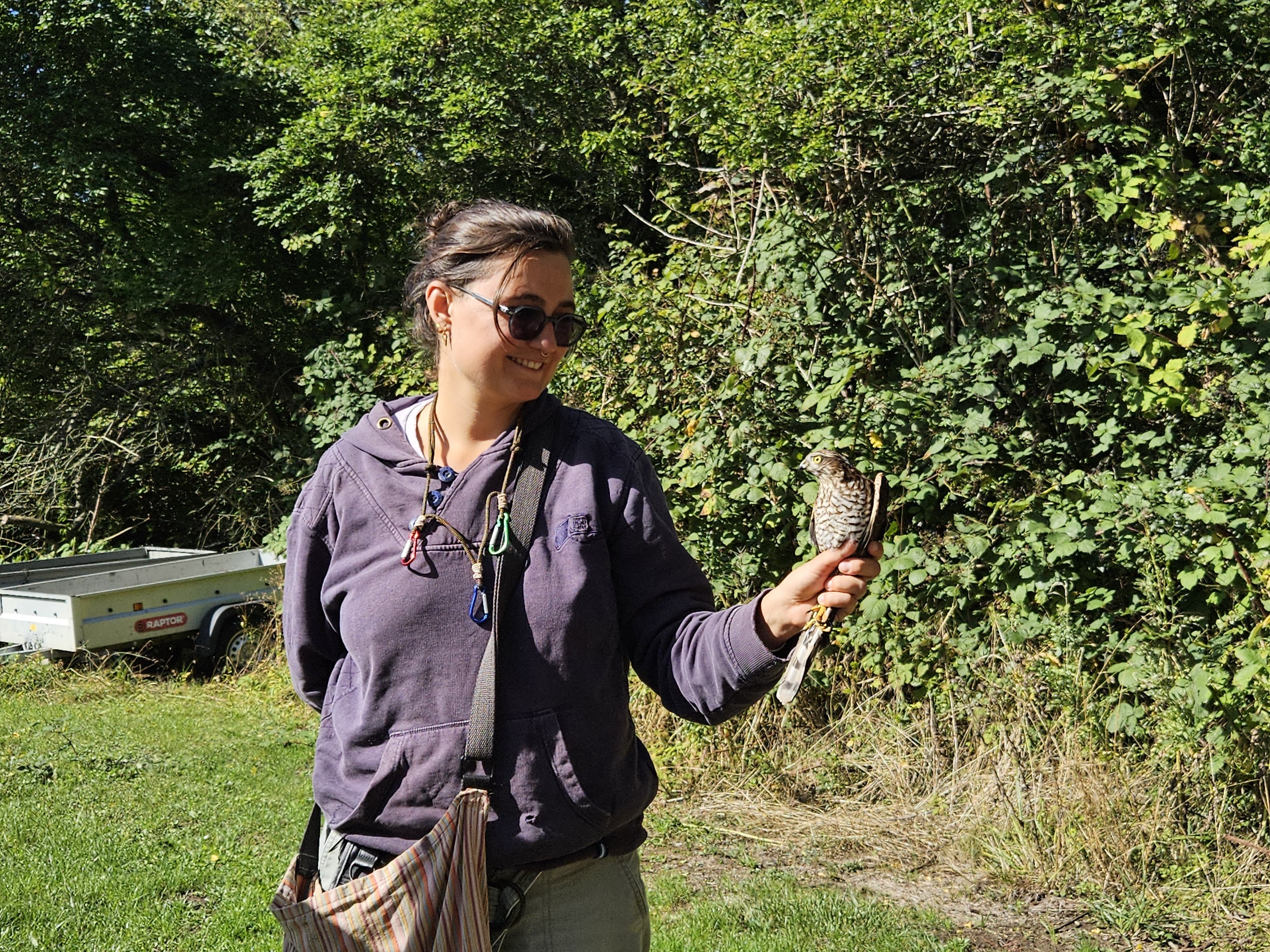
Lua and her new friend, a young Sparrowhawk
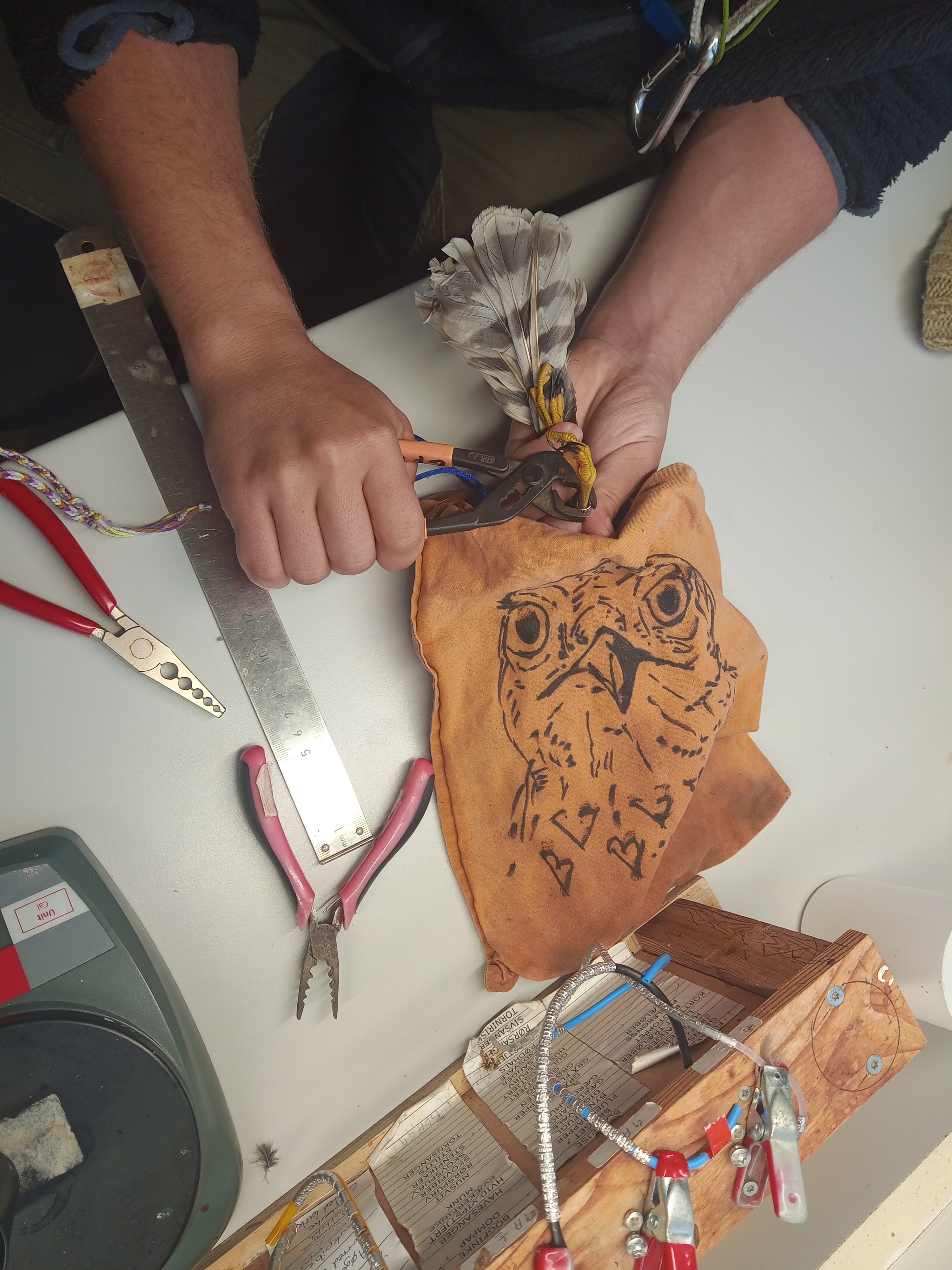
Today, we could for the first time use the designated Sparrowhawk bag Lua created. The fierce Sparrowhawks get very calm, when they have a bag on their head, which makes ringing, measuring and sampling so much easier.
Trækket på Odden: Det gode ved regn og rusk er, at der ikke skal så meget til, før vejret bliver betydeligt bedre, og sådan var det søndag morgen. Vi var to på fast tællevagt for fuglestationen, men i sol, blå himmel og håb om rovfugletræk trak flere til. I løbet af morgenen var vi over ti ude på spidsen med forskellige håb om gode billeder, gode oplevelser og om at lære noget om trækket. Alle fik deres ønsker opfyldt. Selv om der ikke blev sat rekorder, var der pæn trafik både fra land og på ruterne over havet.
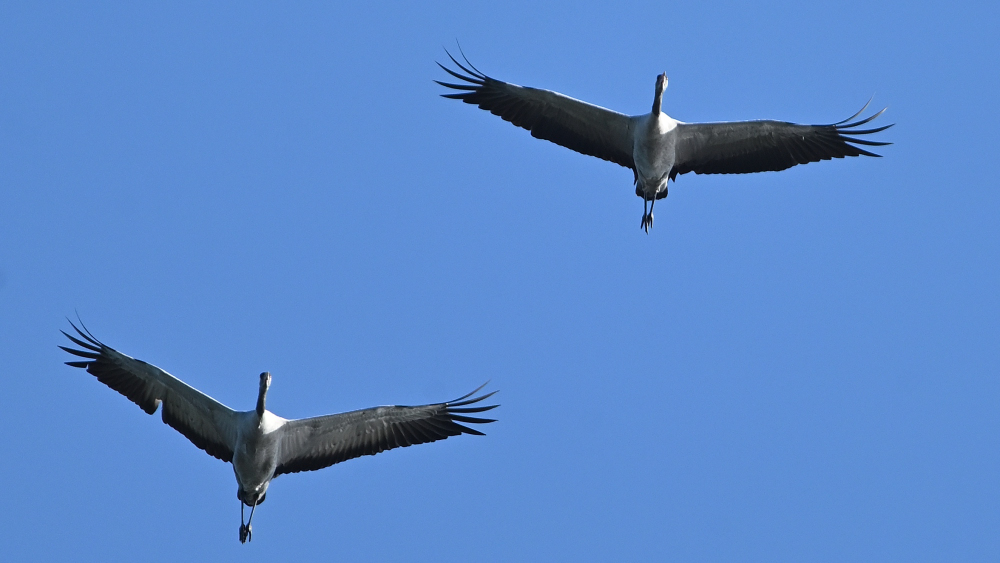 Dagens flok af Traner, ikke så stor, men en begyndelse på det træk. Foto: Ole Friis Larsen/GFU
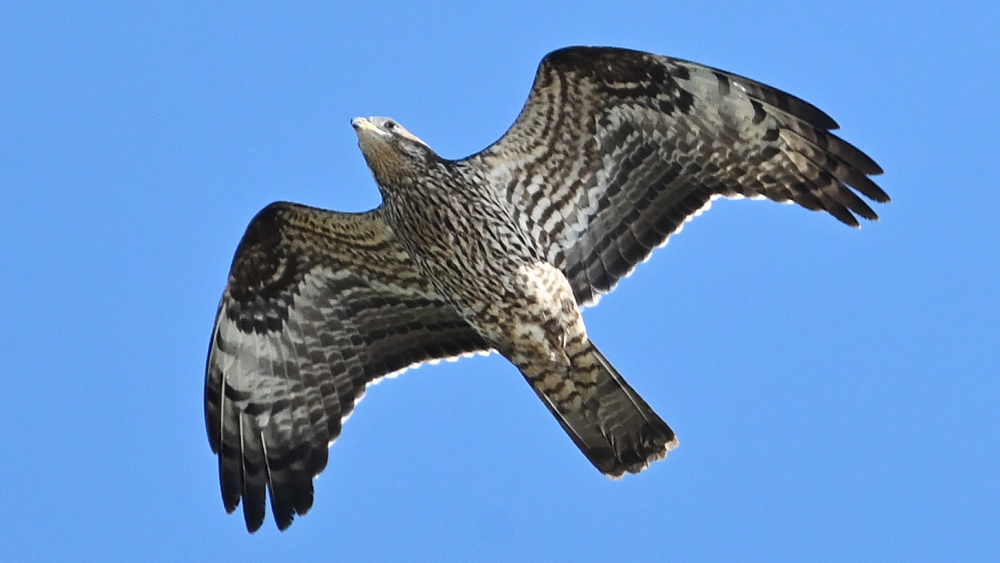
Mest bemærkelsesværdigt og spektakulært var nok trækket af Hvepsevåger (Pernis apivorus) med 32 voksne/adulte fugle i samlet flok og en Mellemkjove (Stercorarius pomarinus). Den angreb nogle Splitterner langt ude over revet, men efter en periode med næsten daglig forekomst af Almindelig Kjove (Stercorarius parasiticus) forekom dagens kjove væsentligt større, tungere og mere sølvmågeagtig i flugten. Den er ikke så stor som en Sølvmåge (Larus argentatus), men bøgerne fremhæver, at den i felten kan synes lige så stor, og det var, hvad denne kjove gjorde.
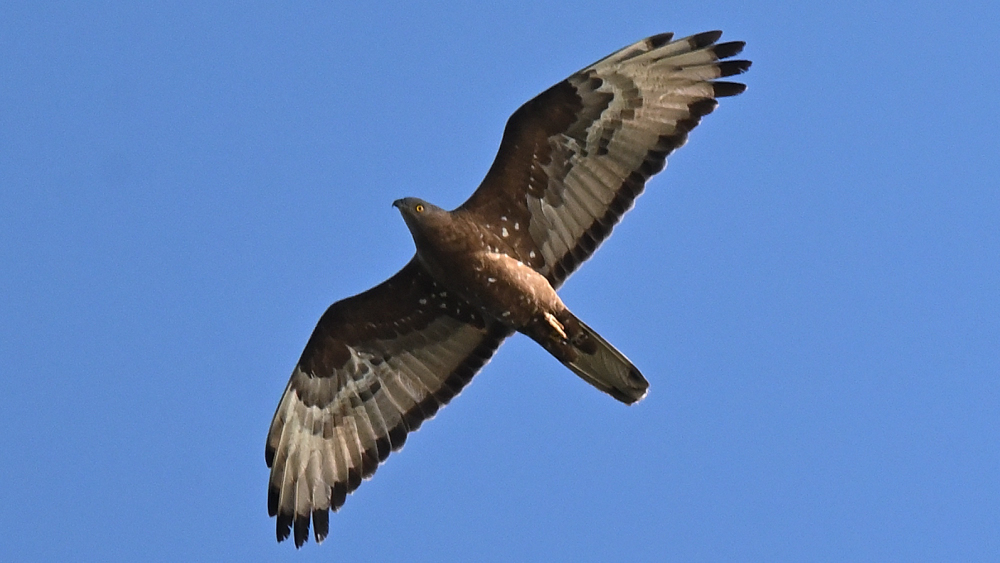 Dagens træk af Hvepsevåger indeholdt både voksne/adulte og unge 1k-fugle (første kalenderår). De voksne har gule øjne, de unge har mørke øjne, men proportionerne er også forskellige. De unge har kortere haler og bredere vinger, som får dem til at minde mere om Musvåger (Buteo buteo). Den voksne fugl på øverste foto er en han med blågråt hoved og meget lidt mønster på undersiden af vingerne. Foto: Ole Friis Larsen/GFU
Med på listen over dagens krydderier var to Traner (Grus grus), der kom tæt sammen i det flotte solskin, også en Rovterne (Hydroprogne caspia) lyste op med sit store røde næb, da den næsten snød os for at blive set ved at krydse ind over land. En flok på 15 Fiskehejrer (Ardea cinerea) var usædvanlig i antallet. Svalerne er ved at være væk, men vi nåede alligevel at se næsten tusind på udtræk. Og så var der Spurvehøgene (Accipiter nisus). Vi har haft over 200 per dag for en uge siden, men dagens træk på over 100 var alligevel imponerende, fordi der gennem alle fem timer konstant var Spurvehøge i luften allevegne.
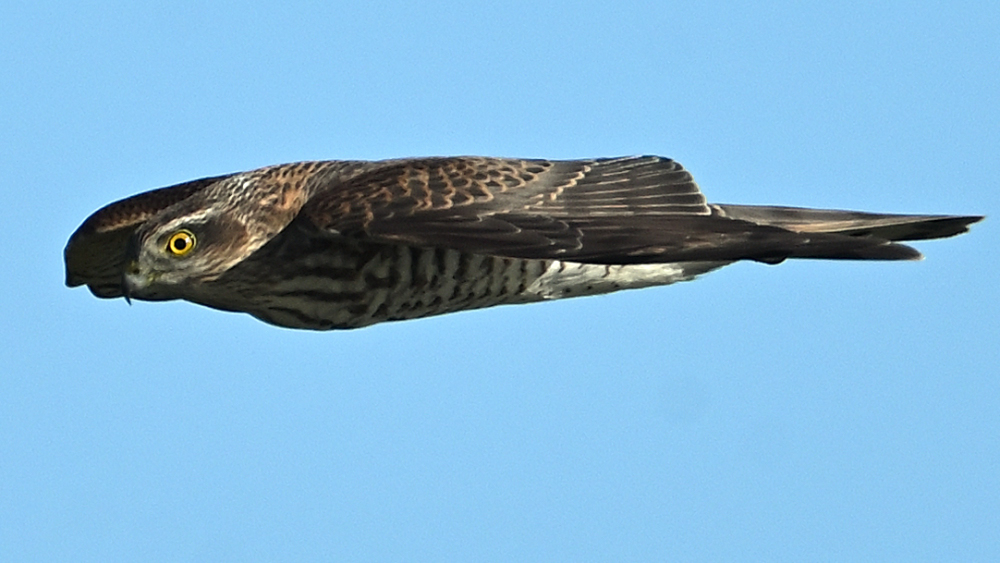 De fleste Spurvehøge i efterårstrækket er unge fugle med lidt bleggule øjne. Denne fugls øjne var lidt mere ravfarvede og tyder på, at den har to år bagen, og måske har været forbi Gedser Odde før. Foto: Ole Friis Larsen/GFU
To Sorte Glenter (Milvus migrans) kom ikke videre trods flere tilløb, men efter standardtiden så Flemming Pagh Jensen dem smutte. Hannah var med for første gang og skaffede os nogle pæne tal for Krikænder (Anas crecca) og Pibeænder (Mareca penelope) ved at passe jobbet med at prioritere havtrækket godt, mens alle andre kiggede på rovfugle.
Fugle registreret i standardtiden: 2.270 . Arter: 35. Tællingen startet 05:57, sluttet klokken 10:57.
Se alle dagens observationer på Gedser Odde i DOFbasen.
På stationen: Hannah Schmidt, Storm Hauris Borum, Lua Koplin, Ole Friis Larsen, Marek Ebert, Børge Langkilde
Welcome back, female blackcap!
Ringmærkningen: Typically, the morning at the bird station begins around an hour before sunrise. Most of us have made it to the dining table and are enjoying the first coffee / tea and are struggling to open our eyes. Then, the first question of the day is always: “How’s the weather looking now?”, and each of us look at our own favorite weather service. The weather seems rather difficult to predict in Gedser, a place surrounded by water on almost all sides. So, naturally, each weather service suggests something different. Today, the rain was supposed to start at 08:00 or 10:00 or 12:00 or even later, depending on who you asked.
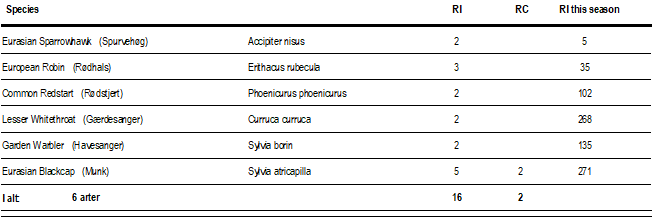
So, we crossed our fingers and prayed to the weather gods for rain later in the day. The nets went up (not all, but those mostly sheltered by the wind – a step into the right direction) and we caught an European robin (Erithacus rubecula) in the first five minutes. Otherwise, the day was filled with more robins, a handful of Common redstarts (Phoenicurus phoenicurus), Lesser whitethroats (Curruca curruca), Garden warblers (Sylvia borin), and Eurasian blackcaps (Sylvia atricapilla).
Most memorable was a recapture, the ring number starting with letters we did not recognize as ours from this year. Sure enough, the beautiful female blackcap was ringed here at the bird observatory in 2024, where it was marked as a juvenile. Moments like these remind us why ringing is necessary – to understand bird migration patterns and their behavior in the least invasive way possible. This individual, most likely born in this very garden, migrated as far as Africa, only to spend its second summer in the very place it originated from.
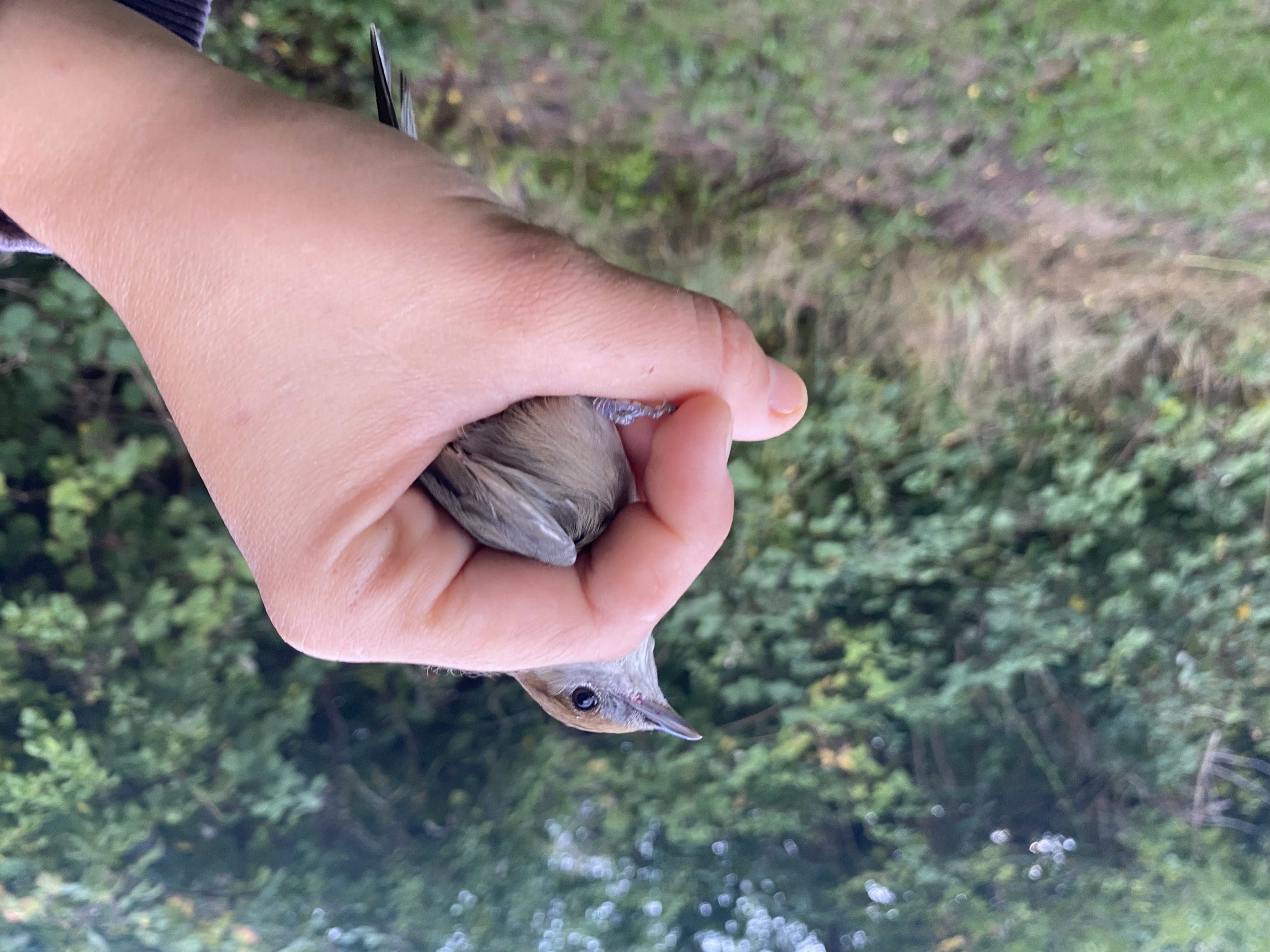 Our bird of the day – a recapture of a female Eurasian blackcap (Sylvia atricapilla), ringed in 2024.
We caught two more Eurasian sparrowhawks (Accipiter nisus), a female and a male individual. This species has been filling the skies around the station more and more these days and it was only a mater of time before they filled our nets as well.
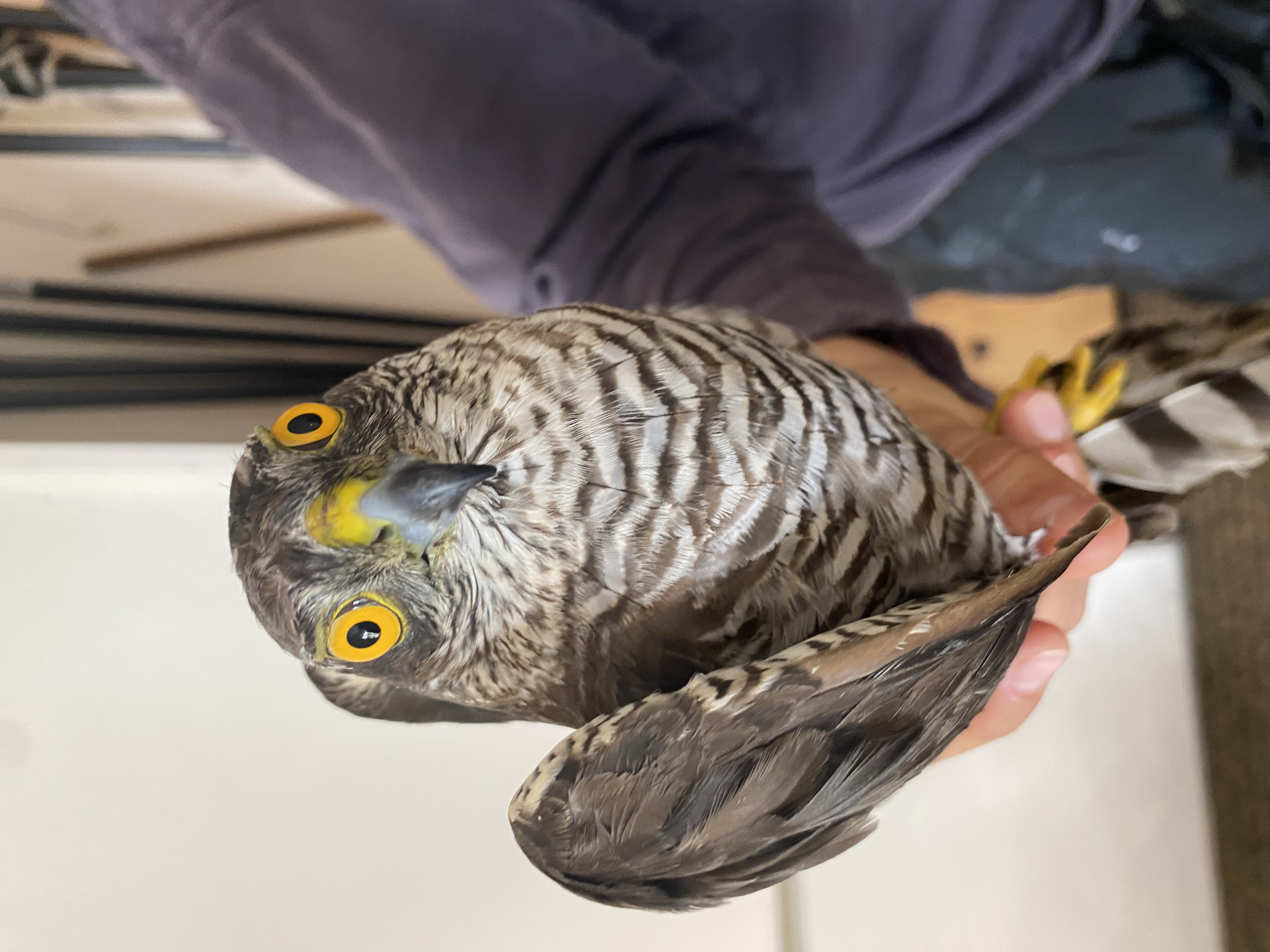 A female Eurasian sparrowhawk. Compared to the individuals we have caught in the past week, her size was visible greater and eyes in a deeper and darker yellow.
While the wind did not stop, the clouds parted ways and the early morning was filled with blue skies here and there. In total, we caught 18 birds of 6 different species.
[...]